
Other

A City Built For People: Bikemore Impact Stories

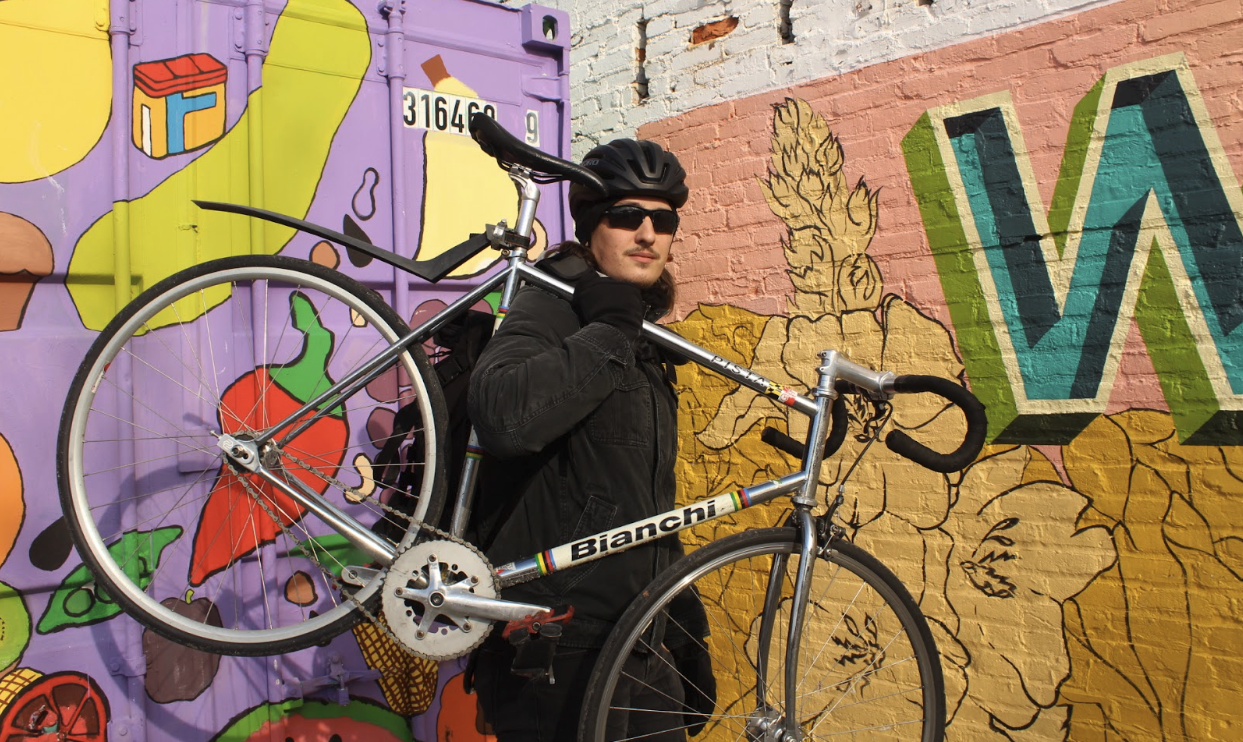
an image of Mike Thomas holding his bianchi bicycle in front of a shipping container at Waverly Farmers Market

There are so many stories in Baltimore, and we’re happy to share with you our fourth following our series for Giving Tuesday. Please consider making an end-of-year donation. Your support is critical to funding our operations and paying our staff.

TW: Some content in this story may be difficult for some to read (talks of traffic violence, car crashes, vehicular manslaughter)

Click here to donate

Mike Thomas, 35, is a bike messenger and artist here in Baltimore City. When folks hear of a bike messenger, they may think of the NOS-fueled fixed gears riding through a cityscape collecting packages for delivery, an e-bike savant pushing the throttle with a hefty bag of food on their back, or a cyclist who’s simply trying to make a few bucks to get by. 

Thomas puts it simply.

It’s like the arcade game Crazy Taxi.

While others ride their bicycle as a form of commute, exercise, or enjoyment, Thomas rides his bike for work. His steel Bianchi Pista is an extension of himself, a form of living, of work, of existence. Without a bike, Thomas would literally be unable to work. He could go back to his job as a server or bartender, but to Thomas that isn’t a method of happiness. 

Cutting off modes of transportation is not going to help people get out of economic strain.

Thomas can’t afford a car, not that he should desire to. A city should present reliable, feasible alternative modes of transportation that are safe and accessible for all folks. Presenting one single, expensive, decaying option, such as a car, is ethically and emotionally fatal to some. Giving cars priority in the city is fatal to all.

Out of towners can be pretty apathetic to [Baltimore]. I’ve also seen people who live in the city have that same type of disdain [towards pedestrians and cyclists].

There is a morbid normalization in this city, it seems, of a manslaughter by car being as easy as breathing air. 

Wayne Richardson was killed by a driver in 2019 on his way to feed his disabled son. Avery Cheley was killed by a driver running a red light. Those drivers were never found, and families lost fathers. Edgar Draper was killed in 2022 by a driver while on his way to surprise his partner Gloria with a gift from his trip to the retail store. Instead, she saw a far darker, more permanent horror. And David Herman, a beloved artist and vibrant life in Baltimore, was killed by a driver on a street that has been promised protected bike infrastructure for too long with little recompense.

One’s first question may be, “Was it the cyclist’s fault?” We are taught to create a perfect victim, one that must adhere to every standard and every law without a single degree of fault to ascribe such a title of “victim” to finally persecute the one committing the murder: the driver of a car. Their appeal is followed after their life is lost, never before, never to prohibit another from happening again. 

I’ve grown numb to car [crashes] because I see one or two a week.

For the sake of transparency, no, these cyclists were not at fault for being killed by giant automations capable of mowing down groups of people. There are many more, still, in Baltimore, unnamed, forgotten, their deaths statistics, numbers, echoes of a life once lived. The aforementioned were simply, in a way, perfect.

No car [crash] death is justified.

Thomas is another soul moving through the city on two wheels. He pushes his own pedals, spins downhill on his fixed gear, and he loves it. You shouldn’t have to fear moving. You shouldn’t be forced to stay still. We are heated beings full of hot energy, each atom and joule within our carbon-based bodies itching to dance, ride, sing, scream, laugh. 

There is a growing case of apathy towards those we are being forced to forget. Remember their names, both living and lost, and remind yourself who permits such deaths.

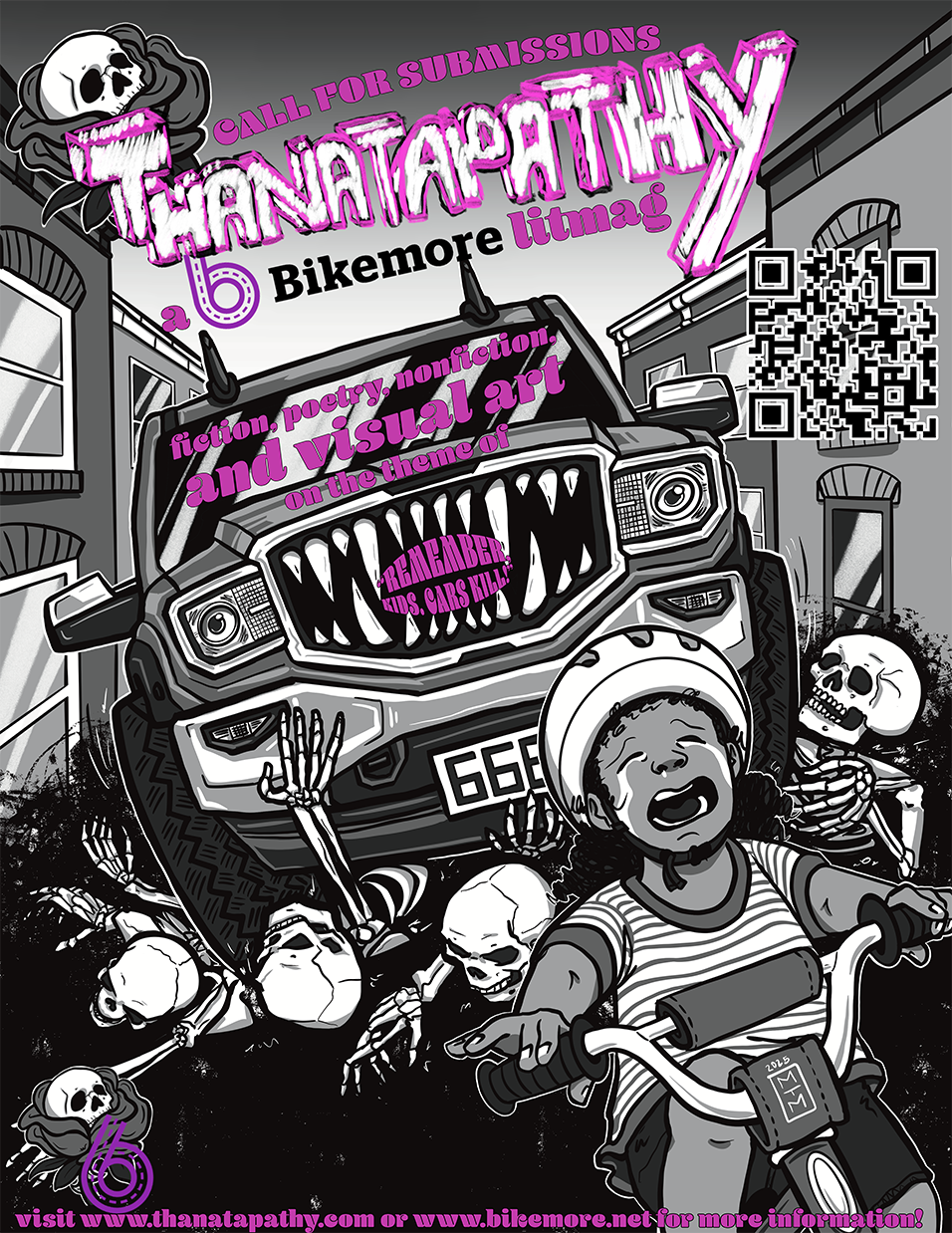
On January 15, 2026, Bikemore will be calling for submissions for a limited literary magazine named Thanatapathy our family biking coordinator Cora Karim’s Chesapeake Conservation and Climate Corps capstone project for the year. Thomas himself is involved in the project, having worked on the art presented on the site. 

In a world that’s getting more commodified and corporatized, some people aren’t getting heard. It could be bikes, it could be something else…It’s good for people to have an outlet…to voice their concerns and express themselves [whether it be for] cycling or alternate forms of transportation.

Save the date, ride your bike, wear a helmet, make real, human connections, and remember, everyone…cars kill.

Consider donating today for more impact stories. Bikemore actively works to advocate for a better city, a city that isn’t covered in the smog of an exhaust pipe or the rolling coal of a compensating truck driver. Our work at Bikemore isn’t just about pushing policies that ensure the safety of people walking, biking, and rolling: we ultimately want a city that’s connected and fluid for all residents, regardless of your mode of transport.

Click Here to Donate

A City Built For People: Bikemore Impact Stories

There are so many stories in Baltimore, and we’re happy to share with you our third following our series for Giving Tuesday.

Your contribution will enable us to continue advocating for improved biking infrastructure, promoting safety education, and building a more connected and equitable Baltimore for everyone.

Click here to donate

Our third story follows Amy White, a recent Baltimore transplant who’s been living here for nearly two years and biking for the same amount. She uses her Pedego e-bike to get around the city, and she’s recently started using her analog bike during her social rides around the city. 

Learning the city on the bike makes the city seem smaller. You see neighborhoods you wouldn’t normally see.

Car dependency can dissuade folks from using other forms of transportation within their home, especially in a place as dense as our city, but White makes do regardless of the automatons racing past her. To her, the motivation comes from her place in the community.

[It’s the] social aspect. I work from home, so this is my outlet for meeting people.

There’s a method to normalize cycling for all folks in the city. Whether one is a commuter, a middle-aged man in lycra, or a person who simply enjoys speaking to your friends while riding down the street on two wheels. Cycling turns heads in a city as car dependent as, unfortunately, Baltimore has become. Families, too, have replaced their own car usage by switching to an e-cargo bike for their children, and White’s noticed this on her own commutes.

I see people take their kids [to school] on bikes. It’s great. They’re not in a queue with a bunch of cars lined up.

Biking can be a scare, especially with all the clanker boogeymen around, but to White, it builds character.

The e-bike gave me more confidence…it gave me the ability to know where I was going.

On your next ride, whether it be a car commute, a bus ride, a walk down the street, look around your surroundings and ponder on the possibilities of a different, denser Baltimore, filled with people interacting beside each other in an open space rather than at a distance, inside a steel cage. And if you fancy riding a bike someday, remember these guiding words from White:

Be prepared!

Bikemore actively works to advocate for a better city, a city that isn’t covered in the smog of an exhaust pipe or the rolling coal of a compensating truck driver. Our work at Bikemore isn’t just about pushing policies that ensure the safety of pedestrians: we ultimately want a city that’s connected and fluid for all residents, regardless of your mode of transport.

Click Here to Donate

A City Built For People: Bikemore Impact Stories

Following up on Giving Tuesday, we're publishing a second impact story and inviting you to support our ongoing work.

Click here to donate

Bikemore had the pleasure of speaking to Taylor Graham, an administrator of Baltimore Bike Party, a mass-ride that happens the last Friday of every month at St. Mary’s Park. His approach to riding around Baltimore is more on one’s mindset than sense of fear.

Don’t be afraid, but be aware.

While talking with Graham, one can feel the amount of empathy he exudes for others, especially for folks who aren’t as experienced or adept in riding. 

“Apply the same strategies or philosophies or tactics of just being in an urban environment for cycling. Be aware of the time of day. Be aware of the cars. Just having a sense of awareness eliminates a lot of the fear…You don’t even have to start in the city. We have the BWI trail, the Baltimore-Annapolis trail. We have NCR.”

Graham is a Baltimore native and listening to him speak taught us how perspective truly does influence one’s approach to their home. Graham found a sense of community within cycling, and it only grew by his inclusion with Bike Party. 

“I can only give my experience for Bike Party since it started before me. To my knowledge, it started as a deviation from an event called ‘Critical Mass’ as a form of protest to vehicles. They just built the community around it, and [Bike Party] caught around like wildfire organically…It’s just been something that’s been going strong. Last Friday of every month.”

Our conversation moved to the topic of kids and how one may normalize children on bikes in the city. For some of us, children at Bike Party, with the presence of a guardian, is something that brings an equal amount of joy to the kids and the peers amongst them.

“As a Baltimore native, I probably look at things differently than the average person…If I had a younger family member, and if they have the confidence, I would definitely coach them to ride defensively and not concede to vehicles. [I] don’t want to let their ego put [them] in a dangerous place.”

The answer came as a surprise, yet Graham’s perspective is what truly defines how one approaches the world. Some may say fear is the mind killer (Frank Herbert’s Dune), and Graham’s own mind seems to be a bulwark beyond definition. One may envy how he perceives the city, its beauty, its flaws, though one may argue we should be inspired by Graham’s definitive logic towards Baltimore. 

You can put it on the record: Bike Party is the most unifying event in the city…You see people from all walks of life. You see the wheelie guys, you see the hipsters, you see the professionals. You see everyone from any pocket of Baltimore coming around for one unifying event which is cycling.

I love [Bike Party] for the communities who get to see these people coming through South Baltimore, deep in East Baltimore, North Baltimore, these communities who don’t get these things. Just seeing the excitement of people there is a gratifying feeling.

Graham’s love for Baltimore and cycling align with Bikemore’s own mission tenfold. We advocate for safer streets, the normalization of bikes, and a greater presence of community for all folks to feel more comfortable and connected in Baltimore.

Safety doesn’t and should not just end with a mass group ride, though it will always be a step in the right direction. 

Click Here to Donate

A City Built For People: Bikemore Impact Stories

This Giving Tuesday, Bikemore invites you to support our ongoing work. 

Your contribution will enable us to continue advocating for improved biking infrastructure, promoting safety education, and building a more connected and equitable Baltimore for everyone. 

Click here to donate

On November 7, 2025, Ibrahim Auguste, 32, spoke to Bikemore after a star-lit ride beneath the Baltimore night sky. We stood beside Southpaw in Fells Point after riding with Chris Broughton’s Bike Social Baltimore, leaning against our bicycles chained to the green U-bike stand, speaking through the chugging sounds of passing cars. 

Our Bikemore representative, Cora Karim, met Ibrahim in February of 2025 during a Valentine-themed alley rat race here in Baltimore named “Lovers Rat Race” after bonding over their shared love of the Japanese anime “Naruto.” Since then, their admiration for cycling in the city has grown tenfold due to their ability to constantly reconnect with each other. 

There are so many people you can meet or network with. One guy in our group is the maintenance guy who owns our section of Lime bikes in the city.

The community is a very tight knit but eclectic group of people. You’ll never know if you don’t ride with them.

Auguste first started riding on his dark emerald-green ISEO bike named “Rayquaza”, named after the legendary dragon-type Pokemon with the same emerald-and-gold scales on the flying serpent beast. It was 2018, and he had left New York City to return to his home city of Baltimore. He found biking to be a better convenience than public transit, and he recognized there was lacking attention to those who use biking as a necessity rather than something for pleasure. 

“Biking infrastructure can be improved. It has been slowly improving since I started cycling because there [are more] repaved and protected bike routes than there were years ago”, Auguste said. “Growing up off of Hartford and Hamilton, there used to be a Blockbuster and beauty supply there. My family and I got hit by a tractor-trailer three times while in a car. Imagine if a cyclist or pedestrian were there. They wouldn’t be here right now.”

Throughout our conversation, Auguste held a passion in his eyes. He smiled with each word professed, and he felt genuine in his love and admiration for the city. Unlike many of the lesser privileged folks in Baltimore, Auguste could drive a car if he wanted to. But he recognizes the ease and content a bicycle provides him and chooses to cycle instead. 

You also get to see a different side of people because some of them do have cars, and their thoughts on how people should be nicer to cyclists and not try to run them over ‘cause they’re in the road, well, that will shift, too, because you might make your best friend in the cycling community.

If you’re in the car being a dickhead, you may have just hit someone who could’ve elevated your life or just helped you get deeper into the community.

Auguste is proud to call Baltimore his home. He recognizes how far Baltimore has come and how much it has changed, and his love for the city shows in how he is able to want more. He’s seen increased bike initiatives pushed forward by Bikemore, such as the Big Jump or the planned lane on Eutaw Place, a stronger need for public transportation for those who don’t or can’t use a bike, and he defines his life on the affluence Baltimore provides for its diverse city. 

“You can ride. You can still get to point A and point B and experience the whole city in a whole different way,” Auguste said with a wide smile on his face. He spreads this wild joy towards everyone, regardless of how quiet that sidewalk can be, however deafening the street becomes with the ear–shrieking honks and plumes of exhaust sitting beneath our necks. It was helpless not to smile with Auguste. 

To some, Auguste’s perspective on life may be considered beneath them because he uses a bike to move. To him, it’s a spark of happiness. 

Being in a car pushes the need to speed. People become blurs as you race past them. We become smudges on a canvas. You forget who a person is because you become so disconnected when in a car.

You get angry, and that anger is pushed onto people who seem so happy on a bicycle or a sidewalk.

Everyone deserves to be happy, and no one deserves to die because of it.

We asked Auguste what his perfect Baltimore is. Like many, he had his thoughts and opinions on certain facilities who privatize the wealth of Baltimore and take it from the very folks who live here and deserve more.

To Auguste, a perfect Baltimore is one that is embedded in the factual reality of what Baltimore is rather than an exaggerated fiction: “It’s not just ‘The Wire’. There’s danger everywhere [in the world]. But there’s danger when you have disenfranchised people, a strong poverty line, and people from out of the country just treating Baltimore like a tourist attraction and the people like zoo animals,” Auguste said with a flair like many others in contemporary history.

“My perfect Baltimore would be a central hub for culture, connection, growth, diversification of everything. That would be my perfect Baltimore. Downtown is beautiful. Fort McHenry is beautiful. The Inner Harbor is beautiful. It just gets a bad rap because of one single experience rather than tons of people who know the city and love it.”

We asked Auguste if he had any words for us:

Bikemore, keep doing what you’re doing. Don’t stop. Keep doing it.

Ibrahim's vision for a "perfect Baltimore" — a central hub for culture, connection, and growth — is one that Bikemore shares and works toward every day. 

Our initiatives are designed to connect diverse communities and elevate the experiences of everyday Baltimoreans who rely on sustainable and accessible transportation options.

This Giving Tuesday, Bikemore invites you to support our ongoing work. Your contribution will enable us to continue advocating for improved biking infrastructure, promoting safety education, and building a more connected and equitable Baltimore for everyone. 

Click Here to Donate

Rest in Peace, Jamie Roberts

Some of you have probably heard by now that Baltimore's own Jamie Roberts was tragically killed in Kentucky last week as she rode across the country while doing the 4K For Cancer.

One of Jamie's friends set up a Facebook group to honor Jamie and to finish her journey across the country and people are dedicating their miles that they bike and run to her. If anyone is interested in seeing something really inspiring with the community surrounding her, check it out.

If you'd like to donate to the Ulman Cancer Fund for Young Adults, the cause for which Jamie was riding across the country, you can do so here.

Let's use this tragedy as a reminder to pay more attention when you're operating a motor vehicle. If you see someone riding a bicycle (or, in Jamie's case, changing a flat tire on the side of the road), SLOW DOWN and give at least 3 feet of space when passing. 

We at Bikemore don't like to think in terms of "motorists" or "cyclists" or "pedestrians." We are all human beings just trying to safely get to where we're going. Let's all pay more attention to our surroundings and show more care for our fellow human beings.

Rest in peace, Jamie.