
Other

Joint Statement on the Leadership Change at the Maryland Transit Administration

We want to congratulate Tony Bridges on his appointment as Administrator of the Maryland Transit Administration (MTA). He brings extensive experience to the role: service as Chief of Staff at the MTA, sponsorship of transit-related legislation as a member of the House of Delegates, chairmanship of the Baltimore Regional Transit Governance and Funding Workgroup, and roles at the Maryland Department of Transportation (MDOT) and in the Governor's Office that give him an awareness of the agency's value, potential, and challenges. He also brings a personal connection to the workforce: his father served as President of the Amalgamated Transit Union Local 1300, which represents many of the people who make the MTA run.

Mr. Bridges inherits an agency transformed under Administrator Holly Arnold. She rebuilt the MTA's capacity to deliver major projects and assembled an experienced, talented team that is actively advancing the Red Line, the BMORE BUS plan, and the Light Rail Modernization Program. That team — and the momentum it has built — is the MTA's most valuable asset, and retaining it is essential to delivering these projects on time.

This is a pivotal time for the agency. The FY 25-30 and FY 26-31 Consolidated Transportation Programs (CTP) finally bring down the backlog of the MTA's state of good repair needs after more than fifteen years of chronic underfunding. However, this progress may be in jeopardy.

Despite revenue increases passed by the Maryland General Assembly in 2024 and 2025, MDOT is rumored to be proposing funding cuts in the FY27-32 CTP, even as the DMV Moves Coalition seeks significant additional funding for WMATA, county governments and Baltimore City seek restoration of Highway User Revenues, and the roads lobby continues to push costly highway expansions despite a substantial backlog of maintenance needs. Baltimore's transit riders have waited through decades of disinvestment. They must be prioritized first in the coming CTP.

The MTA's initiatives cannot come soon enough. The Light Rail Modernization Program is urgently needed as the agency struggles to keep existing cars, tracks, and power systems in working order. The Red Line and BMORE BUS would bring real service improvements to Baltimore transit riders after decades of fighting simply to maintain what we have. Advancing the Red Line toward a full funding agreement, launching BMORE BUS improvements, and keeping Light Rail Modernization on schedule must proceed without pause during this transition.

We applaud Governor Moore for moving decisively to name Mr. Bridges as Administrator upon Administrator Arnold's resignation. We will measure the success of this transition by whether these projects stay on schedule, whether the experienced team advancing them is empowered, and whether the coming CTP funds the work.

Mr. Bridges knows this agency, and he knows its riders. We stand ready to work alongside him and to advocate forcefully on behalf of the people who depend on transit to get where they need to go every day.

Brian O’Malley, President and CEO
Central Maryland Transportation Alliance

Jed Weeks, Executive Director
Bikemore
A City Built For People: Bikemore Impact Stories

We’re starting 2026 with our final impact story for the winter season about family biking and a brighter future for all. Take a moment out of your day and consider donating to our organization. Help us start the new year with a few extra dollars to help pay our staff and keep Bikemore running for years to come. Happy New Year!

Love and kindness are central to Juan Carlos Puga’s life.

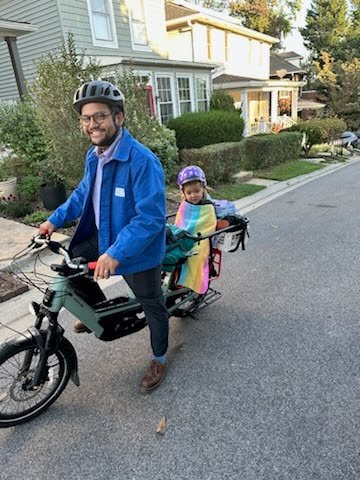
An immigrant, lawyer, and the president of the Bikemore board at just 34, Puga has discovered the secret to life at such an early age. He adores his wife, his friends, and most of all his daughter Isa. Love is a lesson that many in this world deserve and desperately need. It teaches us empathy. It teaches us compassion. It teaches us perspective. Love is your daughter, your mother, a tender touch, your bicycle, your lover, the singing man who dances with a stick at the corner of Broadway and Eastern, a plate of food, a cup of tea.

Without love, Puga may not be the man he is today. 

I used to bike with my daughter on [the] front tube seat [of my Crust Nor’Easter bicycle]…I loved it, and I always wanted to keep her on the front tube seat because it feels interactive, fun, where you’re [able to talk to] her. Right when she was getting too big for [the front tube seat] we bought the e-bike.

Puga rides with his family on their e-cargo bikes, a Surly Skidloader and Cannondale Cargo Wagon, because of the ultimate joy it provides them. It’s binding, almost entrancing really, how much it reveals the beauty of the city, especially through the eyes of a child.

[My daughter Isa] talks about bike riding. Not about the bike.

There’s a misunderstanding about the cost of an e-bike, but the Puga family figured out quite simply what the best option was.

We did the math, and one year’s worth of car insurance was the equivalent of [an e-bike].

Puga teaches us another vital lesson to take into the new year: patience. Too many things in this world happen too quickly, without caution, without care, and regardless of the powers that be of which continue to force us to adhere to the status quo, it is up to those like Puga who approach life with unrestricted empathy to create a better city. 

The reality is we don’t live in a city where it has to be all or nothing. It doesn’t have to be black or white… Life, humans, transportation [are] grey, complex, and [very] different.

Consider donating to Bikemore to help us in our mission of creating an empathic, fluid, and compassionate city for its people.

Bikemore’s success is only possible thanks to our donors. Individual donations help us pay our staff, organize our events, and advocate for safer streets. Start your new year with a donation to Bikemore so that one day more families like Puga’s can ride through the streets of Baltimore with safety paramount above all.

Call for Submissions for Bikemore's Inaugural Literary Magazine!

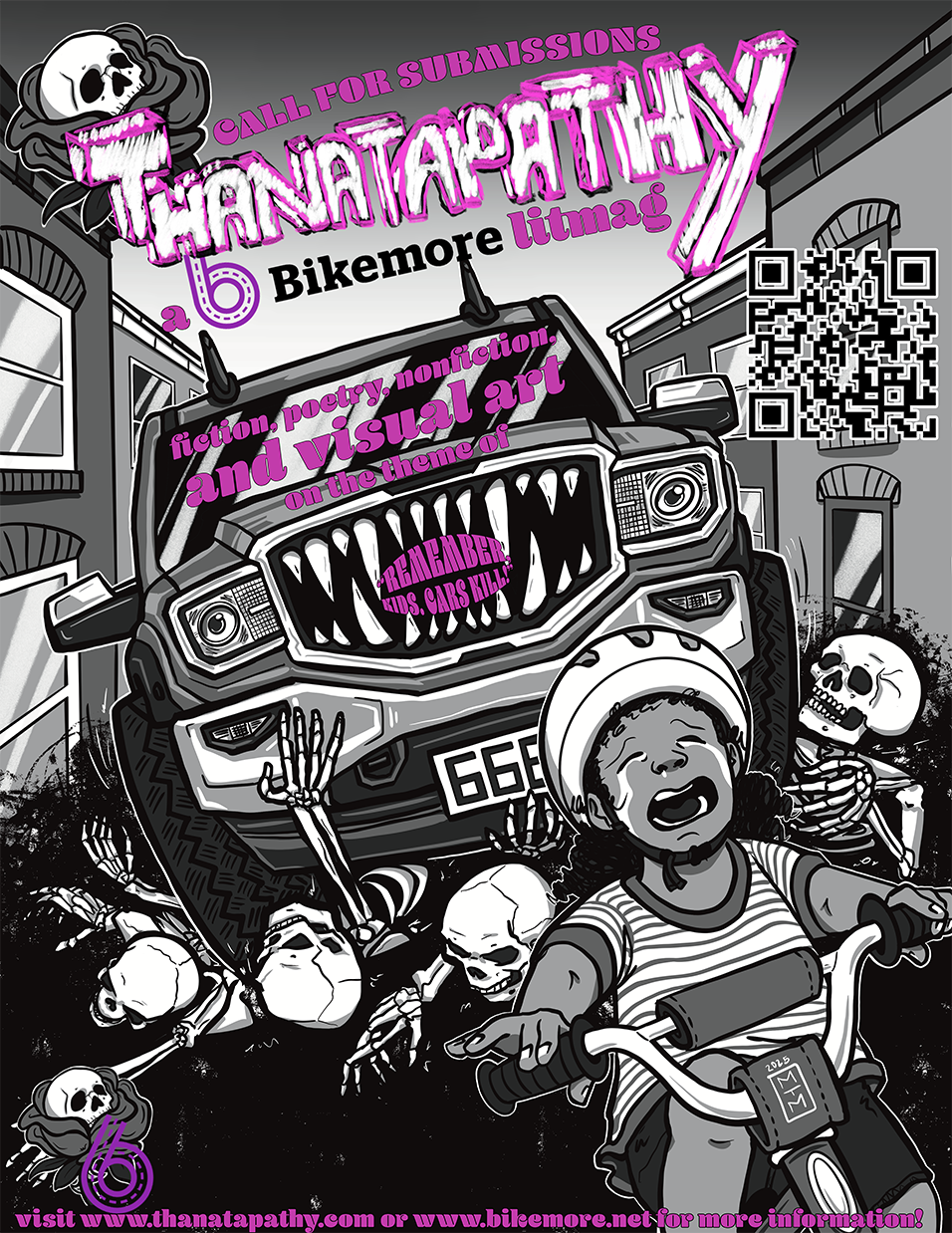
Bikemore is proud to present our limited literary magazine called THANATAPATHY made by our family biking coordinator Cora Karim for her capstone project through the Chesapeake Conservation and Climate Corps.

Submissions are officially open today, January 15, 2026, and we invite one and all to submit their prose, poetry, and visual art to be a part of this macabre and symbolic project on the theme of "REMEMBER, KIDS. CARS KILL!"

Take the time to review the website by clicking the button below. We look forward to seeing all the art submitted!

Spread the word! Tell your friends, your families, your dogs, and the sewer rats, too! Tell your enemies, your allies, the creature that lurks in your closet, tell them all, spread the word, and remind everyone, everybody, that cars kill!

A City Built For People: Bikemore Impact Stories

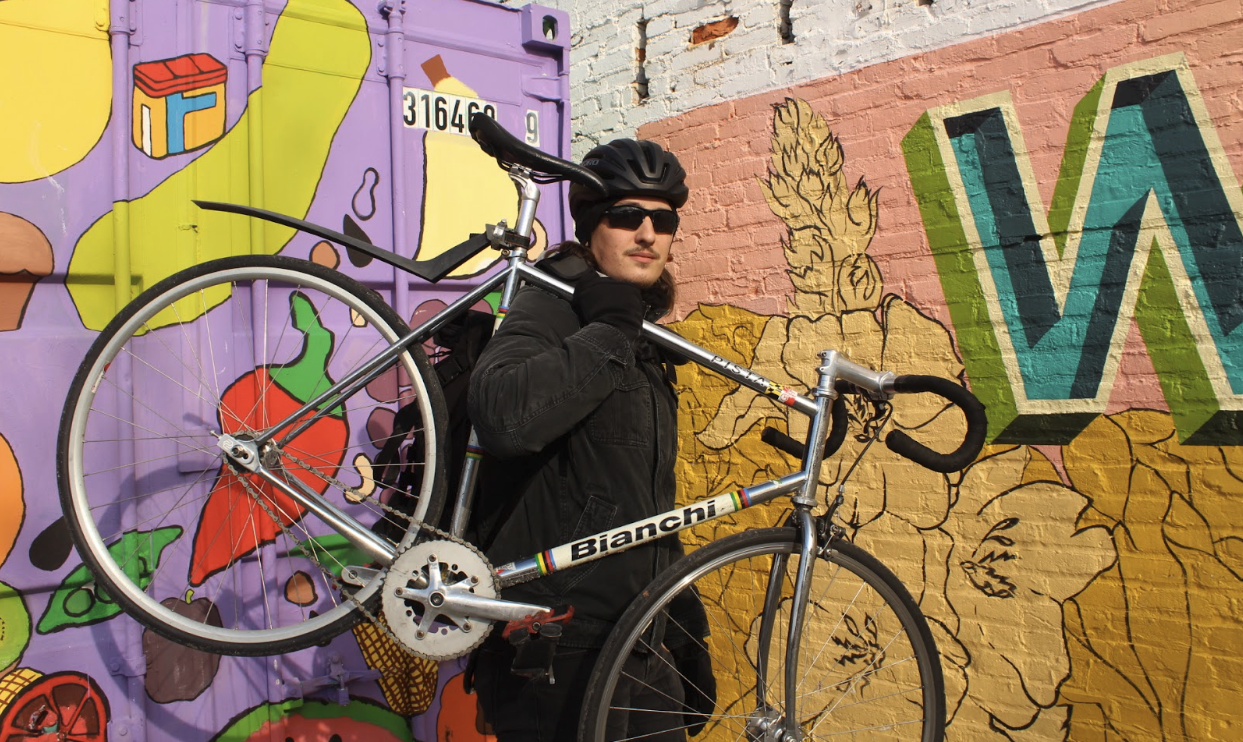
an image of Mike Thomas holding his bianchi bicycle in front of a shipping container at Waverly Farmers Market

There are so many stories in Baltimore, and we’re happy to share with you our fourth following our series for Giving Tuesday. Please consider making an end-of-year donation. Your support is critical to funding our operations and paying our staff.

TW: Some content in this story may be difficult for some to read (talks of traffic violence, car crashes, vehicular manslaughter)

Mike Thomas, 35, is a bike messenger and artist here in Baltimore City. When folks hear of a bike messenger, they may think of the NOS-fueled fixed gears riding through a cityscape collecting packages for delivery, an e-bike savant pushing the throttle with a hefty bag of food on their back, or a cyclist who’s simply trying to make a few bucks to get by. 

Thomas puts it simply.

It’s like the arcade game Crazy Taxi.

While others ride their bicycle as a form of commute, exercise, or enjoyment, Thomas rides his bike for work. His steel Bianchi Pista is an extension of himself, a form of living, of work, of existence. Without a bike, Thomas would literally be unable to work. He could go back to his job as a server or bartender, but to Thomas that isn’t a method of happiness. 

Cutting off modes of transportation is not going to help people get out of economic strain.

Thomas can’t afford a car, not that he should desire to. A city should present reliable, feasible alternative modes of transportation that are safe and accessible for all folks. Presenting one single, expensive, decaying option, such as a car, is ethically and emotionally fatal to some. Giving cars priority in the city is fatal to all.

Out of towners can be pretty apathetic to [Baltimore]. I’ve also seen people who live in the city have that same type of disdain [towards pedestrians and cyclists].

There is a morbid normalization in this city, it seems, of a manslaughter by car being as easy as breathing air. 

Wayne Richardson was killed by a driver in 2019 on his way to feed his disabled son. Avery Cheley was killed by a driver running a red light. Those drivers were never found, and families lost fathers. Edgar Draper was killed in 2022 by a driver while on his way to surprise his partner Gloria with a gift from his trip to the retail store. Instead, she saw a far darker, more permanent horror. And David Herman, a beloved artist and vibrant life in Baltimore, was killed by a driver on a street that has been promised protected bike infrastructure for too long with little recompense.

One’s first question may be, “Was it the cyclist’s fault?” We are taught to create a perfect victim, one that must adhere to every standard and every law without a single degree of fault to ascribe such a title of “victim” to finally persecute the one committing the murder: the driver of a car. Their appeal is followed after their life is lost, never before, never to prohibit another from happening again. 

I’ve grown numb to car [crashes] because I see one or two a week.

For the sake of transparency, no, these cyclists were not at fault for being killed by giant automations capable of mowing down groups of people. There are many more, still, in Baltimore, unnamed, forgotten, their deaths statistics, numbers, echoes of a life once lived. The aforementioned were simply, in a way, perfect.

No car [crash] death is justified.

Thomas is another soul moving through the city on two wheels. He pushes his own pedals, spins downhill on his fixed gear, and he loves it. You shouldn’t have to fear moving. You shouldn’t be forced to stay still. We are heated beings full of hot energy, each atom and joule within our carbon-based bodies itching to dance, ride, sing, scream, laugh. 

There is a growing case of apathy towards those we are being forced to forget. Remember their names, both living and lost, and remind yourself who permits such deaths.

On January 15, 2026, Bikemore will be calling for submissions for a limited literary magazine named Thanatapathy our family biking coordinator Cora Karim’s Chesapeake Conservation and Climate Corps capstone project for the year. Thomas himself is involved in the project, having worked on the art presented on the site. 

In a world that’s getting more commodified and corporatized, some people aren’t getting heard. It could be bikes, it could be something else…It’s good for people to have an outlet…to voice their concerns and express themselves [whether it be for] cycling or alternate forms of transportation.

Save the date, ride your bike, wear a helmet, make real, human connections, and remember, everyone…cars kill.

Consider donating today for more impact stories. Bikemore actively works to advocate for a better city, a city that isn’t covered in the smog of an exhaust pipe or the rolling coal of a compensating truck driver. Our work at Bikemore isn’t just about pushing policies that ensure the safety of people walking, biking, and rolling: we ultimately want a city that’s connected and fluid for all residents, regardless of your mode of transport.

A City Built For People: Bikemore Impact Stories

There are so many stories in Baltimore, and we’re happy to share with you our third following our series for Giving Tuesday.

Your contribution will enable us to continue advocating for improved biking infrastructure, promoting safety education, and building a more connected and equitable Baltimore for everyone.

Our third story follows Amy White, a recent Baltimore transplant who’s been living here for nearly two years and biking for the same amount. She uses her Pedego e-bike to get around the city, and she’s recently started using her analog bike during her social rides around the city. 

Learning the city on the bike makes the city seem smaller. You see neighborhoods you wouldn’t normally see.

Car dependency can dissuade folks from using other forms of transportation within their home, especially in a place as dense as our city, but White makes do regardless of the automatons racing past her. To her, the motivation comes from her place in the community.

[It’s the] social aspect. I work from home, so this is my outlet for meeting people.

There’s a method to normalize cycling for all folks in the city. Whether one is a commuter, a middle-aged man in lycra, or a person who simply enjoys speaking to your friends while riding down the street on two wheels. Cycling turns heads in a city as car dependent as, unfortunately, Baltimore has become. Families, too, have replaced their own car usage by switching to an e-cargo bike for their children, and White’s noticed this on her own commutes.

I see people take their kids [to school] on bikes. It’s great. They’re not in a queue with a bunch of cars lined up.

Biking can be a scare, especially with all the clanker boogeymen around, but to White, it builds character.

The e-bike gave me more confidence…it gave me the ability to know where I was going.

On your next ride, whether it be a car commute, a bus ride, a walk down the street, look around your surroundings and ponder on the possibilities of a different, denser Baltimore, filled with people interacting beside each other in an open space rather than at a distance, inside a steel cage. And if you fancy riding a bike someday, remember these guiding words from White:

Be prepared!

Bikemore actively works to advocate for a better city, a city that isn’t covered in the smog of an exhaust pipe or the rolling coal of a compensating truck driver. Our work at Bikemore isn’t just about pushing policies that ensure the safety of pedestrians: we ultimately want a city that’s connected and fluid for all residents, regardless of your mode of transport.