How does bike parking on the MARC affect ADA?

PXL_20210521_113833204.jpg

Back in May during Bike to Work Week, MDOT and MTA announced that starting on June 1, all MARC trains would accommodate full sized bikes. This means that now the Camden, Penn, and Brunswick lines all have bike parking spots. This is huge news in improving accessibility for regional, multi-modal transit. Previously, only certain trains accommodated bikes and this was only consistent on weekend Penn Line service.

After the announcement, a number of folks have expressed concern about bike parking on the MARC trains taking away ADA spots on some cars. We reached out to the MTA for clarification on this issue and have some follow up details.  

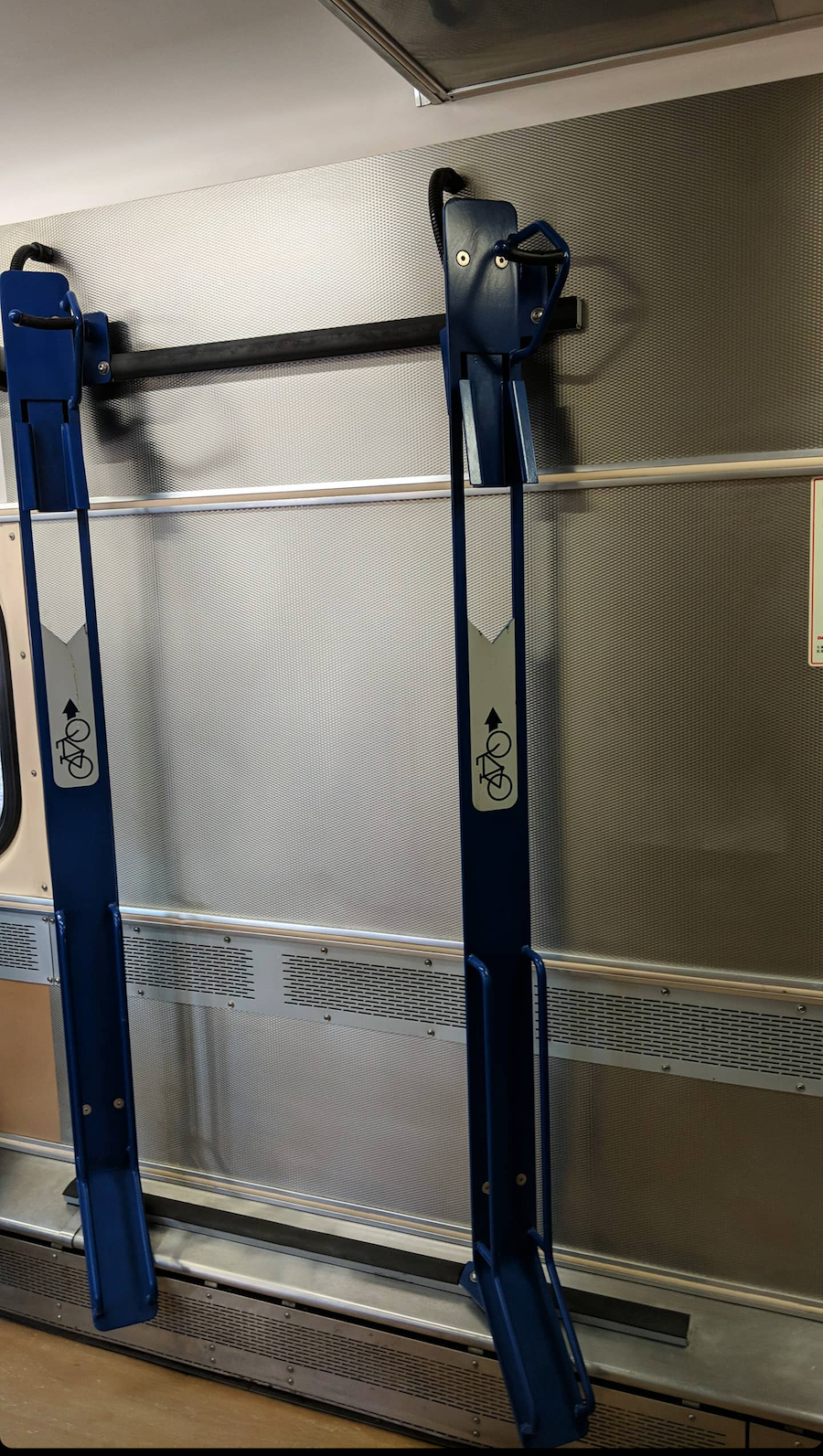
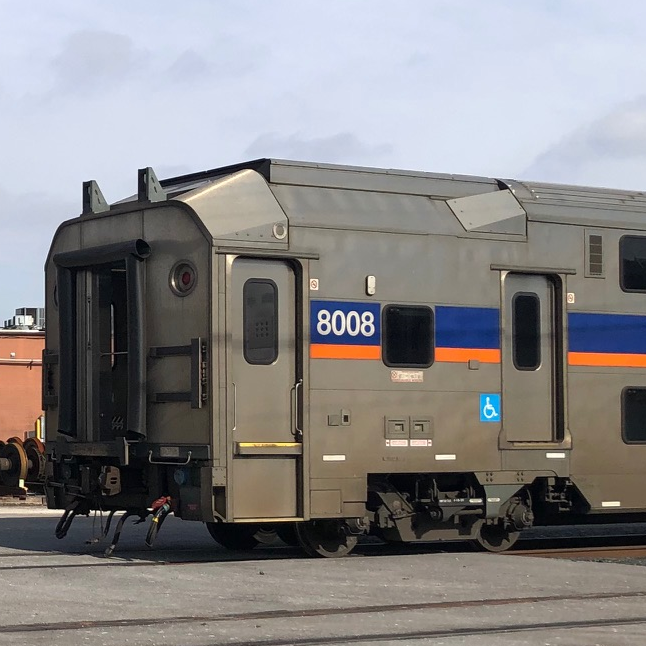
There are four different MARC car styles with bike parking. One type of car is a “bike car” and has 10+ horizontal parking spots. Two types of cars have 2 vertical spots at each end of the car with exterior green lights to signal space availability. And finally, one car where bikes can be secured over folding chairs with bungee cords. These are the same style of the seats that can be used for users with wheelchairs and other accessibility needs.
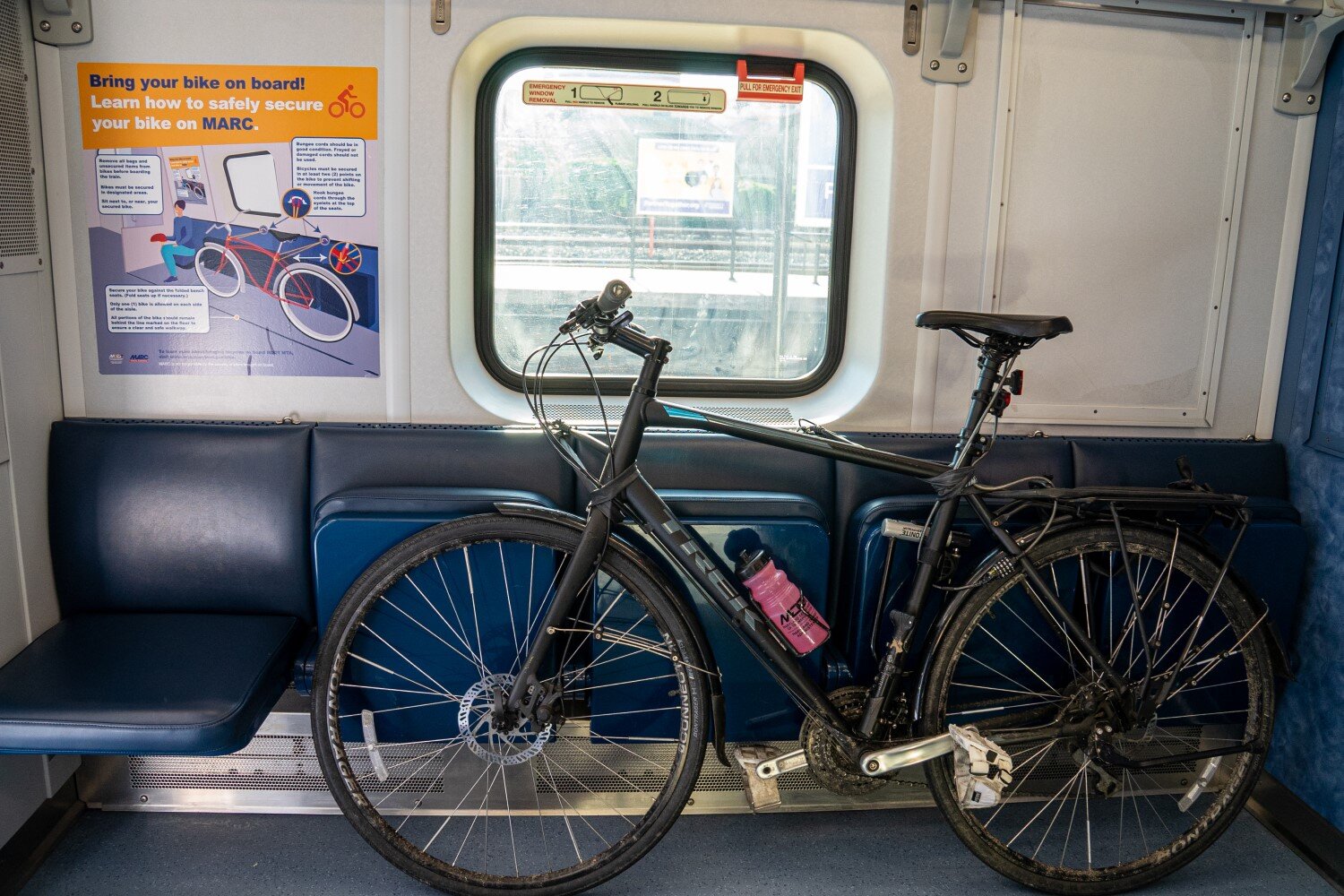
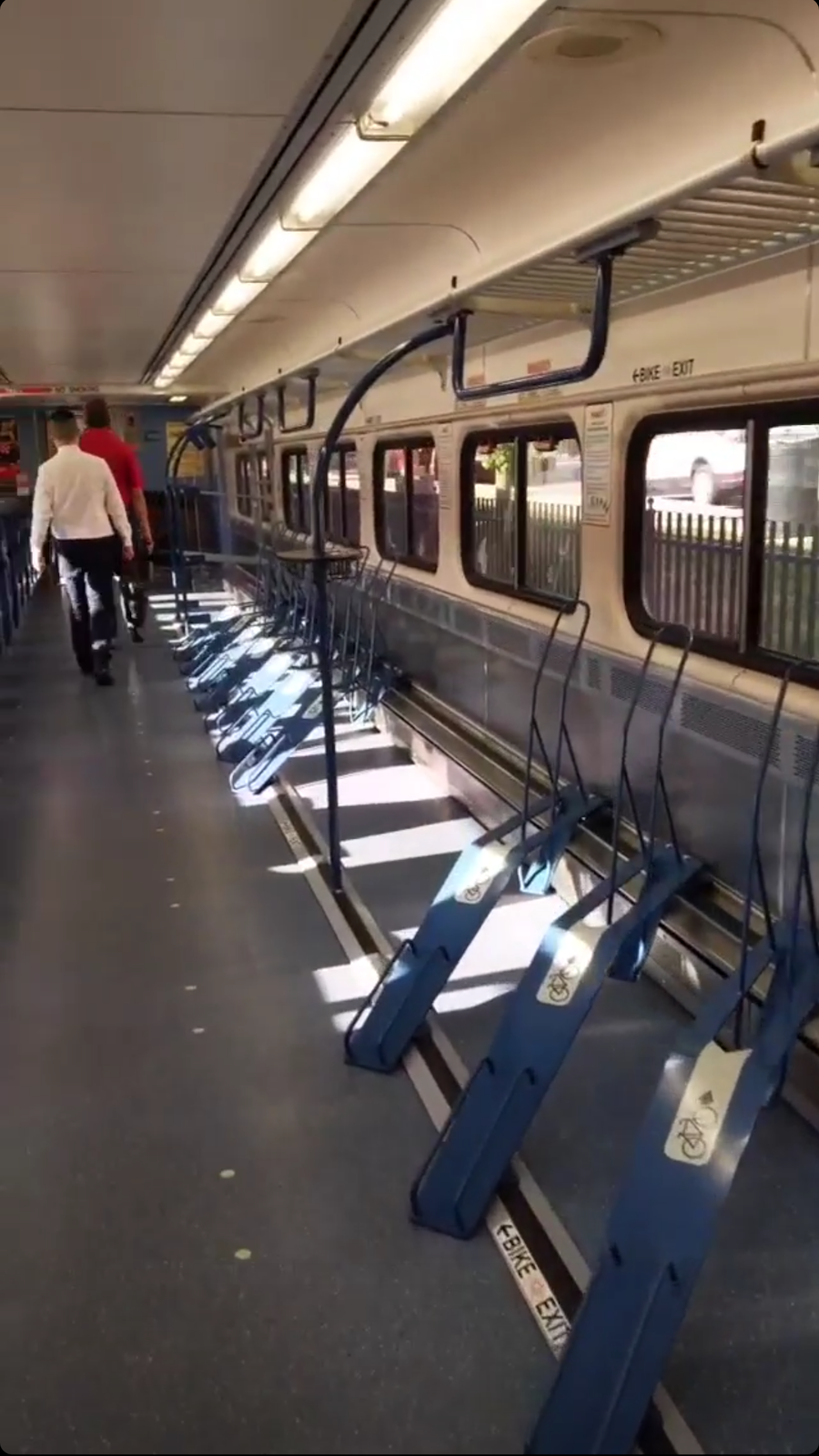
Each MARC train will have a variation of cars, and therefore a variation of bike parking. It’s likely that people will have multiple options for parking their bike on the train, not just folding chair spots.

On cars with folding chairs, only one of the two entrances will be allowed for bike parking; cyclists should look for a green “Bicycle Entrance” sign adjacent to the car doors to know where to park their bike. The other end will have blue ADA signs to indicate the ADA entrance.
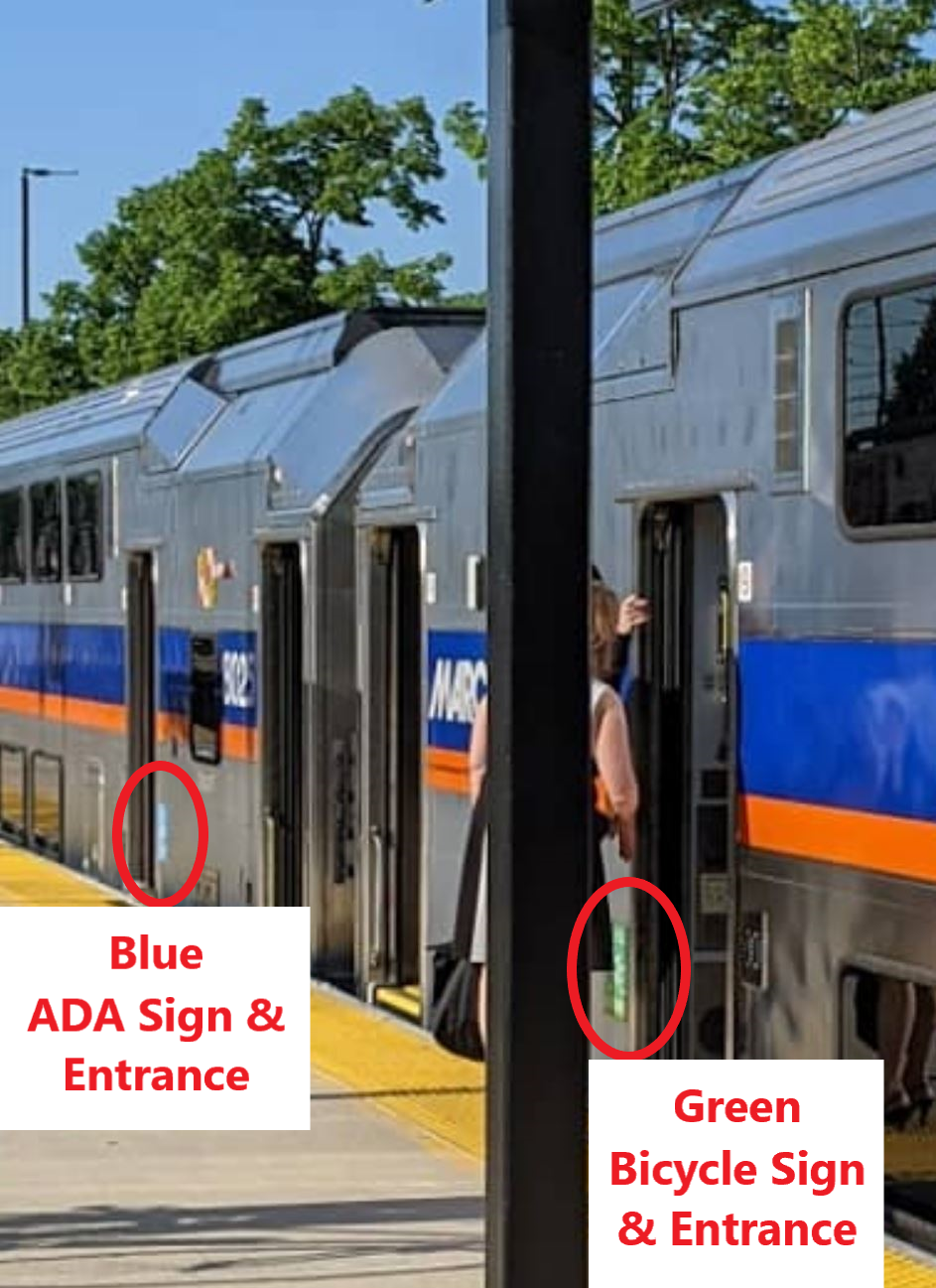
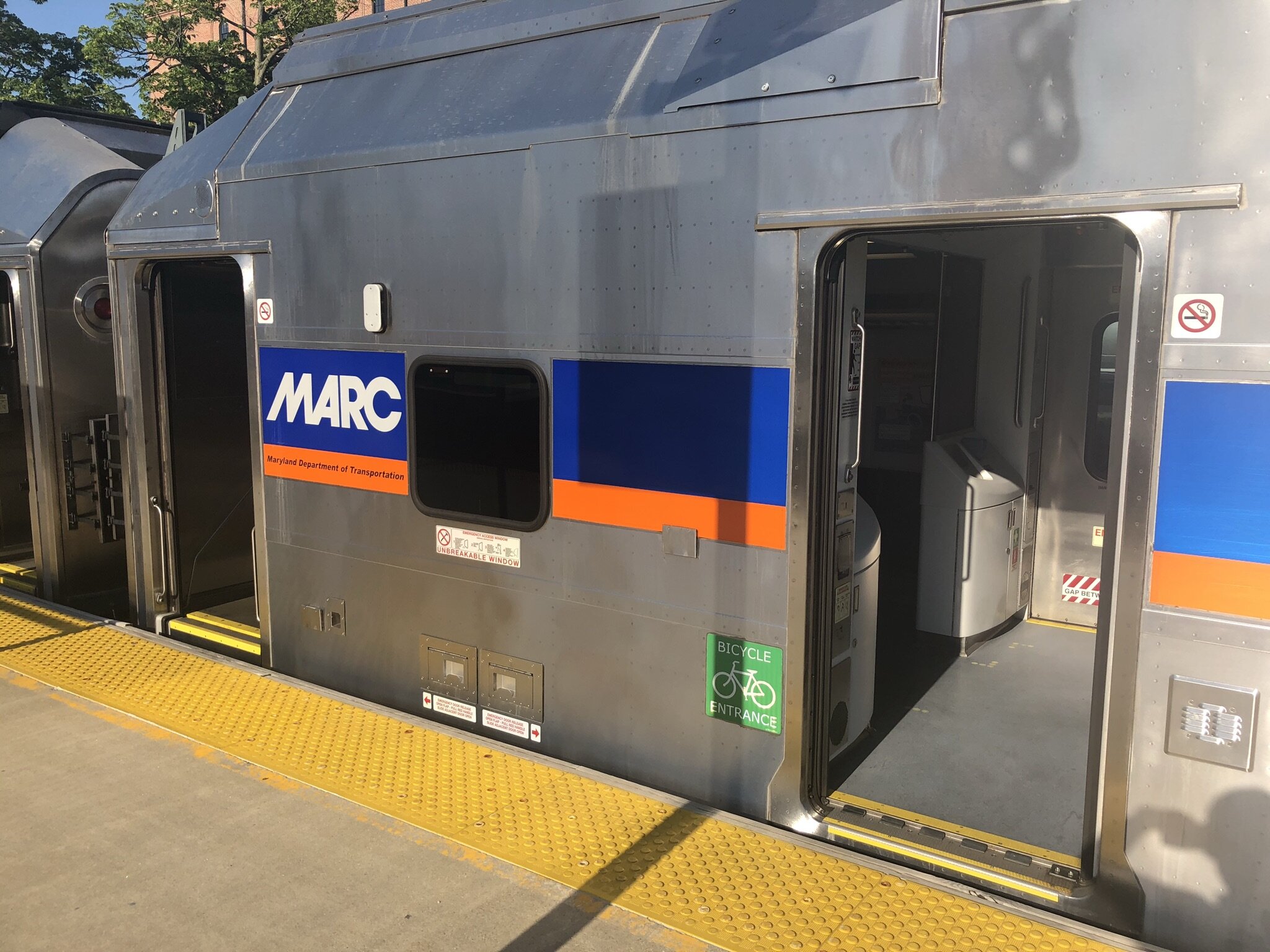
One side of these cars will always have dedicated ADA seating, and the MTA stated that people with disabilities will have priority over bicycles for all spots and people sitting in the folding seats on either end are not required to move for bicycles. 

Obviously conflict between users could still arise and this has the potential to lead to harm. MTA is using the 90% decline in ridership to test the new policy. Ultimately as demand for the MARC increases, they must expand capacity for all types of users and prioritize ADA needs. The MTA should receive more funding for all of its services; including MARC trains, which could all have a dedicated bike parking car to increase accessibility and reduce conflicts.

MTA recently released a video that demonstrates how to park your bike on the various types of MARC train cars, available to watch here. For more details about using bikes with MTA services, visit MTA’s website.

We hope this helps answer some questions.

A future for Bikemore

A purple square graphic with the words “Bikemore is searching for our next executive director.” in all caps and “details @ bikemore.net/jobs.” Drawn yellow graphics of a block of rowhomes, a person in a wheelchair at a bus stop, a cyclist on a green…

We are searching for Bikemore’s next executive director.

Bikemore has made huge strides in the past six years: We advocated for and built the Maryland Avenue and Monument Street cycle tracks. We endorsed and elected a progressive, young mayor who is dedicated to building Complete Streets and the Baltimore Greenway Trails Network. We grew from a staff of one to a staff of five, all people who are dedicated to improving transportation in Baltimore City.

We know we still have a ways to go. In our search for our next executive director, we are looking for someone who will lead the charge to grow and diversify our work, building on Bikemore’s mission of advocating for a livable city.

We want to ensure the vision of Complete Streets is enacted everywhere from routine resurfacing to visionary projects. We want to increase funding for and expand service on our public transit systems. We want to completely reimagine our roadways and land use and housing policies to make Baltimore a city where everyone has access to the things they need and want.

So help us out. The single best way you can contribute to that is by starting a monthly donation.

Building financial stability is critical for us to attract the new leader we all want, and that stability will give them time to get acquainted with the role, our strategic plan, and chart a course for success.

Our average monthly donor gives $18 a month. But any size of recurring gift you make helps us build impact from small, grassroots dollars to transformative change in Baltimore’s walking, biking, and transit infrastructure.

Can you support Bikemore in our next phase? Start a donation today.

Donations made through this form will go to our 501(c)(4), Bikemore in Action, our greatest need. To make a charitable donation through our 501(c)(3), click here.

Making Art in the Right of Way more accessible

For a long time, the Department of Transportation has run an Art in the Right of Way program. First, let’s break down what that means. 

The Baltimore City Department of Transportation (DOT) controls the Right of Way, which means that they dictate how spaces reserved for the purpose of transportation (aka roads, sidewalks, and trails) are used. This is important because that means any temporary or permanent changes on Baltimore City roadways have to be approved by DOT. It’s why people have to seek out Block Party permits to close down streets to car traffic for an event, why the MTA has to work with DOT to paint red bus lanes, and why DOT has to approve all artwork on our streets.

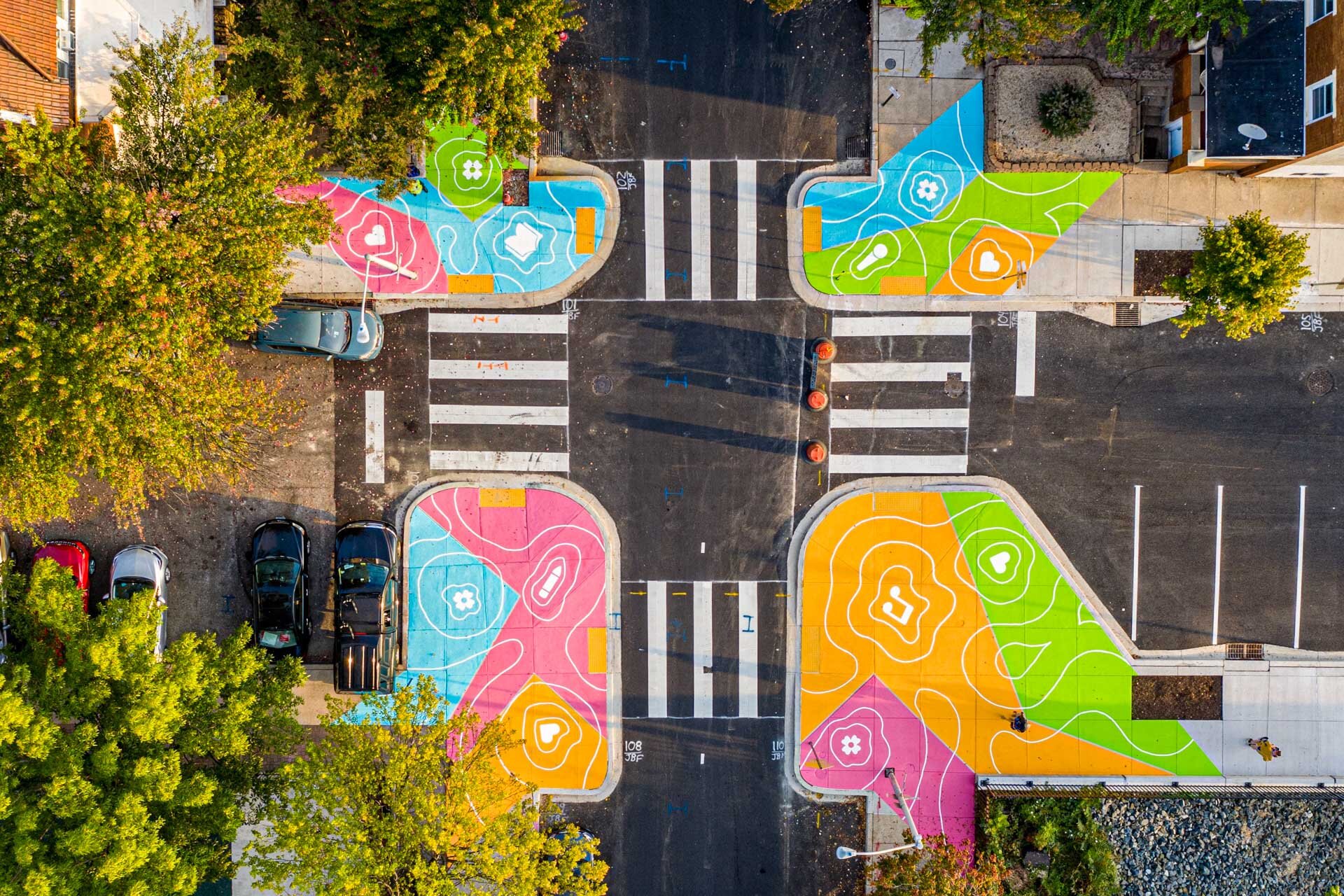
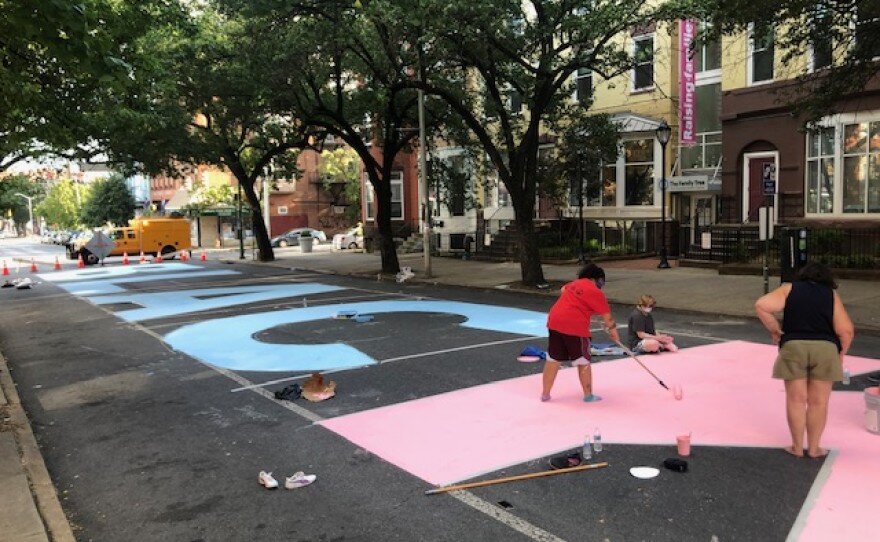
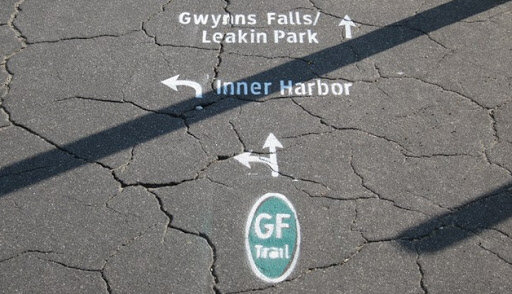
People have used the Art in the Right of Way program to do street murals, paint trail markers (did you know all of the green oval trail markers are painted by volunteers?), and traffic calming for years.

1 - Reverberations Crosswalk by Graham Projects; 2 - Black Trans Lives Mural by Baltimore Safe Haven; 3 - Gwynns Falls Trail marker


A few years ago, graduate students in MICA’s Social Design program asked the question: “How might we ensure pedestrians and bicyclists are seen and prioritized?” After working on multiple different types of visibility projects from reflective clothing to creatively lighting major roadways, the Made You Look team settled on creating more transparency and best practices on how to install traffic-calming art. Essentially, they sought to make the process of creating art in the right of way more accessible.

With these intentions in mind, they’ve worked with partners in the Maryland Department of Transportation Motor Vehicle Administration’s (MDOT MVA) Highway Safety Office (MHSO), public artists, and community members throughout the past couple years on a few traffic calming projects and recently released an “Art in the Right of Way Toolkit.” They’ve also been hosting corresponding workshops open to community members to attend and learn how they can implement traffic calming projects in their own neighborhoods. 

Last week, we attended their Art in the Right of Way Workshop in the company of neighborhood leaders, public artists, and elected officials all looking to learn more about traffic calming art. During this session, the presenters and attendees emphasized the importance of community engagement from project conception to end, using a design thinking process. This means involving neighbors from the very beginning: learning from them what intersections and roads are dangerous for pedestrians, involving them in the design of the new art, and inviting them to participate in a paint day. Many attendees left the call excited to embark on a process of making their own neighborhood art. 

In the Made You Look guide, you can find best practices for: 

  • How to decide on location and design of the art through a community participatory process

  • How you can obtain an MOU from DOT to do an Art in the Right of Way Project

  • How to prepare for installation and how to install your public art

This Wednesday at 5:30pm, they are hosting their last community shareback and closing out their third year of the design program. You can join them at Whitelock Community Farm and screenprint your own reflective streetwear, get bike repairs from BKYE Collective, and check out the new “seasonal turn” crosswalk art at Whitelock & Brookfield!

Hopefully, we’ll be seeing more colorful art that makes our streets safer in neighborhoods all around the city.

Reflections from our interns, and an announcement

Not a photo of Patrick or Sumi, but like in this photo, they’re rolling out for now.

Not a photo of Patrick or Sumi, but like in this photo, they’re rolling out for now.

Through the beginning of 2021 to now, Bikemore has had the privilege of hosting two interns: Patrick from UMBC and Sumi from Johns Hopkins. During their time working here, which is ending this week, they’ve been invaluable in supporting our policy communications, and adding additional capacity to our small staff of three. Here, Patrick and Sumi share some reflections. And, special announcement: Sumi will be working with Bikemore as a full-time intern during the summer as well! Get ready to see her out and about with us from June to August.

From Patrick: 

 This past semester I’ve had the incredible opportunity to work for Bikemore as a part time college intern. This experience has really helped me find a passion for things like transportation equity, housing policy and even urban development. It has allowed me to see Baltimore in a new light and think about what it could be like if we really invested our resources into creating more sustainable and equitable cities.

Combining this knowledge and curiosity with my college classes has given me the option to think about a potential masters degree in urban planning or public policy. This kind of on the ground learning makes a huge difference because it lets me experience what a nonprofit career could be like. I really appreciate this because I think that nonprofits are an essential part of any community or city and something I see myself making a career out of.

From Sumi: 

 My first day at Bikemore, I was extremely intimidated. It was hard not to be -- I was the only new intern to a relatively small and intimate company that was focused on transportation policy, an area I had no expertise on. But over the course of the past four months I've not only become more comfortable with my co-workers and confident in my ability as an intern, but I've also learned about Baltimore's history with housing and transportation. Bikemore is a bike advocacy organization, yes, but I couldn’t imagine just how intertwined our work ended up being with zoning, housing, sustainability, and historical redlining. In holding interviews, I spoke to affordable housing advocates, city council members, CEOs, and affected residents. In doing research, I learned about the Complete Streets Ordinance, Baltimore zoning laws, and redlining. It was a world I had only learned about in class, but now I was able to interact with it and make a concrete difference. 

Throughout my experience, I was surprised at how much I learned -- not only about zoning, housing, and transportation, but about non-profits in general; I learned communication skills, policy advocacy, social media engagement, and networking skills. My co-workers were always helpful and generous. And I learned so much about Baltimore that I fell further in love with the city -- I'm even considering working here full-time once I graduate. I’m happy to be able to say that I’m going to continue my work with Bikemore throughout the summer, too! I want to thank my supervisor, Clarissa Chen, for being so helpful and positive in my work at Bikemore, as well as Liz, Jed, and Menelik for being supportive, informative, and inspirational role models. I also want to shout out my other intern, Patrick, who has been so fun to work with. I'm excited to continue my work with Bikemore and Baltimore -- I feel like my work has just begun.

What does a parking cashout mean for Baltimore?

Written by Patrick Reid, UMBC student and Bikemore Intern

The Baltimore City Council passed an important new bill in March that could change how some city government employees commute. The new bill aims to study something known as a parking cashout.

Parking cashouts are an incredibly effective way to increase the use of alternative modes of commuting to work. Basically, parking cashouts give employees the cost of a dedicated parking spot as cash, allowing them to use the money to pay for alternative modes of transportation. Free parking at work is often an included employee benefit; this takes the value of parking to create incentive for using other modes of transportation. 

Enticing local business leaders to support sustainable initiative can sometimes seem like a daunting task, especially when many have their profit margins to consider. But a cashout program is a win-win situation. Employees receive a cash benefit,  and employers can save costs and even receive a tax credit. A study by the Maryland Department of Transportation (MDOT) illustrates how these savings work in an example below. 

A table showing how a parking cashout with the commuter tax credit would save employers money on employee benefit costs.

The table shows just how beneficial the parking cash out program would be for businesses who are looking to not only support sustainability and increase transit usage but also just cut down on their costs. By using the tax credit and maximizing the amount of money given to the employees who opt into the program the employer saves $7,500 while the employee makes an extra $50 a month or $600 over a year. 

The program is economically sound, but would it actually contribute to an increased use of alternative modes of commuting like bikes or transit?

According to a study in Washington D.C., it absolutely would. Looking at a sample of 987 Washington commuters who were faced with the prospect of not receiving free parking at their place of work, we see clearly some potential changes in behavior. For these commuters the options of biking or walking increased 15% while public transit usage increased by 31%. The number of commuters saying that they would get to work by “car alone” would fall by a staggering 50% to less than a quarter of surveyed commuters choosing to commute by car if the parking was not free!

parking choices dc.png

What these numbers look like in practice is a cleaner, more connected city that can shift focus away from cars and instead on new modes of transportation like bikes and public transit. It means a more environmentally sustainable future and many more options for commuting. The Washington-based survey data in addition to the economic report from MDOT show the feasibility of a parking cash out program for all stakeholders involved.

While the current proposal only looks at the city government, a broader rollout of a cash out program could really make a big difference in Baltimore. What the city needs are bold new ideas and the courage to pursue them. This program could have a really meaningful impact if it was rolled out to more industries throughout Baltimore. We have the chance to transform the way that Baltimoreans commute, to make it environmentally conscious, safer and even put a little extra money into each paycheck in the process.