
Advocacy

Protecting the Jones Falls Valley from Future Industrial uses

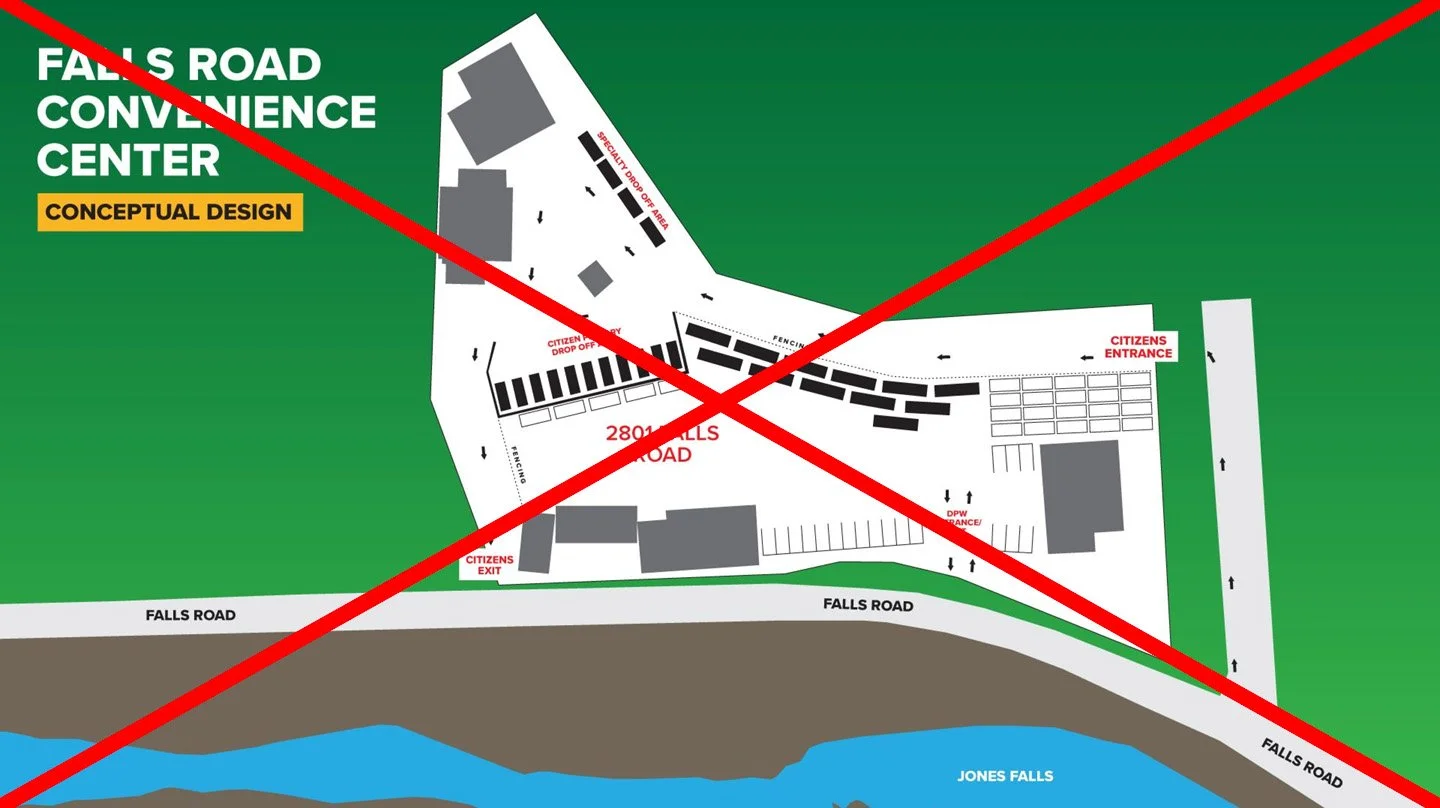
an image of the falls road convenience center proposal with a red x through it

In August, we asked you to share opposition to plans to relocate the Sisson Street Convenience Center to the Jones Falls Valley.

As a result of your advocacy, the Sisson Street Task Force was formed, and Bikemore was asked to join to advise on traffic safety and represent the interests of bicyclists and pedestrians.

In a November task force meeting, Bikemore Executive Director Jed Weeks motioned to remove the Falls Road site from consideration, and the task force unanimously voted in favor of that motion.

While we expect the mayor to accept the recommendations of the task force, this vote was only advisory. And even if the city never planned to relocate to the Falls Road location, there was still a huge risk: the sites are zoned industrial and owned by Potts & Callahan. In theory, nothing could prevent them from selling or leasing the property to another industrial use, including a private waste facility.

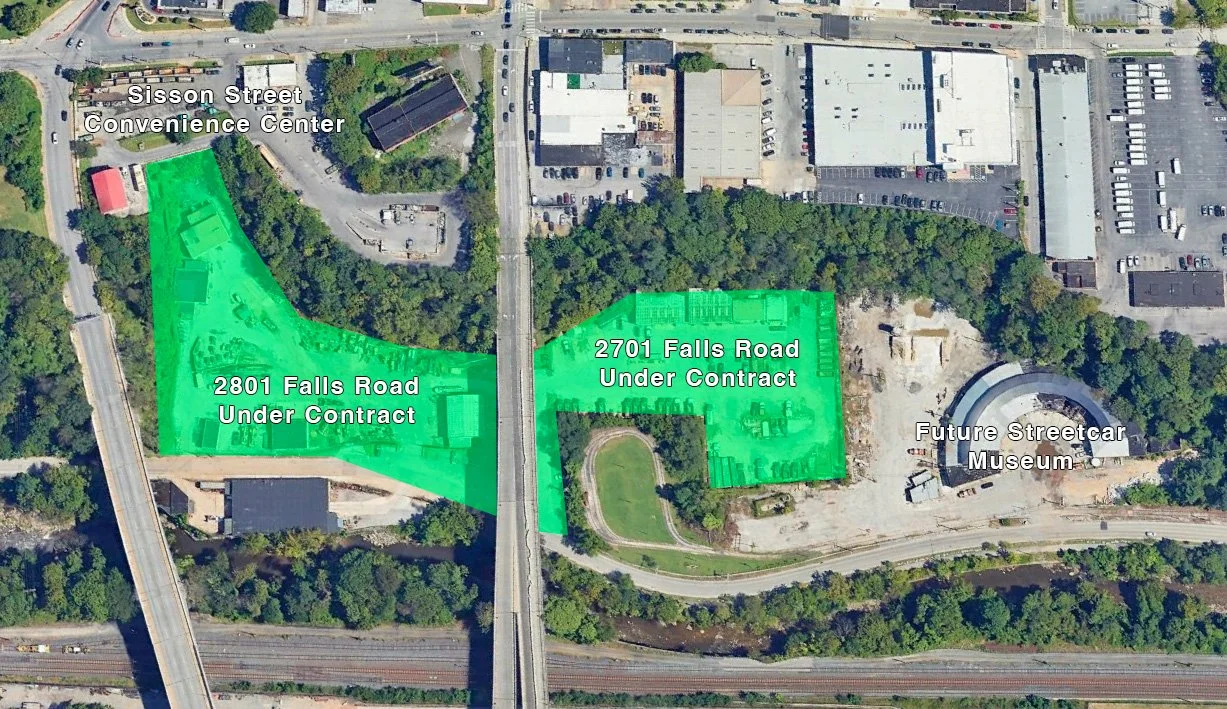
an image showing the 2801 and 2701 Falls Road sites in the context of the Sisson Street Convenience Center

Today, Seawall Development announced that they are under contract on 2801 and 2701 Falls Road, both of the active Potts & Callahan industrial sites.

If their purchase is successful, Seawall Development has committed to advocates and neighbors, including Bikemore, Blue Water Baltimore, Friends of the Jones Falls, and the Greater Remington Improvement Association that they will prevent industrial uses on these sites, and instead work collaboratively with us to re-imagine both sites to meet the desires of Baltimoreans to see the Jones Falls Valley realized as a world-class linear park, flanked by walkable, mixed use development in Remington.

Challenges to protecting these sites remain. The financial viability of this sale is likely predicated on the ability to re-develop the existing Sisson Street Convenience Center, as connectivity between Remington and the Jones Falls Valley between the two sites would only be possible through that re-development. The industrial zoning is still in place, and a comprehensive rezoning of both the Falls Road and Sisson Street sites to allow appropriate human scale redevelopment (and restrict uses like big box stores and parking lots from the Sisson Street sites) would likely be necessary.

If the Sisson Street Task Force moves toward Option 2, the phased closure of Sisson Street Convenience Center, Bikemore will advocate for the report to include these recommendations.

If realized, these efforts would take the largest remaining industrial uses in the lower Jones Falls Valley off the table permanently, protect the site from a potential future convenience center, eliminate dumping and runoff concerns from the existing Sisson Street facility, and facilitate a much stronger connection between communities and the Jones Falls Valley.

Seawall Development will be hosting public visioning sessions for Baltimoreans to share what they’d like to see these sites become, and we will share that information as it becomes available.

FY2027 Baltimore City DOT Capital Improvement Program Testimony

Last week, Bikemore’s Executive Director Jed Weeks testified at the Baltimore City Planning Commission on the FY2027 DOT Capital Improvement Program - which is the capital budget that funds construction and retrofit of our roads and bridges.

“I want to start by saying I see a lot of good things in this year's CIP - critical safety projects that have been long paused now advancing, and a focus on hardening quick build infrastructure into permanent installations - reducing maintenance costs and eyesores. I want to especially thank DOT's planning chief and team for the progress we are seeing here - and I truly think they're the best thing happening at DOT right now. And I know we have a director that knows the stakes and is a believer in designing streets to save lives.

Since the adoption of the Complete Streets Ordinance in 2018, I have testified before this commission concerned about other divisions' seeming inability to follow that ordinance and since 2021, I have pointed to work that goes explicitly against the 2021 Complete Streets Manual guidance. 

My concerns continue today.

Specifically, the agency has been unable to lawfully execute resurfacing and continues to advance expensive, legacy streetscape projects that have no impact on safety and overbuilt bridges that still don't comply with the law. 

I have flagged projects like Belair Road Streetscape to this commission for years - this project directly undermines the goals of MTA's bus prioritization for the corridor and entirely contradicts the recommendations of the ULI study from which the project supposedly originated.

As I shared the past two years, the Sisson Street bridge in this year's CIP is engineered to accommodate double stacked freight - despite CSX lowering the tracks so that is not necessary. It has 15 foot wide lanes for truck traffic for a walmart that doesn't exist, and no shared use path or bicycle facility as required under adopted city plans. 

We are paying millions more than we need to for an outdated design that's not compliant with complete streets, and we will pay even more to later retrofit it into compliance, just like we've had to do with the Harford Road and Wilkens Avenue bridges. 

Have the other bridges in the project pipeline been designed in compliance with ordinance? We don't know, because despite asking this question every year, we've never been given an answer.

Of the 58 TEC Division resurfacing projects scheduled for 2025, 25 required retrofit to include all-ages bicycle infrastructure or shared use walking and biking paths under ordinance. As resurfacing began this past spring, zero of those plan sets were designed, and the city admitted that to achieve their resurfacing goals, they'd have to break the law.

Every single other resurfacing in the city this year broke the law in some way. Just look across the plaza to Lexington, where the city striped illegal travel lane widths and stop bar setbacks. It's literally in view of the agency office and city hall.

DOT needs more money. 

We have and will continue to fight for new revenues for the agency and a larger share of transportation dollars from the state, as we have successfully advocated in prior years alongside members of this commission, other advocates, and city and state elected officials.

But it makes that fight for resources hard when we have seen no meaningful reform of the broken divisions at DOT that are lighting that money on fire. 

DOT has an opportunity to change that - with new leadership and key positions out for hire.

Moving forward, I hope that the Planning Commission can help DOT ensure projects are only funded when they are generated from the agency's planning team, based on a goal of advancing adopted city plans, and demonstrably in compliance with ordinance. 

Thank you, and please let me know if you have any questions.”

2025 in Shared Mobility

a man rides up Greenmount Ave on a scooter as a food delivery worker on a bike waits to cross the street.

In Baltimore, 2025 was the best year for our city's shared mobility program to date.

As a city, we took over 3 million rides during the year, reaching over 3.9 million miles covered on shared e-bikes and scooters. This is nearly double the rides Baltimore took in 2024!

Rides were also more equitably distributed, with ride origins from 2024-2025 increasing by 144% in East Baltimore, 163% in Southwest Baltimore, and 133% in Northwest Baltimore.

We saw the introduction of a new model of e-bike across the city, which adds a throttle option, making it easier for riders of all abilities to get around the city. There have also been many painted corrals installed around the city, making parking and placement easier, as well as decluttering our streets and sidewalks, perhaps the biggest problem the public sees with shared micromobility.

Additionally, we’ve had a major uptick in the enrollment and usage of the Access Program discounts, which waive unlock fees and discount the per-minute fees of the rides by 80%. These access programs are available to anyone who is enrolled in any form of government assistance; more information about the programs can be found at bikemore.net/enroll. In my work at Bikemore, I have directly enrolled upwards of 50 individuals into this program while going out into the community to provide information about it.

Finally, Lime and the League of American Bicyclists released a report Building Safer and More Friendly Streets: Lessons from Lime Data on Infrastructure, Safety, and Transit Access. The report looked at 5 million rides across 3 cities: Baltimore, Nashville, and Phoenix. It clearly shows that all-ages, separated infrastructure increases ridership and drives safety. 

In Baltimore, Lime analyzed ridership between 2022-2025 on newly installed separated bike lanes, and the increases in Lime ridership were dramatic. 28th Street saw a 526% increase, Harford Road saw a 423% increase, and Central Avenue saw a 229% increase in ridership. 

One piece of separated infrastructure can bridge divides and dramatically expand access for riders. For example, the map below shows the trip routes riders utilizing the 28th Street separated bike lane took this past year.

an image of thousands of trips passing through a fixed point along the 28th Street bike lane, showing how those trips branch out deep into East and West Baltimore.

Looking forward, we hope for continued expansion of the micromobility program from both providers, especially their equity programs, and for the city to consider directly subsidizing trip costs for all riders.

Public access to anonymized trip data, which we successfully advocated for in Baltimore's permit legislation, makes it easier to tell stories on the impact this program has on transportation access in Baltimore.

We are grateful for both Lime and Spin for their help in our continued efforts to advocate for safer streets that have separated infrastructure to improve access for all Baltimoreans.

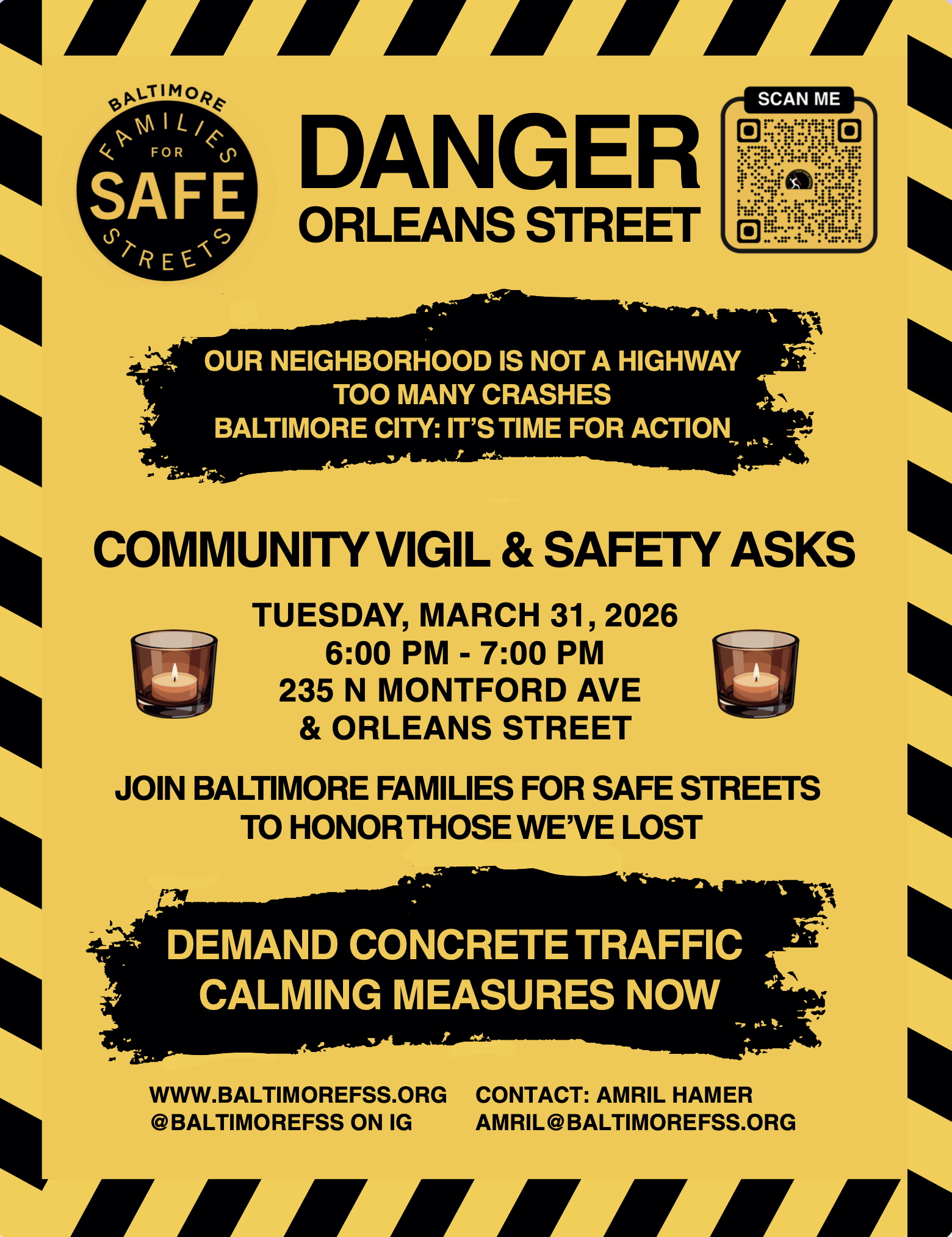
Bikemore Launches Baltimore Families for Safe Streets Chapter

Bikemore has launched a local chapter of Families for Safe Streets!

Visit the website at www.baltimorefss.org and read the introduction from our newly hired organizer below!

My name is Amril “Amery” Hamer, and I am reaching out to formally introduce myself as the new Organizer for Baltimore Families for Safe Streets.

I am incredibly excited to join this vital movement, which confronts the preventable epidemic of traffic violence by advocating for life-saving changes and providing support to those impacted by traffic violence.

As a former organizer at Transportation Alternatives working alongside Families for Safe Streets in the Bronx, I have witnessed the devastating impact traffic violence has on families and their community.

My 'why' is to prevent others from experiencing a preventable tragedy. I'm here to help push for real solutions—like lower speed limits and Vision Zero designed streets—to build a safer future together.

My Role
In my capacity as Organizer, I will be focused on several key areas:

  • Empowering those affected by crashes through emotional support, advocacy training, and community building.

  • Channeling collective grief and trauma into action, ensuring that your voices/stories are powerful and make a difference as we demand safer roads together.

  • Advocating for evidence-based solutions like safe speeds, safer road designs, and safer vehicles, with the ultimate goal of achieving Vision Zero—where no loss of life to traffic violence is acceptable.

Get Involved & Connect
I am eager to connect and learn from your experiences and insights. I believe that by working together, we can achieve substantial, life-saving changes in our community.

Attend a Gathering:  We offer support gatherings and peer mentorship opportunities to connect with others who have been impacted.

Share Your Story: Your story is a powerful tool for change. I would be honored to hear it and explore how we can share it to advocate for specific changes in Baltimore.

Reach Out: Please feel free to email me at amril@baltimorefss.org with any questions, ideas, or just to say hello.

If you have been personally impacted by or have lost a loved one to traffic violence, please click below and let us know.

I look forward to working alongside you to make Baltimore's streets safer for everyone.

Support Zoning and Land Use Reforms for More Accessible and Affordable Housing

a chart showing the benefits of Minneapolis housing and zoning reforms

Earlier this summer, the Housing Options and Opportunity Act was introduced in Baltimore City Council. It is a part of a package of five bills aimed at making it easier to build more (and more affordable) housing in Baltimore City, three of which will be heard by the Baltimore City Council Land Use and Transportation Committee this month. 

The five bills would:

  • make permissible single-stair apartment buildings, which would allow for easier creation of family-sized apartment units and make it easier to ensure every bedroom in an apartment has a window,

  • allow for both smaller and larger units in more areas, and adjust yard requirements to make buildings fit better into the urban fabric,

  • move the Zoning Administrator under the Department of Planning, which would, amongst other things, help solve a longstanding zoning enforcement challenge with bike parking,

  • eliminate off-street parking minimums for the few remaining categories where they apply, allowing for more affordable construction and more pedestrian-oriented design,

  • legalize smaller multi-family homes where only single-family homes are currently permitted, allowing more families access to opportunity in more neighborhoods.

Legislation like this has been incredibly successful in other cities.

“Reform lowered housing cost growth in the five years following implementation: home prices were 16% to 34% lower, while rents were 17.5% to 34% lower relative to a counterfactual Minneapolis constructed from similar metro areas.” - Zoning Reforms and Housing Affordability: Evidence form the Minneapolis 2040 Plan

“Single-stairway four-to-six-story buildings with relatively small floor plates cost 6% to 13% less to construct than similar dual-stairway buildings. They can also fit on smaller infill lots, potentially increasing the supply of apartments in high-opportunity urban and suburban neighborhoods. And to the degree that these modern buildings replace older, riskier buildings, or enable residents to move out of older housing, single-stairway apartments will actually increase fire safety.” - Small Single-Stairway Apartment Buildings Have Strong Safety Record: Revised building codes could encourage construction, boost supply of lower-cost homes

Bikemore in Action is supporting this full package of bills, and we encourage you to support them as well. 

You can help right now by sending an email in support of bills being heard this month.