shared mobility

2025 in Shared Mobility

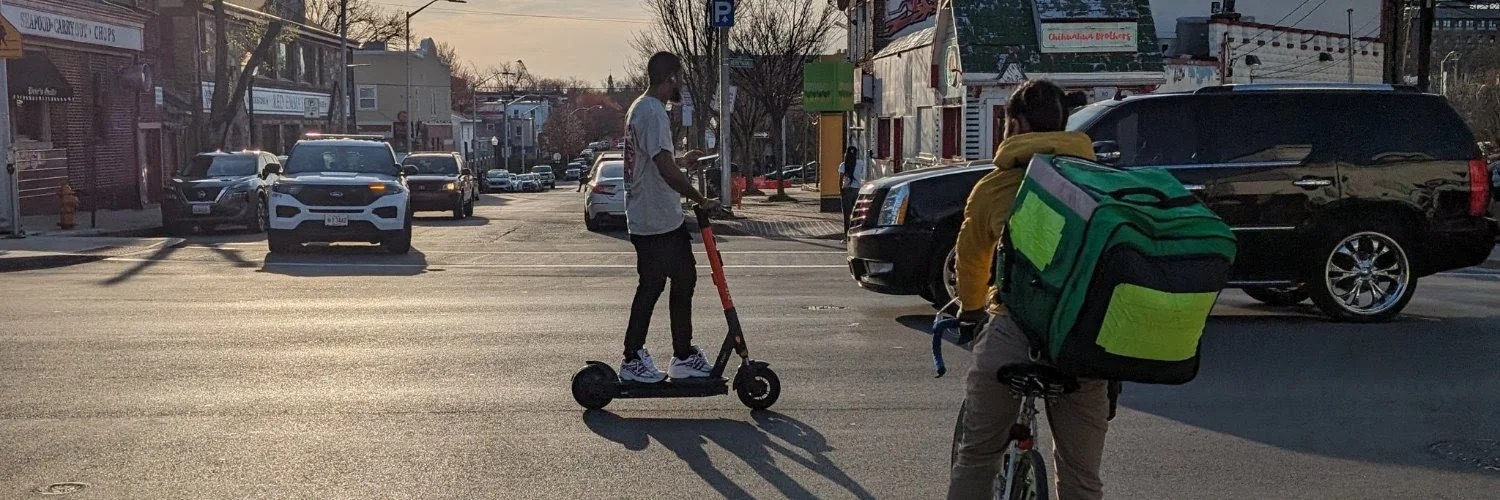
a man rides up Greenmount Ave on a scooter as a food delivery worker on a bike waits to cross the street.

In Baltimore, 2025 was the best year for our city's shared mobility program to date.

As a city, we took over 3 million rides during the year, reaching over 3.9 million miles covered on shared e-bikes and scooters. This is nearly double the rides Baltimore took in 2024!

Rides were also more equitably distributed, with ride origins from 2024-2025 increasing by 144% in East Baltimore, 163% in Southwest Baltimore, and 133% in Northwest Baltimore.

We saw the introduction of a new model of e-bike across the city, which adds a throttle option, making it easier for riders of all abilities to get around the city. There have also been many painted corrals installed around the city, making parking and placement easier, as well as decluttering our streets and sidewalks, perhaps the biggest problem the public sees with shared micromobility.

Additionally, we’ve had a major uptick in the enrollment and usage of the Access Program discounts, which waive unlock fees and discount the per-minute fees of the rides by 80%. These access programs are available to anyone who is enrolled in any form of government assistance; more information about the programs can be found at bikemore.net/enroll. In my work at Bikemore, I have directly enrolled upwards of 50 individuals into this program while going out into the community to provide information about it.

Finally, Lime and the League of American Bicyclists released a report Building Safer and More Friendly Streets: Lessons from Lime Data on Infrastructure, Safety, and Transit Access. The report looked at 5 million rides across 3 cities: Baltimore, Nashville, and Phoenix. It clearly shows that all-ages, separated infrastructure increases ridership and drives safety. 

In Baltimore, Lime analyzed ridership between 2022-2025 on newly installed separated bike lanes, and the increases in Lime ridership were dramatic. 28th Street saw a 526% increase, Harford Road saw a 423% increase, and Central Avenue saw a 229% increase in ridership. 

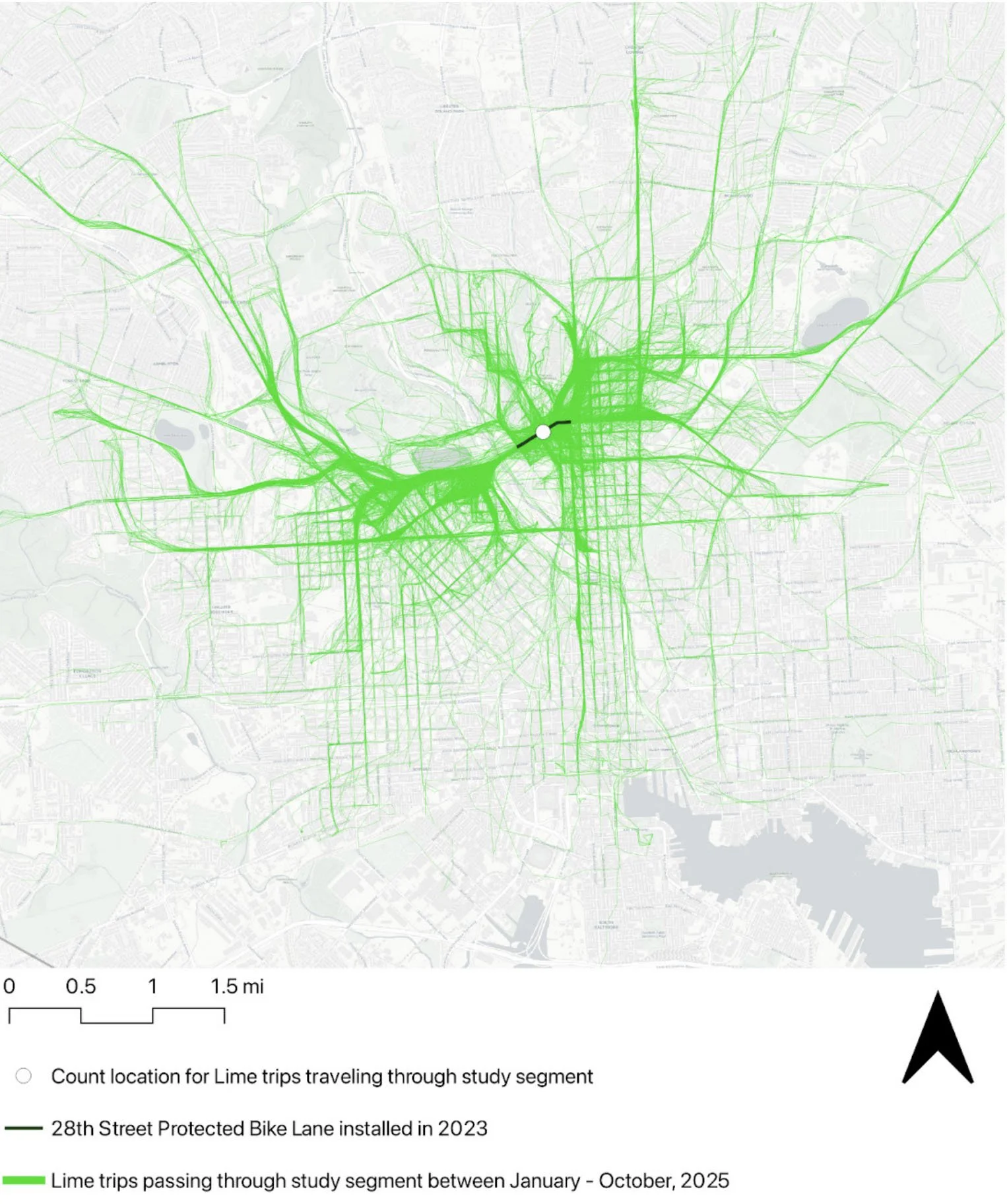
One piece of separated infrastructure can bridge divides and dramatically expand access for riders. For example, the map below shows the trip routes riders utilizing the 28th Street separated bike lane took this past year.

an image of thousands of trips passing through a fixed point along the 28th Street bike lane, showing how those trips branch out deep into East and West Baltimore.

Looking forward, we hope for continued expansion of the micromobility program from both providers, especially their equity programs, and for the city to consider directly subsidizing trip costs for all riders.

Public access to anonymized trip data, which we successfully advocated for in Baltimore's permit legislation, makes it easier to tell stories on the impact this program has on transportation access in Baltimore.

We are grateful for both Lime and Spin for their help in our continued efforts to advocate for safer streets that have separated infrastructure to improve access for all Baltimoreans.

Dockless Vehicle 2020 Update

Screen Shot 2021-02-03 at 1.50.14 PM.png

Bikemore has supported the City’s Dockless Vehicle Program permit for e-scooters and bikes since before the pilot launched in 2018, writing the white paper that served as the basis for the pilot and supporting legislation to make the program permanent. 

While this year’s permit cycle was meant to end in August 2020, it has been on hold due to Maryland’s State of Emergency. So how has the scooter program been doing during pandemic times? 

Here are the highlights from the Department of Transportation’s latest update:

  • Vehicle trips in 2020 decreased 55.6% from 2019. We also saw a shift from weekday rush-hour commute trips to midday/weekend usage. 

  • Trips around the Inner Harbor, downtown, and at college/university campuses dropped significantly, while trips around parks and along transit corridors increased. 

  • DOT used Dockless Vehicle Permit funds to perform an audit on bike facilities and completed work orders to replace 100 flex posts, convert two storm drains to be bicycle/scooter friendly, and added green paint to improve visibility at intersections.

  • DOT is currently working on installing over twenty bike/scooter parking corrals around the city, prioritizing transit connections, reducing vandalism, and equity zones.

  • After the State of Emergency is lifted, DOT will release an updated Rules and Regulations for the Dockless Vehicle permit for public comment before vendor applications open.

  • Currently, SPIN and Lime are the only two dockless vehicle vendors in the city after Lime acquired JUMP and Bolt failed to meet permit requirements.

  • Lime has re-launched JUMP bikes in the city, but the fleet is still quite small.

Also, Lime chose Bikemore as their “Lime Hero” partner back in September 2020! Riders can round up their rides to make a small donation to Bikemore and have the opportunity to learn about our work through the app.

Read the full memo from DOT here.

Role of Scooters During Covid-19

What does scooter ridership look like during COVID-19 look like?

During this pandemic, access to reliable and safe transportation is becoming even more critical, both for our essential employees, and for those needing to access basic needs like food and health care.

Meg Young, the Shared Mobility Coordinator for DOT, recently updated us on what the scooter ridership data is showing — and it’s clear that scooters are providing needed transportation in Baltimore.

Image courtesy of BCDOT

Image courtesy of BCDOT

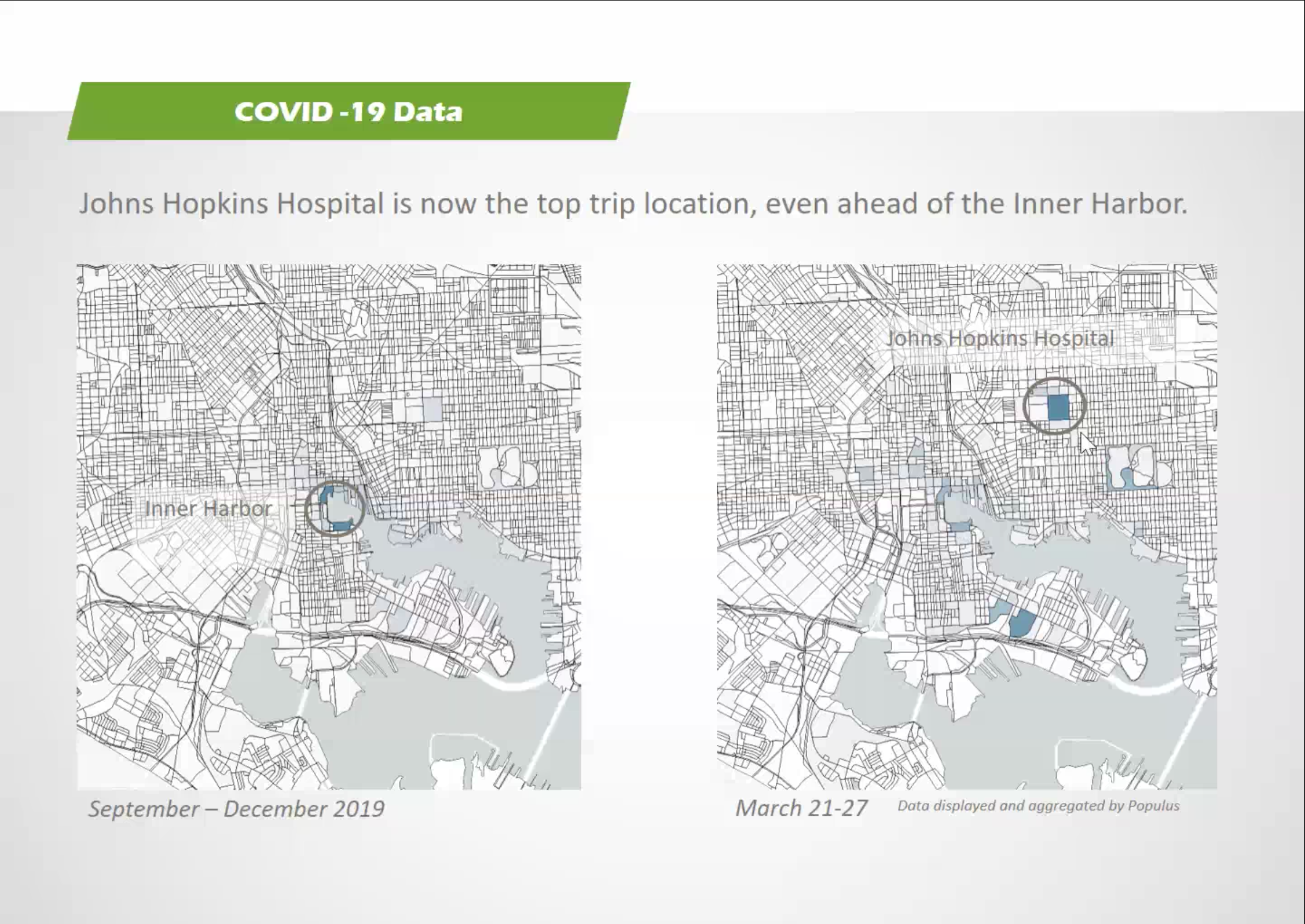
The image above shows Johns Hopkins Hospital replacing the Inner Harbor as the top origin and destination for scooter trips.

Image courtesy of BCDOT

Image courtesy of BCDOT

The top graph in the image above shows that when winter hit, fair weather riders dropped. But rides originating in the equity zones stayed steady or increased, demonstrating that riders in equity zones are using scooters as their primary commute option whereas others are often using them more as a choice.

The bottom graph in the image above shows that while choice ridership plummeted at the start of the COVID-19 response, ridership within the equity zones held firm or increased.

What are scooter companies doing to support essential workers?

While Lime has suspended their service in all markets, other companies are stepping up to support health care workers.

Jump and Spin have re-deployed scooters located in the usually popular downtown area to grocers, hospitals, and transit hubs.

Jump scooter rides are currently free for all employees of essential industries. Ask your HR rep for a Jump code to sign up with. And if they don’t already have the code, tell your HR rep in any essential business to fill out this form.

Spin is also providing free 30-minute rides to all health care professionals and hospital employees. You can find more details and sign up here.

Dockless Vehicle Update

Annual chart of dockless vehicle deployment and ridership

Annual chart of dockless vehicle deployment and ridership

When dockless scooters and bikes first came to Baltimore, as advocates we embraced them, working with the Baltimore City Department of Transportation and providers of dockless vehicles to develop a pilot program that was a resounding success

As Bikemore, we chose to embrace these vehicles on city streets because we felt Baltimore needed more transportation options in more places, anecdotally saw a diverse ridership utilizing the vehicles, and because we were hopeful that they could serve to replace car trips under one mile, which are very frequent in Baltimore City. The Pilot Program Evaluation Report showed that many of these things were true. Users self-reported replacing driving and rideshare trips with dockless vehicle trips without negatively affecting their use of transit or biking. Walking increased, as more people were choosing to walk and find a scooter than wait for a rideshare or hop in the car and drive.

Because of the success of the pilot, and wide support amongst all demographics surveyed, Baltimore City Council formally legislated a permanent Dockless Vehicle For Hire Permit Program, developed and administered by Baltimore City Department of Transportation. Bikemore worked closely with city council members and Department of Transportation staff to develop recommendations that were adopted into the rules, regulations, and permit program.

This month ends the first quarter of that permit program, and we’ve seen a steady increase of ridership throughout the summer, peaking with over 75,000 vehicle trips in the third week of September. It’s clear that the demand for more shared mobility options is strong in Baltimore City, and that our city must adapt to this demand by quickly building more protected infrastructure to ride in and dedicated parking areas to store dockless vehicles at popular origins and destinations. 

Baltimore City Department of Transportation is planning to release a report on the program through the first quarter in early November. We look forward to analyzing the program more at that time. For now, we’ve updated our shared mobility page with details on the dockless vehicle providers that have received permits, as well as details on the permit regulations. A summary is below:

Summary

Up to 4 shared mobility vendors are eligible for a year-long permit under the new permanent regulations, which went into effect on August 1, 2019. 

The current permit holders are: 

Jump

Lime

Spin

Bolt 

Below are some highlights from the rules and regulations. For a copy of the full rules and regulations and more information, please visit the Baltimore City Department of Transportation’s Dockless Vehicles page.

Fleet Size

Each permit holder is allowed to deploy up to 1,000 vehicles of a single vehicle type. If a permit holder chooses to deploy multiple vehicle types, they may deploy an additional 1,000 vehicles with a minimum of 150 of each vehicle type. Permit holders may also deploy an unlimited number of accessible vehicles, which are vehicles designed for people living with disability.

Fleet Distribution

Under equity guidance from the adopted rules and regulations, permit holders must distribute a minimum of 5% of their fleet into each of the nine city planning districts, and can deploy no more than 25% of their vehicles in any single district. If more than 35% of vehicles are ridden into a single district, the operator must rebalance those vehicles to the 25% threshold or lower.

Additionally, there are 20 defined one block equity zones in the permit. These equity zones are centered around public transportation hubs, libraries, business corridors, and other areas of likely high ridership that are outside of the central city. A minimum of 4 vehicles must be placed in each equity zone block by 8:00 each morning. These equity zones will eventually receive dedicated parking corrals for vehicle placement, installed by Baltimore City Department of Transportation.  

Payment

Permit holders are allowed to set their own pricing, but are not allowed to differentiate pricing between any user groups except for a defined low-income access plan. They must also notify Baltimore City Department of Transportation about any changes in pricing.

All permit holders are required to offer cash payment options, pay without a smartphone options, and a low-income access plan to any SNAP/WIC enrolled individuals. 

Data

Permit holders are required to share data with Baltimore City Department of Transportation via the Mobility Data Specification, and are also required to provide a publicly accessible General Bikeshare Feed Specification.

Revenue/Expenses

Each permit holder is required to pay a $70,000 permitting fee, a $10,000 performance bond, and a $0.10 excise tax per rental.

The annual permitting fee covers the cost of Baltimore City Department of Transportation shared mobility program staff, in addition to innovative public engagement and infrastructure:

  • A Resident Mobility Advisory Board will be established, similar to the successful Food Policy Advisory Committee. Resident Mobility Advisors will be appointed from communities across the city, and will receive a paid stipend to meet six times a year to discuss mobility challenges in and solutions for their communities. ($6,000)

  • 20 shared mobility corrals will be installed annually based on an evaluation of ridership and equity priorities. These corrals will be installed either on the street or sidewalk, and provide designated parking areas for shared mobility vehicles as well as private bikes or scooters. ($20,000)

  • Existing mobility lanes will be evaluated and improved through resurfacing and patching to provide safer travel surfaces for shared mobility vehicles. ($100,000)

  • Baltimore City Department of Transportation will produce community education materials ($19,000) as well as provide five $2,000 community micro-grants for education and outreach ($10,000)

The refundable performance bond covers anticipated city expenses, including the BPD Special Marine Unit for harbor retrievals, Baltimore City Department of Transportation towing services for improperly parked or damaged/abandoned vehicles, and damage to public property. Any funds not expended on these city services will be refunded to the companies at the end of the permit.

The excise tax of $0.10 per ride goes into the general fund. The Pugh administration committed to restricting these revenues to funding bike infrastructure installation in Baltimore City, however it is unclear if this restriction will be honored given we have a new government.

Dockless Vehicle Update

IMG_20181023_142140.jpg

Baltimore’s Shared Mobility Coordinator Meg Young talking about the scooter program:

Last Spring, scooters launched in Baltimore. The city quickly adopted a pilot program, originally intended to last six months, to explore and evaluate dockless shared mobility vehicles on Baltimore Streets. The initial pilot program rules and regulations were based on a white paper provided to the Pugh Administration by Bikemore.

As of February 28, 2019, the original proposed end date of the pilot program, dockless scooters and bikes had seen almost 756,000 rides by over 190,000 riders. At that time, Baltimore City officials decided based on a detailed survey showing strong support for continuation of a dockless mobility program to extend the pilot while formal rules and regulations were drafted and adopted for a permanent program.

This came in three parts. First, Baltimore City Council drafted authorizing legislation formally legalizing the use and regulation of scooters, e-bikes, and other shared mobility devices in Baltimore City. Second, Baltimore City Department of Transportation drafted rules and regulations based on the City Council’s authorizing legislation. Third, a weighted permit application was produced for vendors to apply for license to operate under the new permanent Dockless Vehicle for Hire Program.

The permit application was released this week. Companies have until July 24th to submit applications to be one of four vendors selected to operate in Baltimore City. Recipients will be announced July 29th, and the new permits will run from August 1, 2019 to July 31, 2020.

Rules and Regulations

We believe the adopted rules and regulations to be some of the best in the country, and can be revisited annually to adopt best practices learned in other cities. The majority of Bikemore’s comments on the rules and regulations were adopted.

Here are some highlights from the rules and regulations (the full rules and regulations can be found on the Baltimore City Department of Transportation website):

  • Providers operating one vehicle type may operate up to 1,000 vehicles, and must operate a minimum of 150 vehicles.

  • Providers operating multiple vehicle types may operate up to 2,000 vehicles, and must operate a minimum of 150 of each vehicle type.

  • Adaptive vehicles (for use by those living with disabilities) are not counted toward vehicle maximums.

  • Providers my operate vehicles 24/7 if they can demonstrate a maintenance and safety plan that ensures vehicles are regularly serviced and safe.

  • Ride purchase must be made possible with cash and without use of a smart phone.

  • Vehicles must be located in every city planning district, vehicle density is regulated, and additional equity priority areas are defined for placement.

Permit Application

The permit application allows up to four vendors to be selected. Eight sections of the permit application are scored to rank applicants based on vehicle information, maintenance, operations, education/engagement, hiring, data, sustainability, and company history.

Scored sections on the permit application

Scored sections on the permit application

Each vendor will be required to pay a $70,000 permitting fee, a $10,000 performance bond, and a $0.10 excise tax per rental.

The annual permitting fee covers the cost of Baltimore City Department of Transportation shared mobility program staff, in addition to innovative public engagement and infrastructure:

  • A Resident Mobility Advisory Board will be established, similar to the successful Food Policy Advisory Committee. Resident Mobility Advisors will be appointed from communities across the city, and will receive a paid stipend to meet six times a year to discuss mobility challenges in and solutions for their communities. ($6,000)

  • 20 shared mobility corrals will be installed annually based on an evaluation of ridership and equity priorities. These corrals will be installed either on the street or sidewalk, and provide designated parking areas for shared mobility vehicles as well as private bikes or scooters. ($20,000)

  • Existing mobility lanes will be evaluated and improved through resurfacing and patching to provide safer travel surfaces for shared mobility vehicles. ($100,000)

  • Baltimore City Department of Transportation will produce community education materials ($19,000) as well as provide five $2,000 community micro-grants for education and outreach ($10,000)

The refundable performance bond covers anticipated city expenses, including the BPD Special Marine Unit for harbor retrievals, Baltimore City Department of Transportation towing services for improperly parked or damaged/abandoned vehicles, and damage to public property. Any funds not expended on these city services will be refunded to the companies at the end of the permit.

The excise tax of $0.10 per ride goes into the general fund. The Pugh administration committed to restricting these revenues to funding bike infrastructure installation in Baltimore City, however it is unclear if this restriction will be honored given we have a new government.
What’s Next

We look forward to Baltimore City Department of Transportation receiving applications from multiple vendors. We understand that all currently operating vendors plan on reapplying, and several other companies not yet operating in Baltimore have expressed interest.

Baltimore City has been on the forefront of shared mobility regulation and ridership success. We believe the establishment of formal rules and regulation and a competitive application will continue this trend, and hopefully bring more vehicles and vehicle types to more Baltimoreans while increasing our city’s capacity to successfully manage the program, reducing instances of vehicle damage, blocked right-of-way, and the other challenges associated with introducing new modes of transportation in Baltimore City.

Ultimately, the best thing Baltimore City can do to make shared mobility safer and more accessible to everyone is build more protected infrastructure.