
Bike Lanes

Maryland Avenue Cycle Track and Downtown Bicycle Network Project Update

In a meeting with Baltimore City Department of Transportation last week, Bikemore received an update on the 2.6 mile Maryland Ave Cycle Track. Current construction timelines estimate the project to begin construction in the Spring of 2016.

Here are some important milestones for the project we are watching to ensure the project does not experience any further delays.

  • Toole Design is currently putting together the PSE (plans, specifics, and estimates).

  • Baltimore Department of Transportation will advertise the project by 9/9.

  • Timeline for advertising is four weeks.

  • This means it will be mid November when the contract is awarded.

  • Given construction schedules it is unlikely whichever company is awarded the contract will begin construction before winter.

  • This means a Spring 2016 construction start.

  • The project is estimated to take 90 days for construction.

Included in the contract is the work to implement the Downtown Bicycle Network. This will include conventional bike lanes on Preston and Biddle and protected cycle tracks on Centre, Monument and Madison.

Additionally Bikemore has been communicating with Baltimore City DOT our recommendations for creating better connection to the Maryland Ave cycle track. BCDOT is already at work to improve signaling at Maryland and 29th st, and listening to input to improve safety and wayfinding from all routes feeding into the cycle track.

And while we are all frustrated with the delays, BCDOT deserves credit for ensuring that the plans didn’t languish in State Highway Administration final review. This is a priority of ours and theirs, and we appreciate them doing all they can within a less than perfect system to get the cycle track installed.

Despite perceptions, construction of the Roland Ave cycle track did not contribute to the delay.

Our hope is that as more of these projects get underway, the more comfortable State Highway Administration gets in quickly approving plans and empowering BCDOT to build the connected bicycle network we deserve.

Charles Street Reconstruction Community Meeting

Bikemore has been working with the Baltimore City Department of Transportation to improve the design of Charles Street from 29th Street to University Parkway.

The old striping plan removed parking for several lanes of rush hour traffic and included a floating bike lane.

The improved plan provides one lane of vehicular travel, a buffered bike lane, and a lane of full-time parking. This will further calm traffic in a corridor used by many who walk, and will provide a safe bicycle facility as recommended by the recently adopted Bike Master Plan and Homewood Community Partners Initiative.

We anticipate some opposition from individuals who prioritize vehicular travel speeds over the safety of all road users, so please come out to the Community Meeting and support this safer plan for Charles Street.

Facebook Event Link


Baltimore City Planning Commission Adopts Bicycle Master Plan

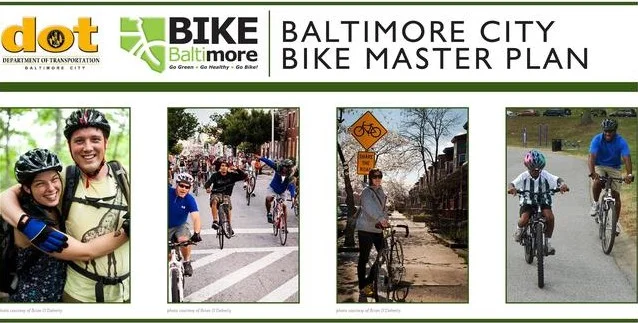
Today the Baltimore City Planning Commission adopted Baltimore City's Bicycle Master Plan. This document is a long overdue update to our city's original bike master plan, and Bikemore was pleased to support its adoption through testimony alongside Bike Maryland at today's hearing. 

We thank the Baltimore City Department of Transportation for adopting many of Bikemore's suggested changes to this plan and for providing answers to every public comment submitted on the plan. 

The next step is turning this plan into paint on the ground, and that will take advocacy from Bikemore and support from our members and allies. 

The full press release from the Baltimore City Department of Transportation is below: 

City of Baltimore’s Bike Master Plan Officially Adopted

New Bike Master Plan will expand City efforts to create a more bike-friendly Baltimore

The Baltimore City Department of Transportation Director William M. Johnson is pleased to announce that the City of Baltimore’s Bike Master Plan was officially adopted today by the Planning Commission. The Planning Commission voted to adopt the new Master Plan which will expand the city’s network of biking facilities and create a more bicycle-friendly environment in Baltimore.

“The 2015 Bicycle Master Plan seeks to uphold the vision of complete streets in Baltimore City which will enable more people to use biking as a viable form of transportation,” said Director Johnson. “Today’s adoption of the updated Master Plan provides the groundwork for the City to expand and enhance its biking infrastructure.”

Since the adoption of the City’s first Bike Master Plan in 2006, Baltimore has made significant progress in becoming bicycle friendly. Over 125 miles of bike facilities have been installed to provide city communities with a comprehensive network of bike lanes and trails. DOT has also installed over 600 bike racks in neighborhoods throughout Baltimore for safe and convenient bicycle parking.

Nearly ten years after the implementation of the original plan, we continue to develop additional improvements for the biking community.   The new Master Plan seeks to add over 100 miles of biking facilities over the next 15 years and commits to implementing 15 cycle projects within the next two years. This includes the installation of cycle tracks on Maryland Avenue/Cathedral Street, Madison Street and Center Street; improved bus/bike lanes on Lombard and Pratt Streets; and the addition of over six miles of bike boulevards in West Baltimore neighborhoods.

The Department of Transportation thanks the Planning Commission for adopting the updated Bike Master Plan, as we continue to invest in city communities to provide a multi-modal transportation system.

###

Recommended Improvement to Bike Master Plan

The proposed bicycle master plan update includes many ambitious and excellent proposals for improving safety and comfort for bicyclists in Baltimore, whether they ride for recreation or transportation. The proposed bicycle facility network, once fully constructed, would allow many thousands of Baltimore residents and visitors to be able to use bicycle-specific infrastructure to access their jobs, schools, grocery stores, favorite restaurants, and social activities by bicycle. The health, quality of life, and local economic benefits of a high quality bicycle transportation network are well documented, and the City should be commended for its plans to implement these measures.

However, recent events in our City underscore the fact that it is not simply the presence of a bicycle facility, but also the type of bicycle facility that really increase the safety and comfort of bicyclists. 

The Master Plan Update includes the possibility of standard bicycle lanes on "main routes," which are often identified to be located on arterial roadways, and shared lane markings, or sharrows for "minor routes." There may be some streets where these treatments are appropriate, but facility selection must be strategic and sensitive to the operating conditions of the street, in order to maximize the safety and comfort of all users.    

Bikemore's proposal is that facilities with some physical separation be the default preferred facility for streets with 85th percentile speeds above 25 miles per hour. This is the suggested threshold because it is an approximation of the speed beyond which crashes between automobiles and bicyclists or pedestrians become dramatically more likely to result in death or grievous injury. We propose using measured 85th percentile speeds as opposed to the speed on the speed limit sign because of the frequency with which drivers exceed the speed limit. 

Furthermore, sharrows are only an appropriate choice for local streets, and in conjunction with traffic calming and "bicycle boulevard" measures that keep 85th percentile speeds below 25 mph, or, ideally, closer to 20 mph. It may also be appropriate to use sharrows to connect short gaps between higher quality facilities. This position is consistent with NACTO Bikeway Design Guidelines and emerging research about the safety and functionality of different bicycle facility types. 

These recommendations will result in the selection of safer, more comfortable facilities, while also allowing for creative solutions in locations where space may be too constrained for a separated bicycle facility. 

For example: if the 85th percentile speed on a street is above 25 mph even though the signed speed is not, and a separated bicycle facility cannot be accommodated, we would find it an acceptable solution to install the standard lane or a paint-buffered lane in conjunction with bicycle friendly traffic calming measures. In severely space constrained locations, standard painted bike lanes may be acceptable in the absence of traffic calming measures for small lengths of narrower cross section on a street, if other factors such as adjacent parking, driveway conflicts, and door zones are taken into account. Where these compromises must be made, we recommend that Bikemore or other credible bicycle advocacy entities be consulted to help collaboratively develop the safest and most comfortable bicycle facility that is feasible in the space available.  

Join Us for the Bike Master Plan Final Review

The Baltimore City Department of Transportation is updating the bicycle master plan, and will be holding a final public review of the document before adoption.

The Open House will take place at the Enoch Pratt Free Library Central Branch on Wednesday, January 28th from 5:30 to 7:00pm in the Auditorium. 

Please let Bikemore know if you're coming via our Facebook Event.  Full details are below: