ACTION ALERT: Monument Street

Tell Mayor Young to halt deconstruction of a half block of newly installed protected bike lane on Monument Street:

Background

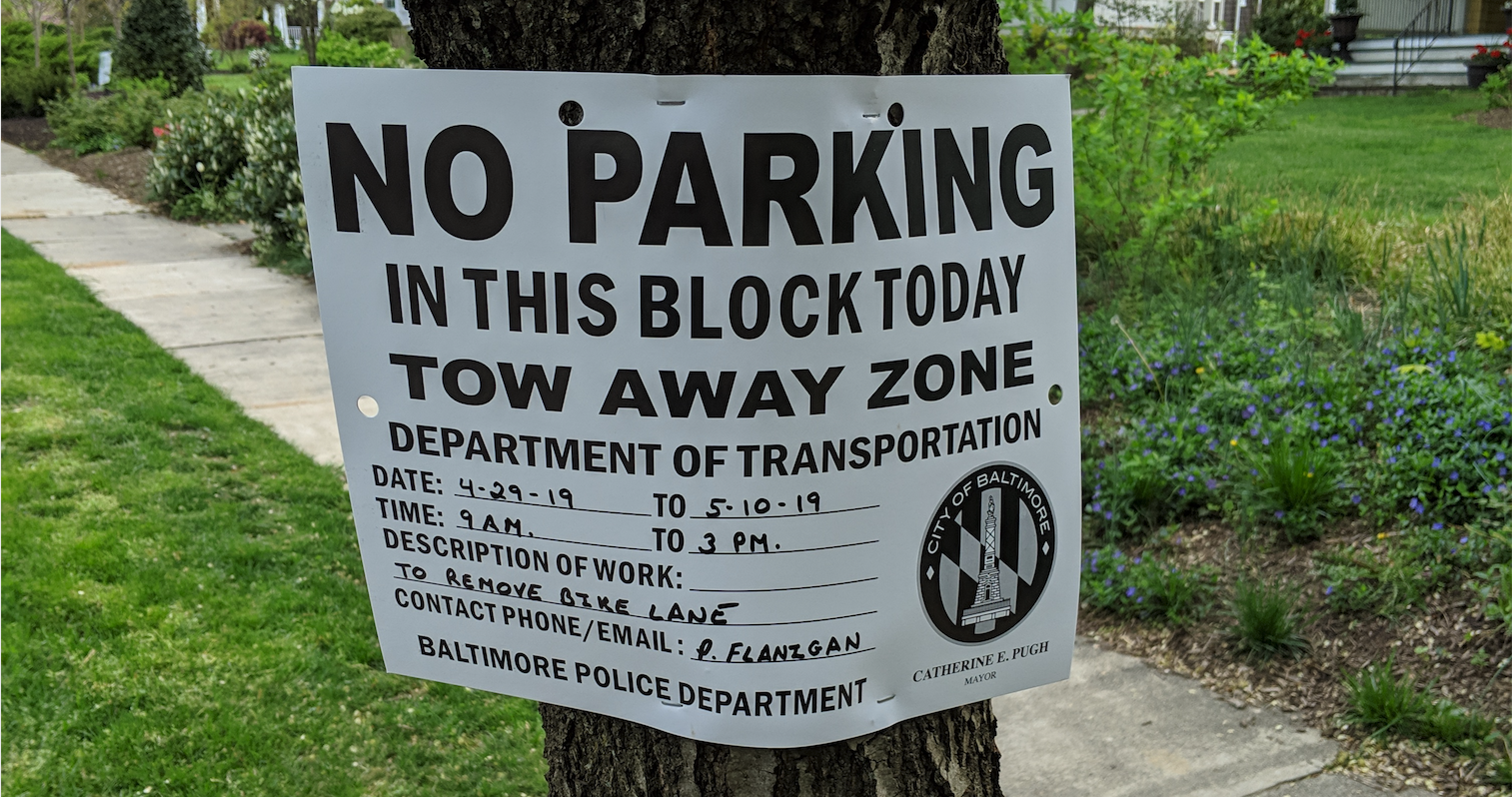
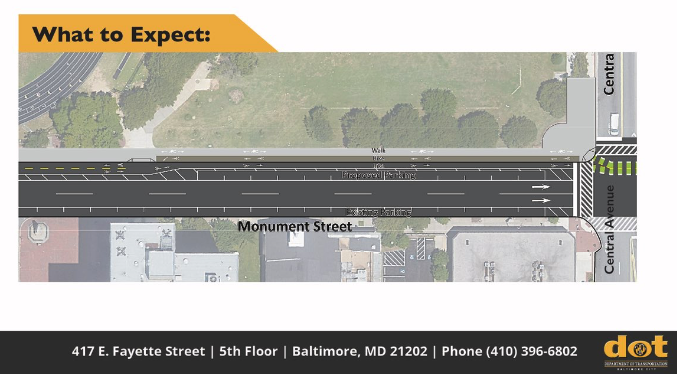
Today the City plans to move forward with the removal and modification of a half block of the Monument Street two-way protected bike lane. Between Aisquith and Central Avenue, DOT will remove the portion of the bike lane dedicated for westbound bike traffic and force riders onto the sidewalk located on the north side, adjacent to Dunbar High School’s fields. This $50,000 change is occurring to restore 12 parking spots on the north side of Monument Street.

Bikemore strongly opposes this removal. For the past six months, when it became clear that the City was moving forward with this change, we repeatedly asked for the designs so we could give feedback. These designs were never made available to either Bikemore or the Mayor’s Bicycle Advisory Commission despite the multiple requests. No public meetings were held about this change. We first learned of the design and removal timeline on the same day everyone else did: May 15th. Thirteen days ago, one day short of the required 14 days notice.

This is unacceptable, and puts advocates in a position that forces us to be reactive versus collaborative. It is an act of bad faith, and if we are to move forward as a City that values streets designed for people over cars, we need the Department of Transportation to do better.

This change on Monument Street is problematic for a variety of reasons. But the main ones are that it violates the recently adopted Complete Streets law and further prohibits the City’s ability to be awarded state and federal transportation dollars.

The Complete Street law requires the City:

    1. Comply with State and Federal funding requirements. Alteration and removal of portions of Monument Street go against the state funded and approved design. Maryland Department of Transportation has said enough is enough, and will not continue to provide grants for complete streets infrastructure in Baltimore as long as we continue to remove or alter those facilities for political reasons.

    2. Promote walking, biking, and transit to the greatest extent possible. By forcing bike traffic onto the sidewalk it makes walking and biking on that section of street less safe. It creates conflict between people walking and people biking, and places people biking in a position that makes them less predictable to people driving cars.

    3. Ensure equity by actively pursuing the elimination of health, economic, and access disparities. We know that 33% of the city lacks access to a car, and according to census data over 75% of households lack access to a car along the Monument Street corridor where changes are proposed. Removing infrastructure proven to reduce access disparity and improve health outcomes to install parking is deeply inequitable.

Future State and Federal funding is on the line:

The majority of funding that improves walking, biking, and transit in the City comes from State and Federal money. Given the City’s current budget priorities it is unlikely, at least in the short term, that this situation will change. When the City destroys projects constructed with State funds, it is no wonder the State is now looking to other Maryland communities to support over Baltimore. This money doesn’t only fund bike lanes, it can be used to fund recreation trails, bike parking, traffic calming, and a variety of other infrastructure that improves the safety and quality of life of Baltimore City residents.

By deciding to remove this section of Monument Street, the Mayor is sending a message to residents that short term responses to a handful of people complaining about parking is more important than long term investment in transportation for the entire city.

If they care about improved community outreach, if they care about equitable investment in recreation and transportation across all neighborhoods, they will pause the planned deconstruction and respond to our concerns.

There are solutions available to the parking concerns that don’t cost $50K and threaten future state and federal transportation funding. It is a Mayor’s job to consider the entire city and make decisions that are strategic, not reactive. The decision to remove this portion of the bike lane to restore parking is short sighted. It doesn’t matter who put these decisions in motion or that they began prior to Mayor Young taking office. This is ultimately his decision. We believe there is a way for him to bring folks together on this issue. It starts with asking the Department of Transportation to stop the removal today.
Take Action!

DOT Instructed to Remove Portion of Monument Street Protected Lane

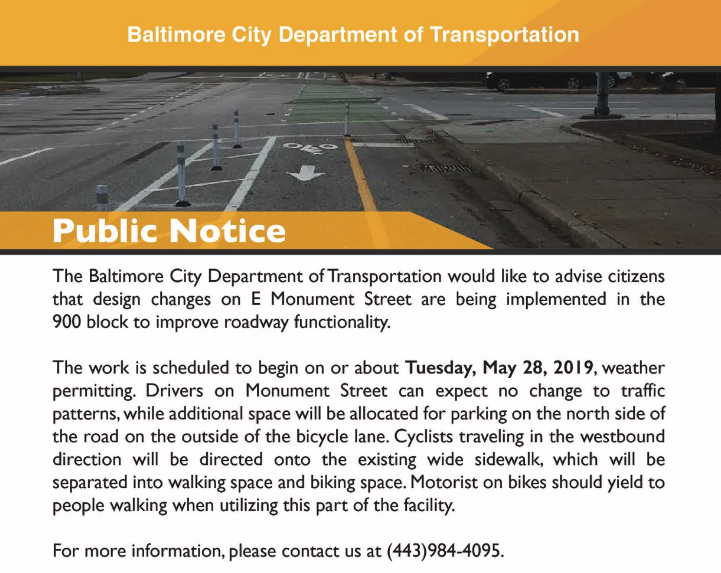
Beginning May 28th, Baltimore City Department of Transportation will remove portions of the newly installed two-way protected bike lane on Monument Street between Aisquith Street and Central Avenue to restore 13 parking spaces.

People riding bikes eastbound will continue to use a one-way separated bike lane in the street. People riding bikes westbound will be directed to use the adjacent sidewalk, which will be marked with both bike and pedestrian symbols.

Since email is down, you can contact the Mayor’s office to express your frustration with their continued removal of safe, all-ages bike infrastructure by calling 410-396-4900.

This change is occurring because of parking complaints from some people that work on that block. Baltimore City Department of Transportation proposed several parking alternatives, including a recently implemented road diet that allowed Sunday parking in the travel lane next to the bike lane and free off-street parking for churchgoers in a city-owned adjacent surface parking lot. These alternatives were rejected.

We have been asking to meet with the city to provide input on how this facility can work for everyone that uses that street. We’ve brought it up and offered assistance at every Mayor’s Bicycle Advisory Commission meeting over the past year. But today we were notified of this unacceptable “solution” at the same time as everyone else.

So where do we go from here? In addition to making the bike lanes on Roland Avenue and now Monument street less safe, the city’s actions are pitting residents who want to ride a bike safely against everyone. It’s irresponsible.

We were clear when we worked to pass the Complete Streets ordinance that three major things have to change: we must stop designing streets that put anyone not driving a car at risk, we must make investments in road safety in the neighborhoods that are consistently underserved, and we must reimagine the community input process so that it is equitable, inclusive, and educational. The community input process should bring people together, not create these impossible divides. The city does not need to wait a year to change course. They could start making this better for everyone today.

We are angry. These past few weeks have taken a toll on everyone trying to get stuff done in the city--bike lanes included. And right now we are weighing our options, but we know we cannot continue to play into this fallacy city leadership has created. Making a street safer is not a fight. It’s an imperative.

Last week many of our supporters gathered to learn about our new strategic plan. We drank some beers, celebrated our wins, and talked about the future. We shared this quote:

“You lose a lot, but you have to play to win. But it’s fine, because you put friction in the system, you give people power over what’s happening in their neighborhoods and hopefully you eventually win.” - Paula Segal, attorney, Urban Justice Center

This is hard work. But it’s the right thing to do. And it may not be tomorrow, but eventually we will win.

Bikemore Statement on the Resignation of DOT Director Pourciau

Today we learned that Director Pourciau has resigned. We want to wish her well on her next endeavor. When Bikemore served on Mayor Pugh’s transition team for transportation we were hopeful. Janette Sadik-Kahn came and spoke, and the mayor sat in the first row taking notes. She accepted the transition team’s recommendation for the passage of a robust complete streets bill that would place Baltimore ahead of most major cities. But at every turn, from Potomac Street to Roland Avenue, the actions taken by Mayor Pugh and Director Pourciau were at odds with the ethos of progressive transportation both claimed to embody.

The amount of leadership change in the Department of Transportation over the past five years is troubling. This lack of leadership has cost the City millions in lost grant dollars, resulted in poorly managed projects, led to the attrition of talented staff, and has sewn deep distrust in communities. When communities don’t trust DOT to do its job, it blocks all progress toward building a city connected with high quality transportation choices.

The next leader of DOT needs to be someone ready to empower the talented and trained city employees. They need to steward resources in order to maximize every transportation dollar. They need to create a vision that promotes the safety of all road users, and improves access to opportunity--especially for our most vulnerable residents. This vision must be explicit enough so that when community contention arises, the path forward is clear--streets should be designed for the safety of people over the movement of cars.

Baltimore cannot afford two more years of backsliding. Under this administration’s leadership Baltimore regularly grabbed headlines for decisions wholly out of step with best practices in the transportation industry. In that time smaller cities bypassed us in investments in biking, walking, and transit infrastructure. Baltimore cannot afford any more injuries or deaths due to unsafe street design. Baltimore cannot afford to return anymore State and Federal transportation dollars. Baltimore cannot afford to lose residents because they cannot get to work.

And lastly, any executive decision made over the past two years that went against best practices in design and engineering should be reexamined and rolled back. Baltimore deserves better. And in the wake of Director Pourciau’s departure and the imminent resignation of Mayor Pugh, vulnerable road users shouldn’t have to continue to pay the price.

Update on Roland Avenue

Screen Shot 2019-04-24 at 5.08.36 PM.png

Baltimore City Department of Transportation has decided to move forward on a directive from an absentee mayor to tear out the Roland Avenue protected bike lane and revert it back to the original design. In the Mayor’s Bicycle Advisory Commission meeting today, we learned that this phase of removal will cost at least $140,000.00. Mayor Pugh’s directive also included the placement of green paint on an indefinite timeline that will extend down University Parkway, adding significantly to projected costs.

At today’s meeting, we publicly confirmed with Department of Transportation staff that traffic volumes and speeds on Roland Avenue require a separated facility based on DOT’s own adopted guidance and national best practice documents codified into city law under the Baltimore Complete Streets ordinance.

For four years, we have shown up to meetings. We helped organize neighbors who believe that people of all ages and abilities should be able to bike on that stretch of road. We have received verbal threats. It has put Bikemore in an impossible position of going head to head with some of the most influential residents in the city. It has misdirected City resources. It created a contentious divide among neighbors. This project has caused unnecessary harm.

It is a failure of leadership when something as relatively insignificant as paint on a street receives this amount of resources and exposure. There are challenges facing this city that eclipse the needs on this one mile stretch of road, and it is our opinion that it is time to move on. Everyone has had their say. The next step should be to implement change that creates the safest, most fiscally responsible option. Removing the bike lane is not that.

We take our responsibility to push for streets that are proven to increase safety seriously, and and we will continue to do so. And the people that bike in this city, including the people who bike on Roland Avenue, are committed to lifting up the causes and leaders who address the multitude of problems facing our city. Streets built for people who bike, walk, and take transit are part of that effort.

The love we have for Baltimore is fierce. How can it not be? We see the city up close every single day. We are your kids’ teachers, we are your doctors, we are the political organizers fighting for affordable housing, we are in City Hall, we are your pastors, we are kids popping wheelies, we are the racers doing laps around Lake Montebello — all adding to the things that make Baltimore unique and beautiful. We are among those building a city where people want to live. The way a handful of people, who in many other instances have proven to be incredibly altruistic, have other-ized their neighbors and people who bike is inexcusable.

We want to apologize on behalf of everyone that is part of this contentious situation. Bikemore is for everyone, and safe streets should be too.

And finally we want to apologize to Rachel and everyone that knew and loved Tom Palermo. This project, as small as it was, had the potential to demonstrate the City’s commitment to preventing a tragedy like that from happening again. It had the potential to build a safe place to do the thing Tom loved most—riding bikes.

We know there are some of you wondering if we are going to sue to halt the removal of the bike lane. It is certainly an arrow in our quiver and one we have demonstrated we are not afraid to use. It is also unsustainable, and is the express reason we championed the Complete Streets Bill. This is a bill the Mayor signed into law, the same Mayor who has given this directive. And this directive is being carried out by the same agency that stood beside us celebrating the law’s passage. What other laws has Mayor Pugh signed with no intention to follow?

It is a challenging time for the City, making it especially important to do the right thing. We ask that the City evaluate the costs of the redesign, the risk of making this arbitrary decision, and the clear compromise to safety this directive will cause, and immediately stop work. To do otherwise would continue to put us on this path of confusion, contention and wastefulness.

The City must take seriously its responsibility as outlined in the Complete Streets ordinance, including the stated directive to promote biking to “the greatest extent possible.” And we will continue to fight until they do.

Statement on Mayor Pugh's Decision to Remove Protected Bike Lanes on Roland Avenue

IMG_20180412_171125.jpg

Today, Mayor Pugh announced the cancellation of the Roland Avenue lane elimination pilot. Instead, Baltimore City Department of Transportation will remove the all-ages protected bike lane on Roland Avenue, return parking to the curbside, and install a standard green painted bicycle lane next to two automobile travel lanes.

We are disappointed that voices behind closed doors were able to influence this decision, despite a PIA request from a Roland Park neighbor showing 62% support for the road diet plan.

We still believe the pilot project should move forward. Why wouldn’t we test a design that could possibly make the street safer for everyone, before committing to spending between $700,000 and $1.4 million to restore a design proven to be unsafe, a design that couldn’t prevent the death of Tom Palermo just a few blocks north?

The meeting to discuss the pilot was supposed to happen Monday night. Since our blog post yesterday, over 100 people have written to Council Vice President Middleton supporting the pilot project, saying that no matter what, separated bike lanes have to remain on Roland Avenue. We have also heard from dozens of Roland Park residents directly who feel the same way, residents excited about the pilot, residents who purchased homes in Roland Park because of the protected lanes, residents scared of what may happen next.

We haven’t determined our next steps. But our position is this:

Baltimore City Department of Transportation must maintain an all-ages, protected bike lane on Roland Avenue, as called for in the Separated Lane Network Plan, and as required by national separated bike lane guidance adopted in ordinance and in policy by the City of Baltimore.