
There are so many stories in Baltimore, and we’re happy to share with you our fourth following our series for Giving Tuesday. Please consider making an end-of-year donation. Your support is critical to funding our operations and paying our staff.
TW: Some content in this story may be difficult for some to read (talks of traffic violence, car crashes, vehicular manslaughter)
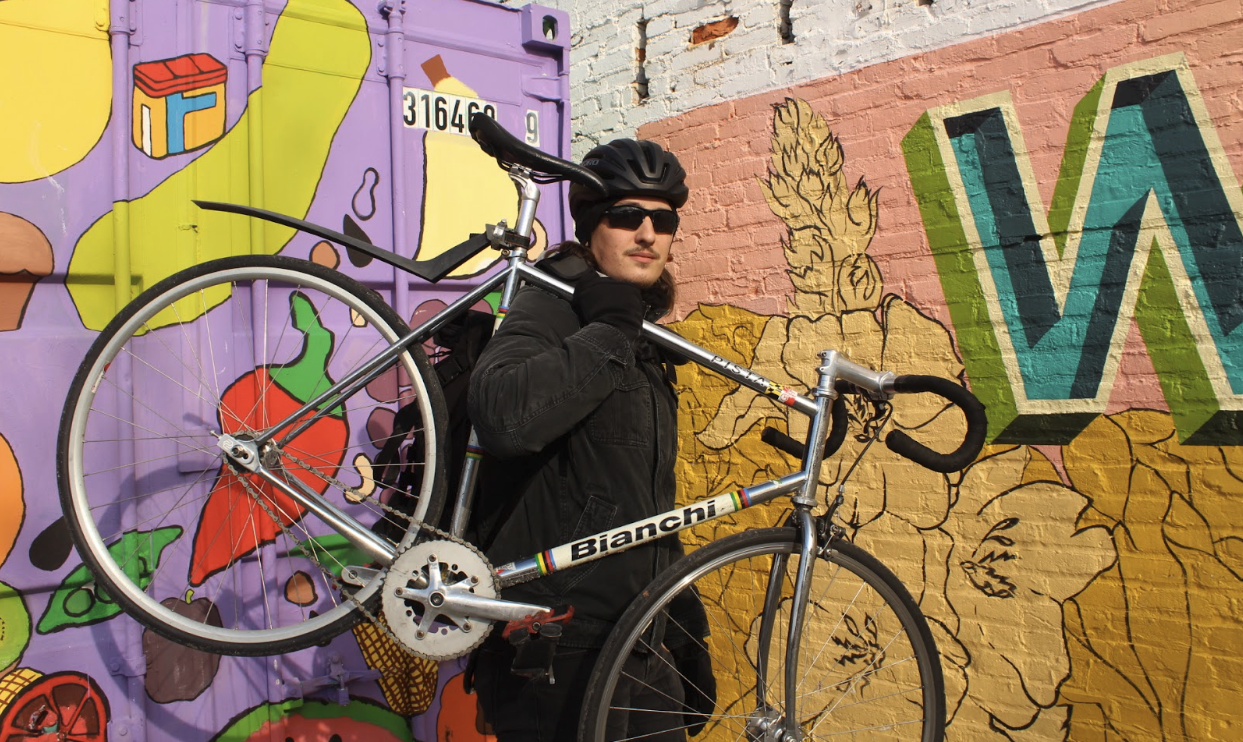
Mike Thomas, 35, is a bike messenger and artist here in Baltimore City. When folks hear of a bike messenger, they may think of the NOS-fueled fixed gears riding through a cityscape collecting packages for delivery, an e-bike savant pushing the throttle with a hefty bag of food on their back, or a cyclist who’s simply trying to make a few bucks to get by.
Thomas puts it simply.
“It’s like the arcade game Crazy Taxi.”
While others ride their bicycle as a form of commute, exercise, or enjoyment, Thomas rides his bike for work. His steel Bianchi Pista is an extension of himself, a form of living, of work, of existence. Without a bike, Thomas would literally be unable to work. He could go back to his job as a server or bartender, but to Thomas that isn’t a method of happiness.
“Cutting off modes of transportation is not going to help people get out of economic strain.”
Thomas can’t afford a car, not that he should desire to. A city should present reliable, feasible alternative modes of transportation that are safe and accessible for all folks. Presenting one single, expensive, decaying option, such as a car, is ethically and emotionally fatal to some. Giving cars priority in the city is fatal to all.
“Out of towners can be pretty apathetic to [Baltimore]. I’ve also seen people who live in the city have that same type of disdain [towards pedestrians and cyclists].
”
There is a morbid normalization in this city, it seems, of a manslaughter by car being as easy as breathing air.
Wayne Richardson was killed by a driver in 2019 on his way to feed his disabled son. Avery Cheley was killed by a driver running a red light. Those drivers were never found, and families lost fathers. Edgar Draper was killed in 2022 by a driver while on his way to surprise his partner Gloria with a gift from his trip to the retail store. Instead, she saw a far darker, more permanent horror. And David Herman, a beloved artist and vibrant life in Baltimore, was killed by a driver on a street that has been promised protected bike infrastructure for too long with little recompense.
One’s first question may be, “Was it the cyclist’s fault?” We are taught to create a perfect victim, one that must adhere to every standard and every law without a single degree of fault to ascribe such a title of “victim” to finally persecute the one committing the murder: the driver of a car. Their appeal is followed after their life is lost, never before, never to prohibit another from happening again.
“I’ve grown numb to car [crashes] because I see one or two a week.”
For the sake of transparency, no, these cyclists were not at fault for being killed by giant automations capable of mowing down groups of people. There are many more, still, in Baltimore, unnamed, forgotten, their deaths statistics, numbers, echoes of a life once lived. The aforementioned were simply, in a way, perfect.
“No car [crash] death is justified.
”
Thomas is another soul moving through the city on two wheels. He pushes his own pedals, spins downhill on his fixed gear, and he loves it. You shouldn’t have to fear moving. You shouldn’t be forced to stay still. We are heated beings full of hot energy, each atom and joule within our carbon-based bodies itching to dance, ride, sing, scream, laugh.
There is a growing case of apathy towards those we are being forced to forget. Remember their names, both living and lost, and remind yourself who permits such deaths.
On January 15, 2026, Bikemore will be calling for submissions for a limited literary magazine named Thanatapathy our family biking coordinator Cora Karim’s Chesapeake Conservation and Climate Corps capstone project for the year. Thomas himself is involved in the project, having worked on the art presented on the site.
“In a world that’s getting more commodified and corporatized, some people aren’t getting heard. It could be bikes, it could be something else…It’s good for people to have an outlet…to voice their concerns and express themselves [whether it be for] cycling or alternate forms of transportation.
”
Save the date, ride your bike, wear a helmet, make real, human connections, and remember, everyone…cars kill.
Consider donating today for more impact stories. Bikemore actively works to advocate for a better city, a city that isn’t covered in the smog of an exhaust pipe or the rolling coal of a compensating truck driver. Our work at Bikemore isn’t just about pushing policies that ensure the safety of people walking, biking, and rolling: we ultimately want a city that’s connected and fluid for all residents, regardless of your mode of transport.