Advocacy

The Boston Street Study is Out, and It is Bad

Screen Shot 2017-08-22 at 11.53.25 AM.png

Baltimore City Department of Transportation’s latest one-off planning study focuses on Boston Street, attempting to consolidate planning over the past decade and make recommendations for “multimodal transportation” improvements. It is disastrous.

The report highlights that the majority of travel through the corridor is single occupancy vehicles, and the biggest barriers to shifting modes away from single occupancy vehicles are a lack of high frequency, reliable transit, and a lack of low-stress bicycle facilities in the corridor.

Given these barriers, it would make sense for the Boston Street Multimodal Corridor Study to focus on biking, walking, and transit improvements to Boston Street. This would be consistent with city planning documents going back almost a decade.

Planning History

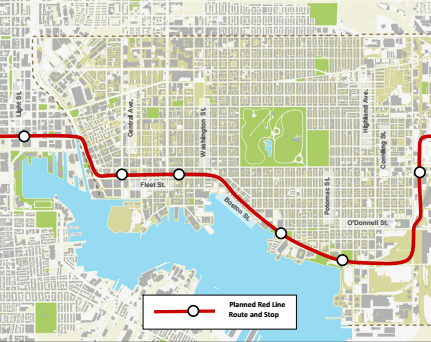
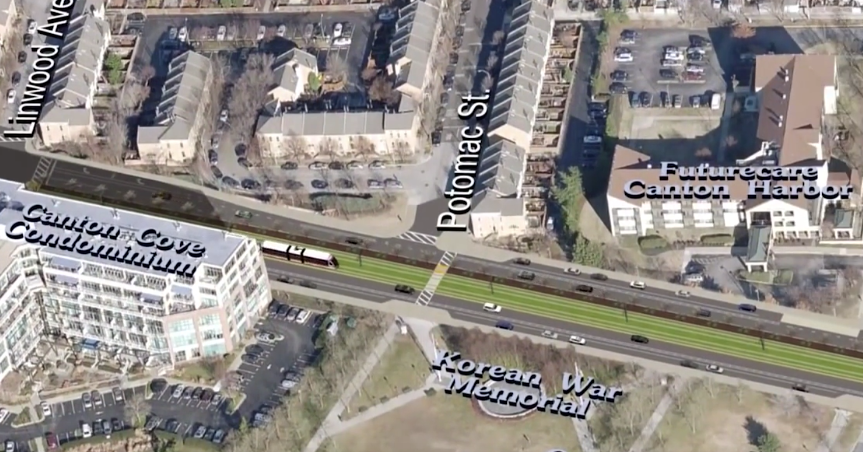
The most significant planning along the Boston Street corridor was for the Baltimore Red Line, which would have provided a significant public transit improvement connecting Baltimore West to East, and would have run along the Boston Street Corridor. The plan for the Red Line contained buffered bike lanes on Boston Street that transitioned to “bike priority” lane markings at station areas where additional street width was needed.
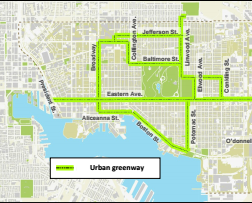
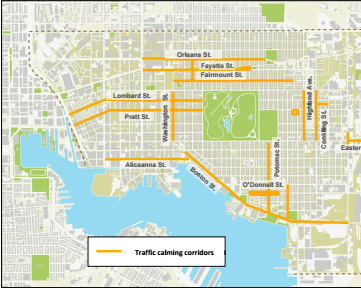
The 2012 Southeast Complete Streets Master Plan called for installation of bicycle facilities and sidewalk widening on Boston Street to support “heavy pedestrian traffic for active commercial districts.” It called for treating Boston Street as a “traffic calming corridor” and installation of urban greening to create a greenway, all to complement the coming Red Line.
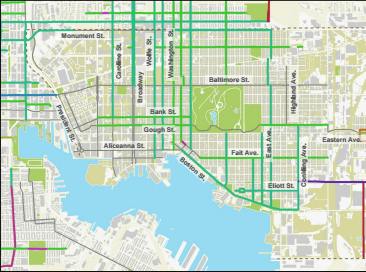
The 2015 Bike Master Plan follows the lead of these prior documents, retaining Boston Street as a “Main Route” for biking, which calls for “bike lanes, buffered bike lanes, cycle tracks.”

2015 Bike Master Plan planned bike facilities on Boston Street

2015 Bike Master Plan planned bike facilities on Boston Street

The 2015 Southeast Transportation Vision produced before cancellation of the Red Line proposes a bike lane on Boston Street. The 2016 update, produced after the Red Line cancellation, maintains this recommendation.

Southeast Strategic Transportation Vision planned bike facilities on Boston Street

Southeast Strategic Transportation Vision planned bike facilities on Boston Street

In sum, over a decade of planning involving countless residents, city, and state elected officials, appointed bodies, and BCDOT and MTA/MDOT staff advanced multiple planning documents focused on improving biking, walking, and public transit to improve quality of life for Canton residents.

The Abrupt Change

In 2017, something changes. At the same time the Boston Street Multimodal Corridor Study begins, the Protected Bike Lane Network addendum begins. Despite Boston Street being identified as a “high stress” street “requiring a bike facility to comfortably cross” in the Protected Bike Lane Network Addendum, Bikemore is told that the “scope of the plan” prevents Boston Street from being included for “political reasons.”

We assumed that this "political" limitation meant that we should expect a Boston Street Multimodal Corridor Study to eschew over a decade of true multimodal planning for moving people on Boston Street, and instead focusing on moving cars.

We were right.

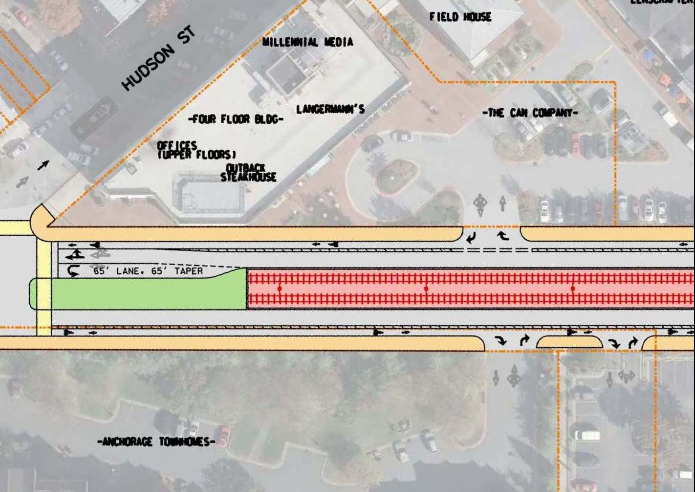
The first recommendation in the study is to build a major new road connecting Toone Street to Boston Street, while widening Boston Street between Haven and Conkling Streets. This widening does not include all-ages, low-stress bike infrastructure—it is solely focused on speeding up cars. The cost of this widening is listed at $2,000,000, and is part of a larger $50,000,000 idea to continue widening Boston Street even further east.

The next recommendations focus on moving vehicles through the neighborhood at the expense of safety and quality of life. The most egregious:

  • Peak hour parking restrictions throughout the corridor are recommended to be expanded, with heightened parking enforcement, to ensure maximum road space allocation to promote speeding cars.
  • Peak hour parking restrictions are recommended for Boston @ Fleet Street, creating a second through lane.
  • Crosswalk removal is proposed at Boston and Aliceanna Street to speed signal timing for cars trying to turn right onto Boston from two turn lanes on Aliceanna at the expense of safe crossing for pedestrians.
  • Lane expansion is also proposed at Boston and Clinton Streets to build 2 turn lanes. Dual turn lanes are commonly proposed in Baltimore but anti-pedestrian and discouraged by our own adopted planning guides.

For walking improvements, the plan audaciously calls for “continuous sidewalks.” It recommends upgrade of sidewalks to include ADA curb cuts, something already required by law. It suggests re-striping faded crosswalks, and it recommends installing pedestrian signals.

For biking improvements, the plan calls for bicycle boulevards on Foster and Hudson Street. These parallel routes have been suggested for almost a decade, and were originally planned to complement Boston Street, not be a substitute for it. The plan suggests the narrow promenade, intended for recreational bicycling during a one year pilot period, could somehow serve as a commuting alternative.

For transit, the plan suggests rerouting one commuter bus, assigning some carpool parking in parking lots, encouraging more private shuttles, and “exploring” expanded/improved water taxi service.

Our View

The Boston Street Multimodal Corridor Study is a plan to spend millions of dollars to dramatically boost the capacity on Boston Street for car commuters at the expense of safe walking, biking and public transit access for residents.

It fails to take into consideration decades of planning for a more walkable, bikeable, livable Canton. It fails to follow planning-commission adopted city planning documents. It fails to meet standards in city’s adopted street design guides.

It is a bad plan.

Share your Comments

Comments on the Draft Final Report can be submitted at the following link: https://www.surveymonkey.com/r/Boston30

We encourage you to demand a true multi-modal Boston Street, that prioritizes walking, biking, and public transportation access in Canton over county commuters passing through the neighborhood on their way downtown.

Email Comments on Potomac Street

Last night, Baltimore City DOT presented a revised design of the Potomac Street protected bike lane at the Canton Community Association meeting. The majority of the room was in support of a protected lane on Potomac, because people like you showed up and spoke out. So, thank you!

The revised design maintains a two-way, all-ages, high-quality protected bike lane. It addresses any emergency vehicle access concerns. It adds loading zones. It maintains parking. You can view the redesign on the Baltimore City DOT website here.

DOT has launched a 30 day comment period on the revised design, and we are asking you to email comments in support.

DOT will disregard template emails, so make sure to customize the subject and write your own comments in the email body. Please be sure to mention the importance of the lane remaining an all-ages, high-quality, protected design.

We'll provide a longer update on the meeting at a later date. Thanks, and keep up the #FightForBikes!


The Necessity of Showing Up and Speaking Out

This summer we spent considerable time and resources ensuring that a high quality, all ages bike facility championed by residents was not removed. That was only possible because you—our supporters—were galvanized and took action.

Next Tuesday marks an important next step in ensuring the success of our action. The Department of Transportation will present the revised design to the community at the Canton Community Association meeting. We are asking you to turn out. And most importantly, be vocal during the meeting of your support of the project.

As part of our settlement with the city, we have been instructed to not to share the design in advance of the meeting. The public—including our members—still needs a chance to be involved in the process. What we can say is the new design has taken into consideration the concerns raised by some folks who live in the neighborhood, received the approval from the Fire Department, and has the support of the Mayor’s office and DOT.

During this process, we were discouraged but not surprised by the divisive rhetoric put forward by those who wished to see the lane removed. It’s challenging moving Baltimore forward on issues regarding safety and transportation. When change happens, those opposed resort to a type of fortress mentality, a belief that only they should have input into changes in their community. What this ignores is the many people who are their neighbors that have been supportive of the project since the beginning. They paint Bikemore as some special interest group (their exact words)—as if improving the safety of all road users, and increasing opportunities of mobility is somehow nefarious and does not in fact have well-documented benefits on the community as a whole. Even throughout the legal process we had to constantly remind those on the other side of the table that this argument was not residents versus people who bike—but that the people who bike are in fact also residents who happen to have an opposing point of view. Yes, we organized and formed an advocacy group to champion that point of view—because as evident by how behind we are at achieving progress in multimodal planning—our interests were not well represented.

Opposition will also state that Bikemore engaged in some secret meetings to try and get the new design put forward. What they leave out is that the plaintiffs in the case were not Bikemore, but our members—members who live in Canton and Highlandtown and rely on the Potomac lane frequently. The secrecy? That’s part of the legal process, one Canton residents were a part of. Our settlement was negotiated under the terms that we would allow the City to engage in a public process moving forward. This was a design put forth by DOT. It did not meet all of our demands, but preserved key pieces that allowed us confidence that the City had taken our concerns into consideration. Anything else is conjecture and hyperbole. It’s about power and nothing more.

Next Tuesday it is critical that those who bike and rely on safe infrastructure to do so turn out and demonstrate a commitment to safe streets. We are especially encouraging our members who live in Canton to be represented. We will be following up with many of you individually. That’s how important it is you show up.

When you show up, we ask you to speak. Community meetings are tough. Opposition intentionally organizes to make it vitriolic so that it intimidates reasonable people from attending and expressing their views. But we can’t sit idly by and allow our needs to be shouted down. When the time comes to have input, we need you to raise your hand. Get in line to speak. You don’t need to have an eloquent speech prepared. Simply saying, “I’m a Baltimore resident and I support protected infrastructure on Potomac” is enough.

To rally supporters we will be out in front at 6:30, handing out stickers to demonstrate your support. We love our city. We want it to work for everyone—no matter how you choose to get around. We believe this design does just that. It’s time we demonstrate strongly that we want choice when it comes to how we get around. Simply planning and designing streets only for cars is something that does not work for the future of Baltimore. And neighbors creating a fortress mentality that believe they represent the whole of a neighborhood, or that those that live in the city and may use that street don’t have a say on what happens on the public right of way is wrong, and the least neighborly way to behave.

We can’t begin to express how grateful we are to your action thus far. The donations, the emails, and the phone calls have been what has kept us going. The time is now to demonstrate that we are residents and we believe in a future that provides safe options for all road users.  

Show up. Speak up. Your city leaders need to hear from you.


FILL THE ROOM: Canton Community Association Meeting
Tuesday, August 8
7 PM - 10 PM
United Evangelical Church
3200 Dillon St, Baltimore, Maryland 21224

→ More info and updates.


Complete Streets Introduced to Council Tonight

BikemoreV1-18.jpg

At tonight’s Baltimore City Council meeting, Councilman Ryan Dorsey will introduce a Complete Streets ordinance. Complete Streets are streets designed to prioritize the safety of all people using the street over the speed of moving cars. This legislation was a priority for Bikemore and a strong part of Councilman Dorsey’s campaign platform.

This will be the first Complete Streets ordinance in the country that is centered around equity — in a deliberate attempt to begin to undo decades of structurally racist planning that has promoted car commuting from surrounding counties over mobility for city residents. 

Over the past year, we have been building a broad coalition supporting Complete Streets. We’ve met with and are proud to have support from a host of community groups, including CASA de Maryland, No Boundaries Coalition, Old Goucher Community Association, and Original Northwood Association. Statewide organizations like Maryland Builders Industry Association have signed on. And, we have national support from groups like the AARP and Safe Routes to School, who recognize the importance of complete streets to aging in place and getting our kids to school. To date, we've met with more than two dozen community associations, a dozen trade groups, national advocacy partners, and key city agencies.

We plan to take our time stewarding this bill toward passage. There will be multiple public work sessions on the legislation, and we will continue our neighborhood tours introducing Complete Streets to residents across the city. Our coalition will grow, and we want your support.

We will be providing updates on the legislation and the growth of our coalition, including a recap of tonight's meeting, at www.baltimorecompletestreets.com

Please visit today and take the pledge to support complete streets in your neighborhood!

Another Tragedy: Remembering Jeremy Pope

This week we lost a dear friend. Jeremy Pope was killed while riding his bike near BWI. He was rear ended by a person driving a car. He often biked that route home from the light rail station, coming from work or spending time with friends in Baltimore. He was a fixture in a group of friends I am lucky to be a part of. His loss is felt by many. Our hearts go out to his family and friends who now have to carry on without him. 

It’s never easy to be a bike advocate when someone loses their life in a preventable crash. It’s hard to find the right words. Each time someone dies, we are asked to reflect on what specific changes can be made to prevent another family from experiencing this tragedy. In Bikemore’s short history, we’ve written about this numerous times: for Aaron Laciny, for Ralph Roane and Marcus Arvin, and for Tom Palermo. Maybe it’s because I just saw Jeremy last Friday at Bike Party, maybe it’s because of the proximity to Aaron’s death, but this one feels particularly tough to write. 

People drive too fast, too distracted, and are killing each other’s loved ones. I think by now it’s clear we need a dramatic change in our culture, and that change needs to be pushed forward by our civic leaders.

Every time I have to beg and grovel for a little bit of decency or consideration for people who bike on the roadway, it seeps into the subconscious of the collective that we don’t belong there. 

Every time civic leaders weigh equally the safety of vulnerable road users against shaving a few minutes off someone’s commute or the convenience of getting to park right in front of one’s house, they are emboldening disregard for the lives of people who ride bikes. They make our deaths appear inevitable, of our own making. 

I’m living this right now—in the midst of planning one memorial bike ride for Aaron Laciny and attending one for Jeremy tonight—I’m still being told by some residents in Canton how unreasonable I am for asking for protected bike lanes to be designed at federally-guided minimum width. 

I met Jeremy Pope at my first Bike Party. I had just moved to Baltimore. In what was already a chaotic ride home through the park, Jed and I happened upon a crash, and were quickly called away to another crash on the other side of the park. When we got there, I saw bikes underneath a car, and all three back wheels on the bikes were bent. Jeremy was one of the people that was hit. Miraculously, nobody was badly hurt. I remember talking to Jeremy specifically, calming him down, encouraging him to stay level-headed while the responding officers treated the whole ordeal with the kind of disdain I’ve now come to expect. We worked with police to ensure all three had a safe ride home with their bent up bicycles. The next few days I connected the driver and the cyclists to make sure folks were working together to get bikes fixed and medical costs taken care of. 

Jeremy was always generous with his gratitude after that. To me, he represented my first Baltimore bike advocacy success story. I was a source of calm and support during an intense and stressful situation for him. He repaid me tenfold over the next two years in hugs, smiles, and encouragement. It’s not often in advocacy you get a concrete win, so kind words from folks like Jeremy are what fuel me to keep going in the face of adversity. 

Jeremy was on a path of self-discovery that is enviable. He constantly sought out ways to be more generous and bring others more joy. He was beginning his career in the bike industry—a career move that isn’t easy and comes with risks. He biked across the country raising money for cancer research last summer. He gave his friendship wholeheartedly to so many. 

13925277_10154225725301508_2089991953972891900_n.jpg

Over the past two days I’ve witnessed the hole Jeremy’s death has left in our community. He was a fixture on many weekly rides, all the bike parties, and a new, but beloved member of the Baltimore Bicycle Works family. His friendship was the kind that was so full of magic and possibility, because he was willing to go deep with those who surrounded him. At a time when so many of our relationships are based on superficial connection, Jeremy succeeded at forging many deep friendships. Those types of friendships are so vital because they allow you to be seen and valued just as you are. These friendships are abundant in Baltimore’s bike community. So while Jeremy and I never got to know one another deeply, I recognize his magic in so many of you. I feel it even more intensely this week as we all suffer this immense loss. 

The bicycling community has planned a ride for Jeremy this evening (Thursday, July 6th) and all are welcome to come in celebration of the life of a wonderful human being. The ride will depart from Baltimore Bicycle Works (1813 Falls Road) at 7:30 and slow roll to Baltimore Design School (1500 Barclay Street) for a candlelight vigil at 8:30. 

Please keep his family and loved ones in your thoughts and always keep promoting safe cycling and safe driving throughout Baltimore.

Liz Cornish, Executive Director