Bike Lanes

Big Jump: Druid Park Lake Drive and 28th Street

Proposed Changes to Druid Park Lake Drive

In January of last year, Baltimore was one of 10 cities selected for the PeopleForBikes Big Jump Project, a grant aimed at bolstering ridership in an already successful community and expanding that ridership into adjacent communities. Reflecting that grant constraint, Baltimore City's application focused on improving connectivity between an area of high opportunity, Remington, and areas in need of opportunity, including Penn North and Reservoir Hill. 

In late May, Baltimore City Department of Transportation plans to install the first component of the the Big Jump Project.

The ongoing DPW Druid Lake Reservoir construction and the traffic changes necessary to stage equipment for that project will result in lane closures on Druid Park Lake Drive. Taking advantage of these already required road closures, we're able to construct a walking and biking connection across Druid Park Lake Drive and the 28th Street bridge, connecting Remington directly to Reservoir Hill and Penn North. 

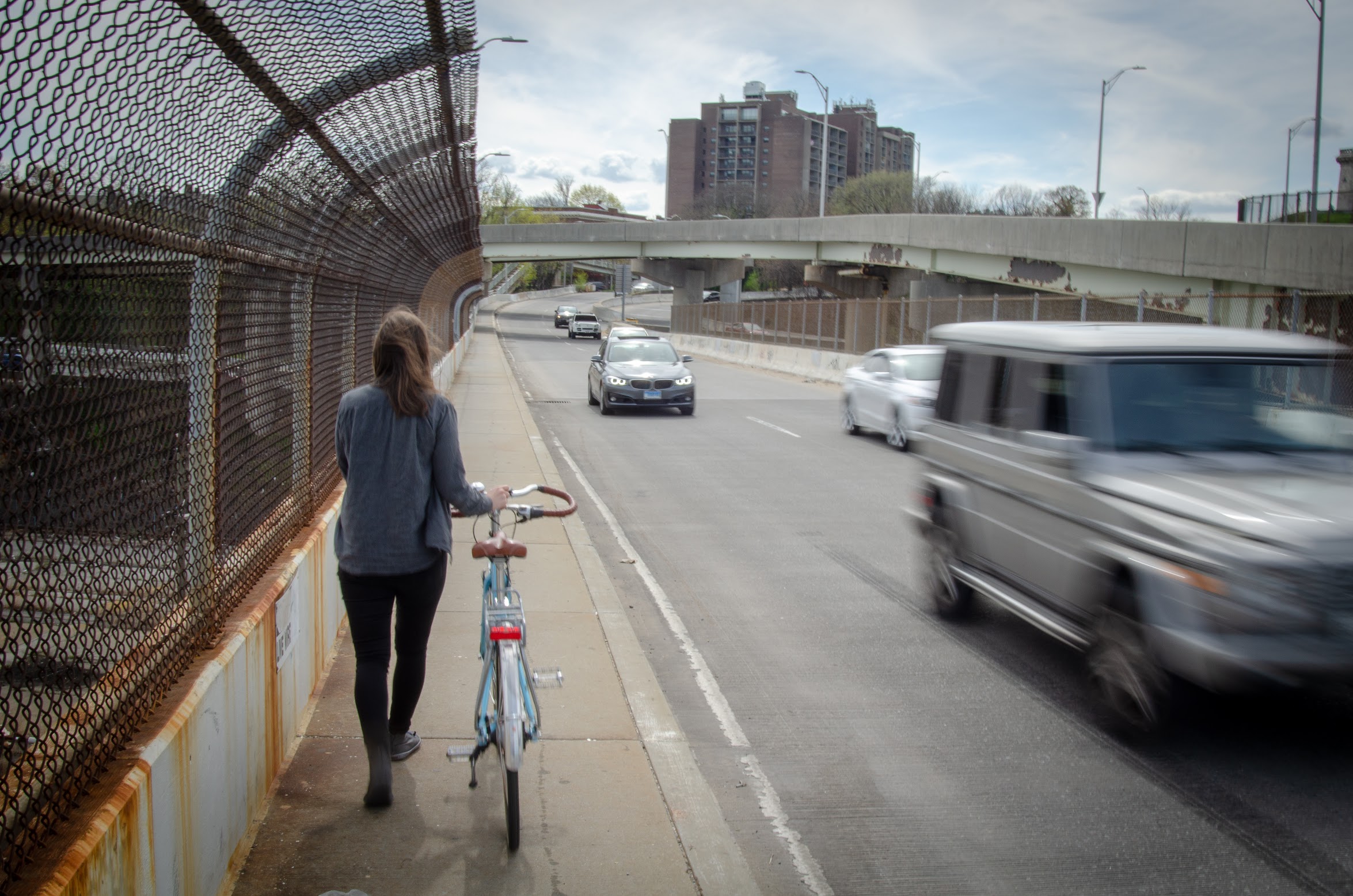
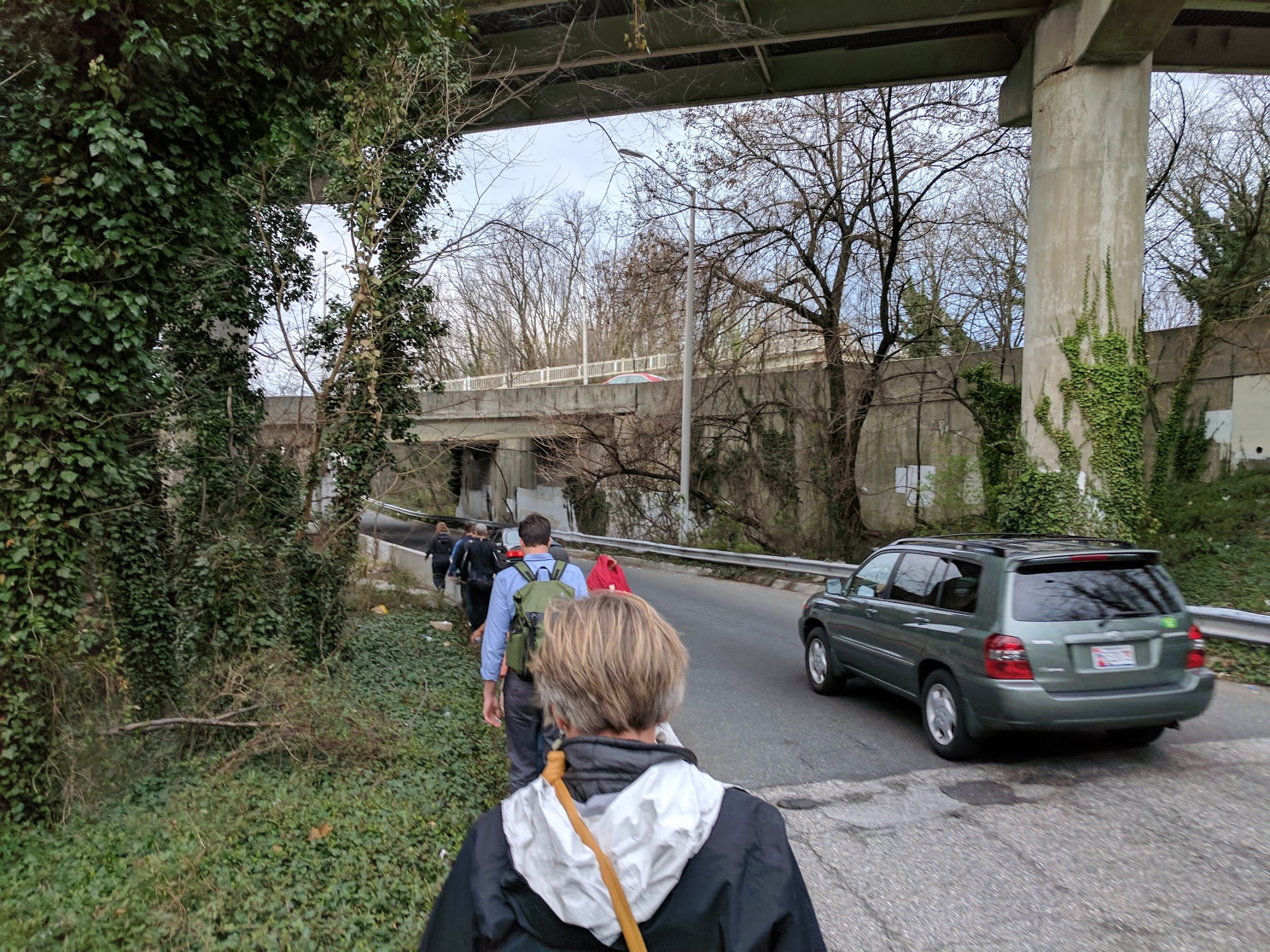
The current crossing is a narrow sidewalk alongside highway speed travel lanes that leads to a non-ADA accessible pedestrian bridge and an overgrown path alongside a highway onramp. Photos of existing conditions are below.
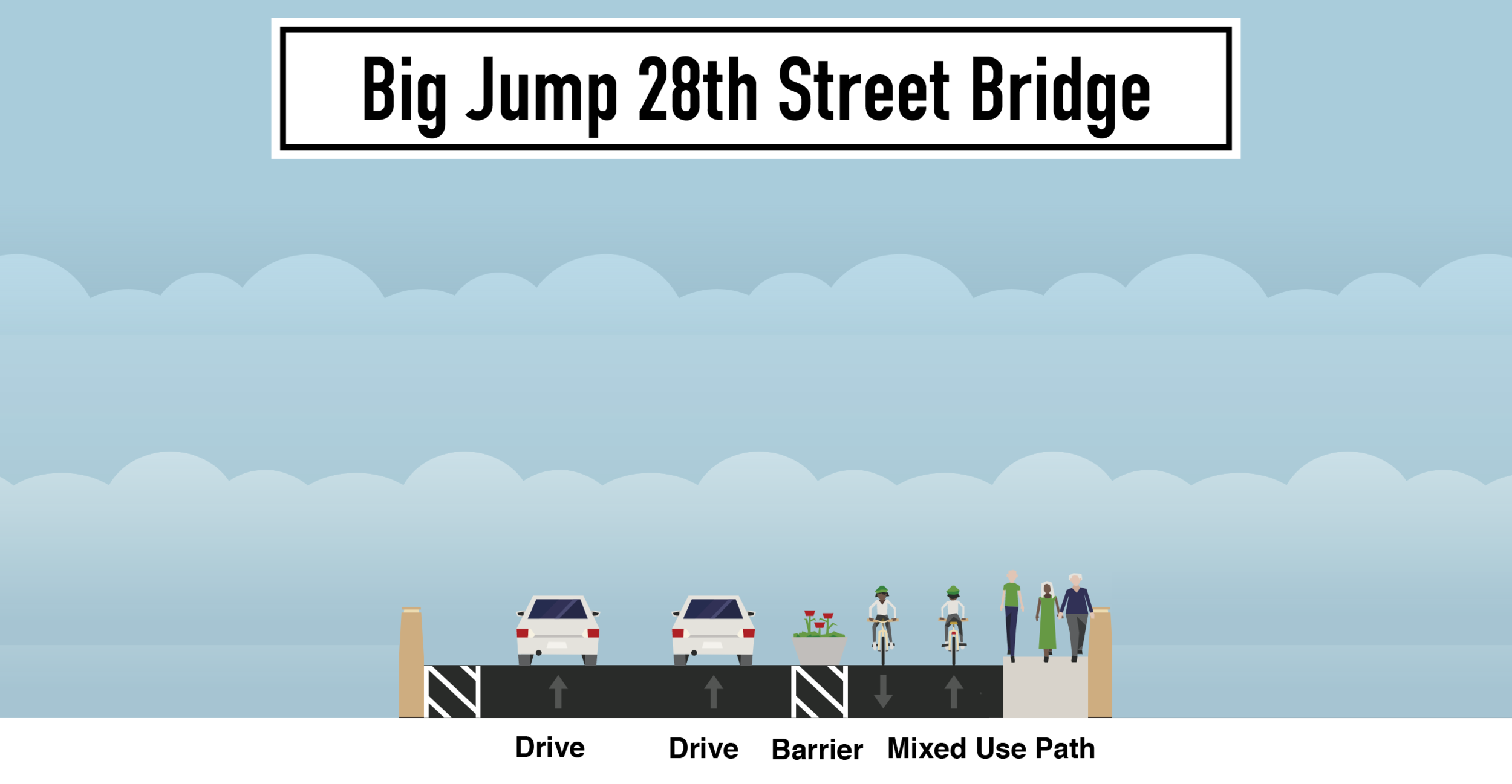
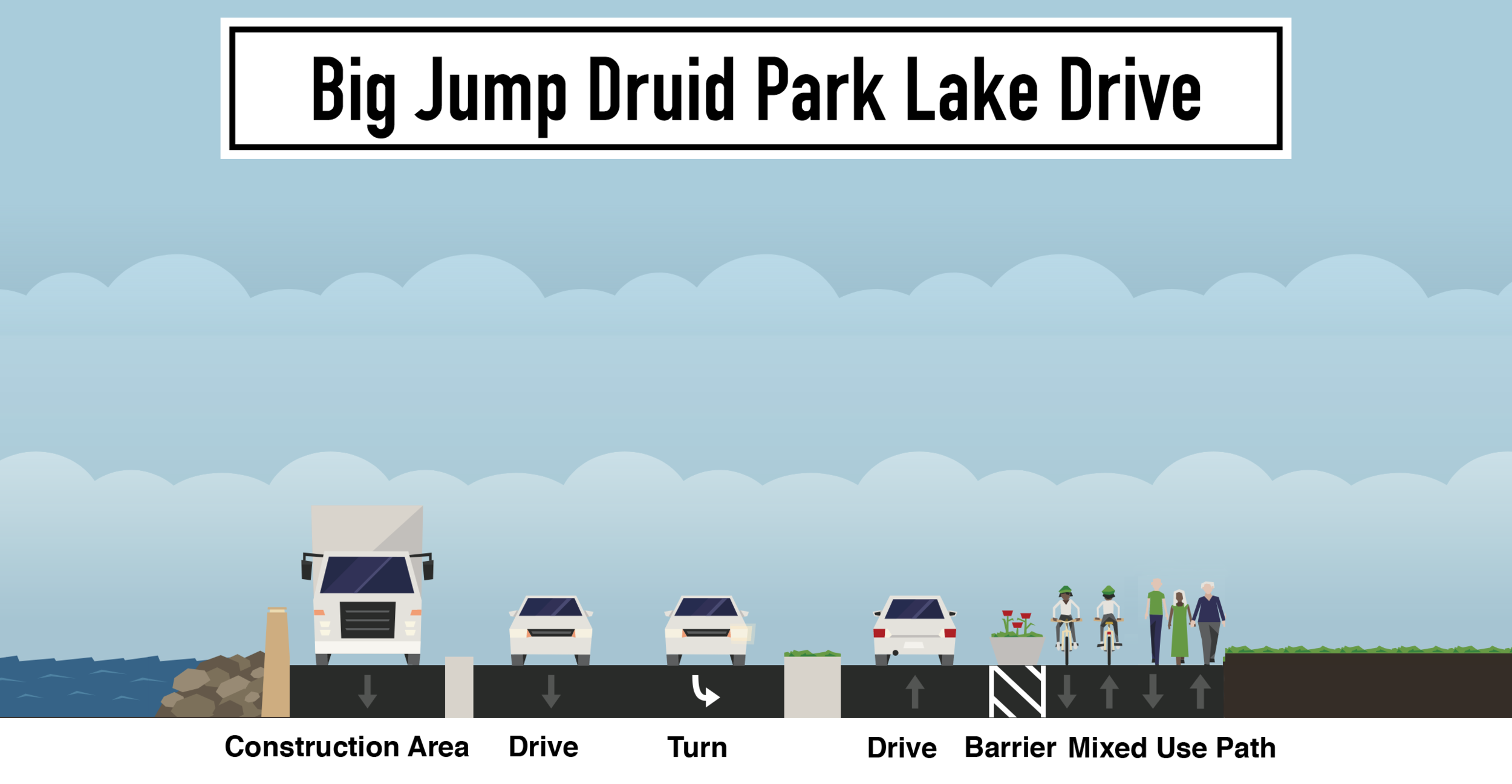
The new connection would be a wide shared-use path separated by water-filled barriers and planters. It will extend from Atkinson Street in Remington to Madison Avenue on the border of Reservoir Hill and Penn North. Additionally, the path will extend north on Sisson Street in Remington to connect to the existing Jones Falls Trail at Wyman Park Drive and extend west along an existing path and sidewalk to connect to the basketball courts on Druid Hill Avenue.

The proposed barrier-protected bike and pedestrian path route is outlined in teal above.
The proposed barrier-protected bike and pedestrian path route is outlined in teal above.
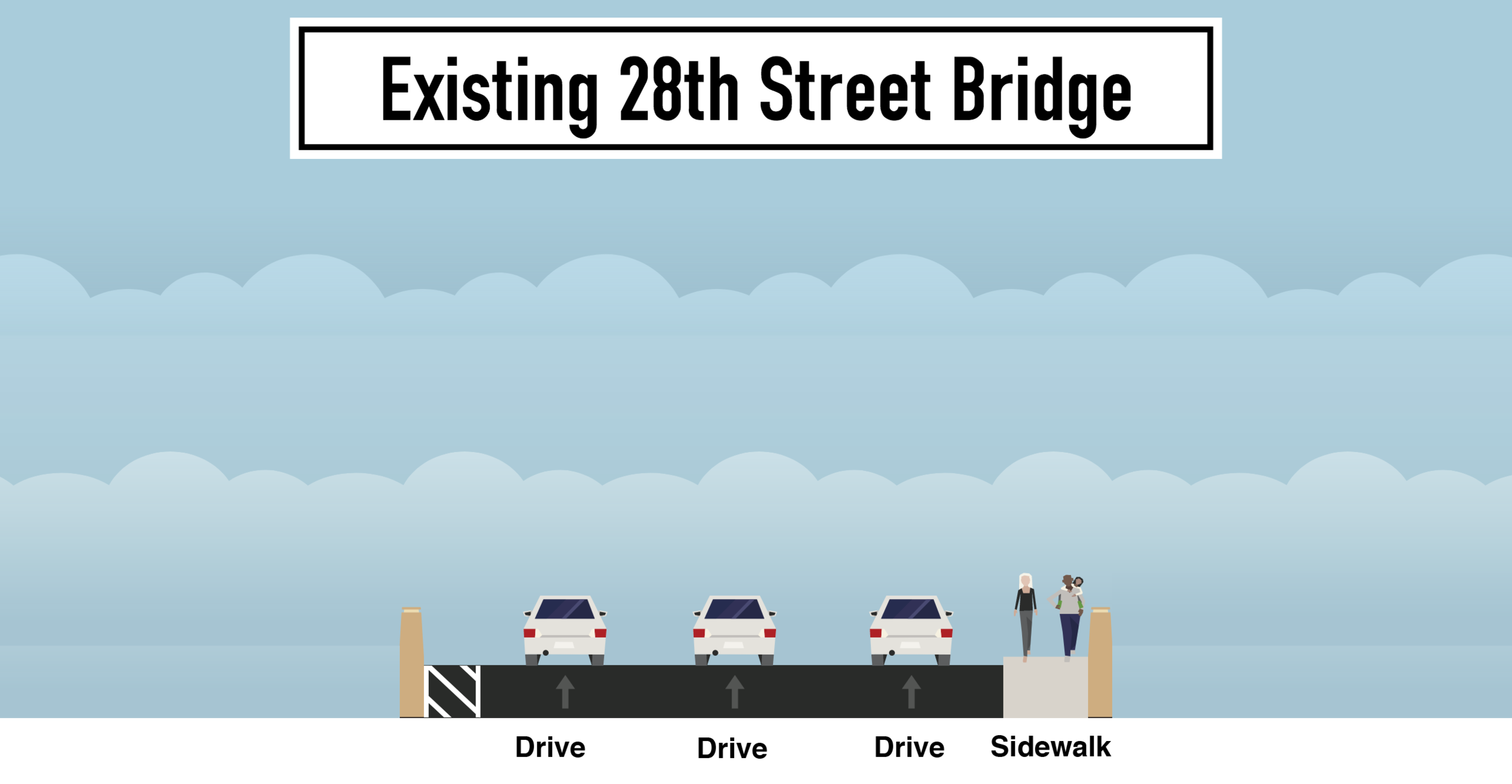
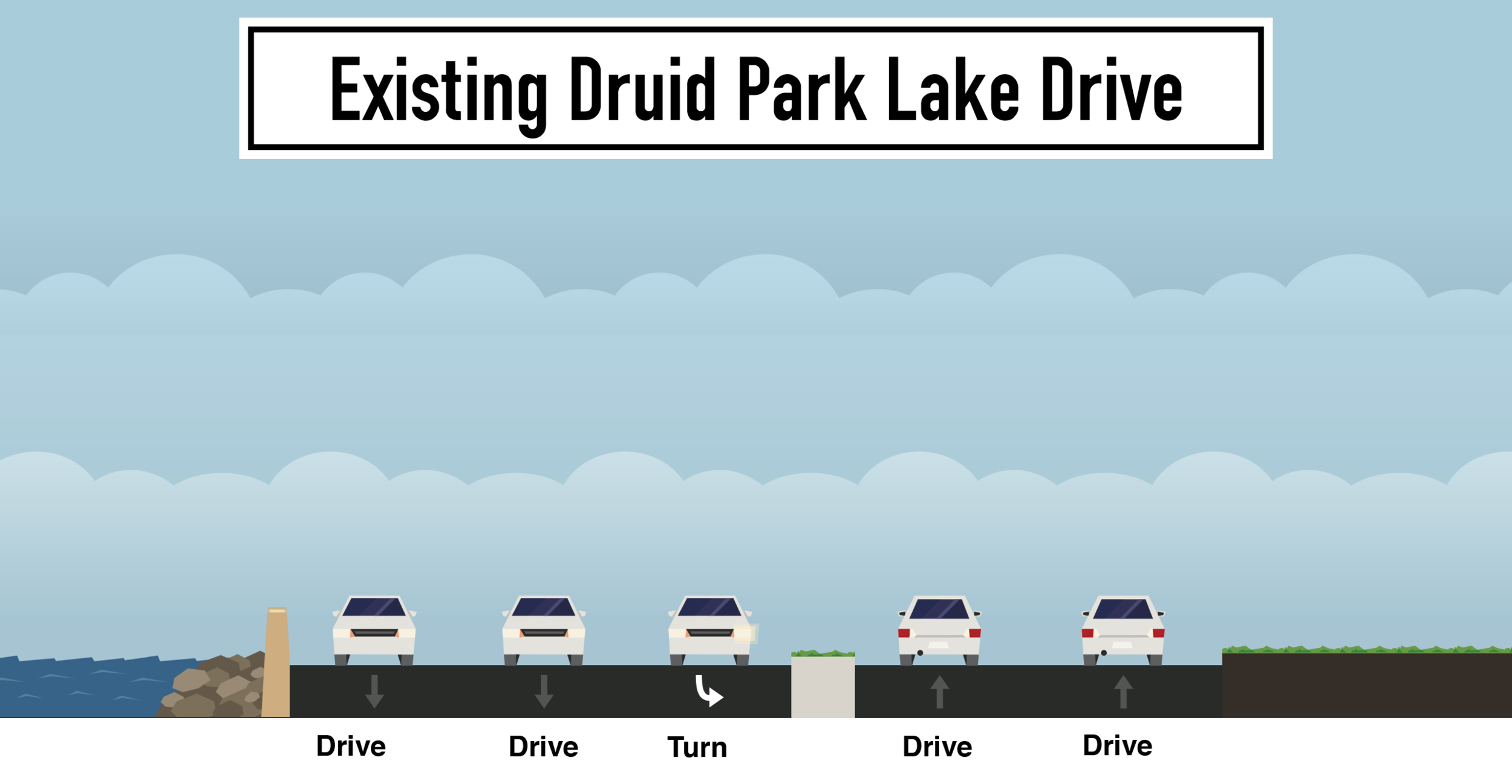
The installation of this walking and biking path in late May will reduce Druid Park Lake Drive to one lane eastbound. Reservoir related construction will reduce Druid Park Lake Drive to one lane westbound. Not only will this project provide a safe walking and biking connection between neighborhoods across a highway, it will halve the crossing distance for pedestrians looking to access Druid Hill Park from neighborhoods to the south. 

Baltimore City Department of Transportation is also engaging in a large-scale corridor study of Auchentoroly Terrace and Druid Park Lake Drive. The goal is to incorporate the successes of this Big Jump Project idea into permanent road reconfiguration or removal to better reconnect Druid Hill Park to the neighborhoods surrounding it, while creating permanent safer walking and biking connections.

This idea has become a potential reality due to persistent advocacy and leadership from Bikemore and Councilman Leon Pinkett, as well as a commitment to The Big Jump Project from BCDOT Director Michelle Pourciau, dedicated and creative staff like Graham Young, and the Mayor's Bicycle Advisory Commission.

Community meetings outlining this project are coming up, and we encourage neighbors to come out to learn more and support this project. Details are below.

Screen Shot 2018-04-17 at 3.09.46 PM.png

Fire Access issue still delaying the Downtown Bike Network

Screen Shot 2018-02-14 at 2.20.24 PM.png

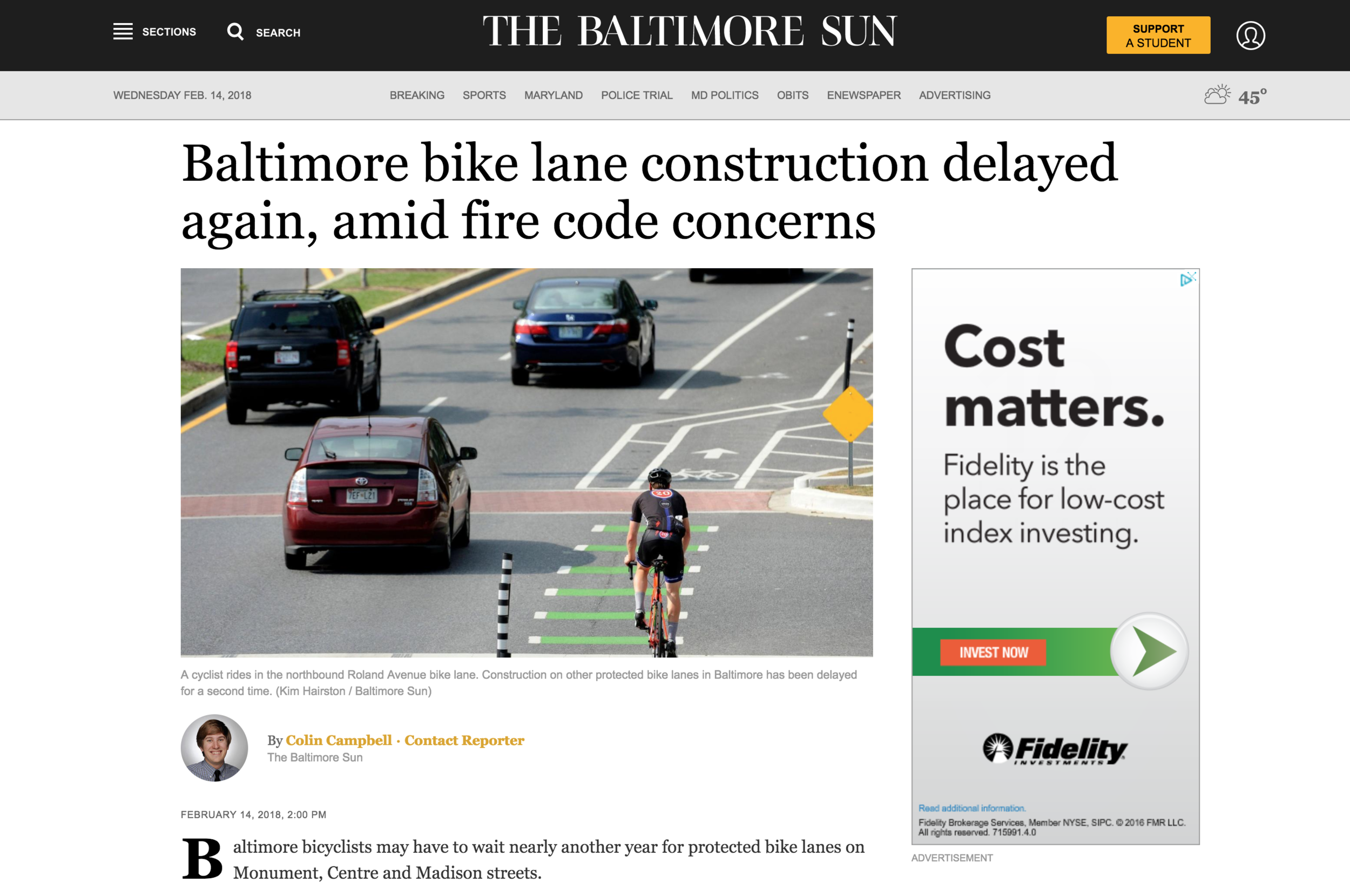
This morning the city's Board of Estimates voted to approve a 318 day delay for work for the contractor hired to construct the Downtown Bike Network — again citing the fire access issue as the cause for delay. This means that the city now has until October 31, 2018 to complete work that was originally set to be completed by January 2017.

Beginning in May of 2017, there were complaints about the width of the Potomac Street bike lane which was then under construction, citing a portion of the Baltimore City adopted International Fire Code addressing the required width of streets. This code is now being applied only to streets with bike lanes, delaying construction of bike lanes that are already fully designed and funded. You can check out full story for more background on this ongoing issue. 

If less than 20 feet of clearance is truly a safety threat, the city should be applying the code to all projects, said Bikemore executive director Liz Cornish — not just those with bike lanes. “They’re not applying this interpretation of the fire code equitably for streets across the city,” Cornish said. “If it is, in fact, a safety issue, it is a safety issue on all streets.”
— Baltimore bike lane construction delayed again, amid fire code concerns, Baltimore Sun

“It’s disappointing to us that this project, which has already been subject to one extension, is already a year behind, and is now potentially behind for another year because of the fire clearance issue,” said Jed Weeks, policy director for local cycling nonprofit Bikemore.
— City Officials Again Delay Downtown Bike Network’s Installation, Baltimore Fishbowl


Want to support us in our ongoing #FightforBikes?

Donate to Bikemore Today


Q&A: Relationships post Potomac, current advocacy strategies & more

Our Q&As are our way of sharing with you questions that we've heard recently. If one person asks it, we know more of you must be curious. These questions came from our Members' Meeting held on January 10th.

It was standing room only at our Members' Meeting!

It was standing room only at our Members' Meeting!


What's going on with the Jones Falls extension?

The Jones Falls Trail extension from Cylburn Arboretum to Mount Washington is currently under construction. It includes a bike and pedestrian bridge across Northern Parkway.

What about targeting your 501c4 work to getting good people elected to the Central committee?

Yes, we're constantly working at many levels of government, but there are definitely other folks working more targeted there.

When does the funding for the Downtown Bike Network expire?

We're working to get clarity around this. 

What is Bikemore's relationship with the City like post Potomac? Were we "iced out" because of it?

We're still in City Hall most days of the week and are definitely still invited to conversations. We did everything we could behind the scenes through collaborative methods before taking the City to court, and they seem to understand that.

Do you have any early ideas for targeted advocacy we should take for the Complete Streets Bill?

We've been working on building a broad based coalition for Complete Streets since the start, with many council members already on board. So while along with Councilman Ryan Dorsey we're leading the effort on this, we already have many diverse champions and are in a good position.

Do police have any data on the bike crime?

No, the police department doesn't categorize if bikes are involved in crime or even crashes. BPD was cooperative and supportive when we were working with them on the assault issue, but advocating for better stats, while very helpful, doesn't seem like a likely win so we're not focusing energy on it at this point. 

What about taking the Mayor on a bike ride?

We've offered before, more than happy to!

Is something going to happen with all those potholes on Druid Park Lake Drive with the Big Jump project?

Yes, if the road is reconfigured that will include repaving. We're concurrently working on a short-term pop up type project here, as well as longer term full redesign effort. 

What's strategies are currently working best to advocate in your neighborhood?

Personal notes to senior staffers that work around the mayor, like Jim Smith or Pete Hammen, seem to be particularly effective right now, and individuals that write heartfelt, personal correspondence to these individuals get responses and dialogue.

Communications and transparency from Bike Share doesn't seem to be improving since the relaunch, as promised. What gives?

Just to clarify, Bikemore does not run Bike Share. We try to support them and share our ideas with them, but we don't run it. It's our understanding and hope that this is simply a staffing issue. It's really the city's responsibility to deal with the communications side, not the operator, and there currently isn't DOT staff devoted to bike programming. It's our hope that with the hiring of a Bike Share Coordinator, the communications will be improved. We're also potentially looking into modeling the Bike Ambassador program that Philadelphia Bike Share system has in place, to employ community members to teach others about bike share. 

The Bike Share electric bikes aren't working. What's going on?

We've heard that the batteries on the electric bikes don't hold charge well with extreme cold temperatures. If they're not back up to speed after this crazy extreme cold front, we'll get back to it. We're also hopeful that with the announcement of a new major sponsor in February, there will be more accountability and solutions to issues like this.

Is dockless bike share interested in coming to Baltimore?

Yes, we think these companies are interested but understand the current state of Baltimore. Bikemore staff and board members went to DC last month to learn from their DOT staffers that worked on their current pilot program, and to talk with dockless operators. We're working on getting BCDOT to adopt a policy ahead of companies coming here so that we can ensure things like safety standards and equity are requirements at the start, as other cities have done. 

What's going on with the Bike Share station at Penn Station?

There's always a challenge when placing Bike Share on Amtrak property, because of the complicated bureaucratic nature of Amtrak. But it's been done in tons of other cities and we're hopeful it will be resolved here as well. 

North Avenue Rising: Take the Survey

In November, kick-off meetings were held for the North Avenue Rising project, a $27,330,000 project to improve transit stops, install bus lanes, and make targeted streetscape improvements to North Avenue. The project is a federally funded Transportation Investment Generating Economic Recovery grant, or TIGER grant. The project has additional financial support from MDOT MTA and Baltimore City. 

Our Ask

Take the project survey available here. 

In questions #6 and #10, please state that you would like to see dedicated, separated transit and bike lanes throughout the corridor, and that you would like to see a center-running transit option.

Background

We wrote a detailed post in July of 2016 about how to make this project better. It is available here. In short:

The red bus lane stops and starts throughout the corridor.

For dedicated transit lanes to be successful, they should be contiguous and ideally separated, or at minimum, curbside. The project as planned currently has parking-adjacent bus lanes, which stop and start throughout the corridor depending on traffic volume. This will result in conflict between buses and cars during every parallel parking attempt and abuse of the lanes by stopped cars and delivery vehicles. 

"Parallel" bike facilities, blocks away.

For bicycling to be comfortable for people of all ages on the North Avenue corridor, and for the planned bike share stations to be utilized safely and effectively, separated bike lanes must also be present on North Avenue, at least along the wider section where buses are most frequent. Presently, bikes are relegated to "parallel facilities," which are not parallel. Worse, there is no connection across the bridge, requiring bicyclists to dismount and walk or illegally ride on the sidewalk. 

These constraints mean we're going to spend millions of dollars on a project that still prioritizes moving and storing private cars over moving people via foot, bike, and transit. The end result will be a street with only moderately improved transit travel times, a street with no safe place to bike, and a street that will still be dangerous to cross as a pedestrian. 

According to NACTO's figures on person throughput, North Avenue today can move 6,000 people per hour. The TIGER grant as designed may improve this to 11,200 people per hour. Our fix can move 34,100 people per hour.

The Fix

The fix is easy, it just costs more money. Based on costs of other dedicated alignment bus corridors, an additional $20-30 million could elevate North Avenue from the flawed project outlined above to a truly transformative corridor.

Wider Section of North Ave

The wider section of North Avenue that has the highest bus volume could have a center-running, separated busway. This would allow for curbside protected bike lanes, parking, and a single travel lane for personal automobiles.

North Avenue wide segment at a bus stop, with center running transit way, protected bike lanes, and parking.

North Avenue wide segment at a bus stop, with center running transit way, protected bike lanes, and parking.

Narrower Sections of North Ave

If we removed on-street parking on one side of the street in the narrower sections, areas furthest east and west on North Avenue, we could continue the center-running, separated transit lane by making it bi-directional. Bus frequency is low enough along this segment that oncoming buses would rarely encounter each other, but if they did, they could merge into the regular car travel lane to pass each other.  This design is being used in Indianapolis with the IndyGo Red Line Bus Rapid Transit project, which has similar bus timing to these parts of North Avenue. 

North Avenue narrow segment, where buses share a bi-directional lane and pass each other in the regular travel lane. Parking is restricted on one side of the street to allow for the bus lane and protected bike lanes.

North Avenue narrow segment, where buses share a bi-directional lane and pass each other in the regular travel lane. Parking is restricted on one side of the street to allow for the bus lane and protected bike lanes.

North Avenue narrow segment at a bus stop. Parking is further restricted to make width for the bus stop and allow for protected bike lanes.

North Avenue narrow segment at a bus stop. Parking is further restricted to make width for the bus stop and allow for protected bike lanes.

While parking would need to be reduced on these edges of the corridor where the street is narrower, this is exactly where neighborhoods have zero-car household rates far above the city average, and where adjacent streets have very low on-street parking utilization. Many buildings also have alley garages and rear parking access. Removing parking would be a challenge, but it would be in line with focusing on the majority of road users in these segments, who lack access to a car and instead walk, bike, or take transit.

Perspective on Cost

$20-30 million is a fraction of the money Governor Hogan reallocated away from Baltimore and to rural highways with his cancelation of the Red Line. Baltimore City could also come up with this money over the several year project timeline. In just the few months since Councilman Dorsey passed legislation to increase the fine for parking in bus lanes and bus stops to $250, the city has already failed to collect nearly $500,000 because they haven't updated their ticketing software to the new amount. 

We can afford a project that gets this right the first time, and sets up a future on North Avenue that could easily be upgraded to real Bus Rapid Transit or Light Rail Transit. We can't afford to spend $27,330,000 on the existing project. North Avenue and the people of Baltimore deserve better than this. 
 

> Take the project survey available here.
 

Tonight, speak up about North Ave Rising!

Tonight is the first meeting about North Avenue Rising. We hope you'll make it out, even if you can't make it until after work!

Here are the main points we'd like you to make:

  1. North Avenue Rising must have separated, dedicated transit lanes throughout the entire project corridor.

  2. North Avenue Rising must have separated, dedicated bicycle lanes at minimum between Pennsylvania Avenue and Broadway, where there is high density, frequent bus service, and a wider right-of-way.

  3. North Avenue Rising must have a road diet, calming the street and allowing space for high quality bike and transit lanes while maintaining parking for businesses.

  4. These requirements should lead to North Avenue Rising including center-running transit, which will further spur economic development and transit growth on North Avenue, and allow for a potential rail transit future for North Avenue once that growth demands it.

There are community meetings Monday through Thursday this week for you to attend. We're encouraging folks to #filltheroom at Monday night's meeting, but we encourage you to attend whichever meeting you're able to.

Monday, November 13, 2017
4:00 PM - 5:30 PM
Impact Hub
10 East North Avenue

Tuesday, November 14, 2017
6:00 PM - 8:00 PM
Bluford/KASA at Walbrook
2000 Edgewood Street

Wednesday, November 15, 2017
6:00 PM - 8:00 PM
Rita R. Church Community Center
2101 Saint Lo Drive

Thursday, November 16, 2017
6:00 PM - 8:00 PM
Parkview Recreation Center
2610 Francis Street

>> Want to know more about North Ave Rising? More about the project and our take.