Tour Dem Parks Recap: Inspiring views, new paths, and jagged asphalt... Cycling through Baltimore's extensive park system.

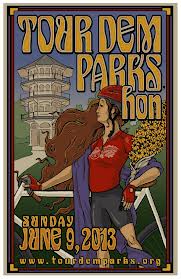
Tour Dem Parks Hon PosterWhat’s Baltimore’s most beloved bicycling festival? Tour Dem Parks, alongside the leisurely harbor-side ride Tour Du Port, surely ranks near the top. After hearing about this citywide bicycling tour for years, my husband Brian and I finally joined the pack and signed on for Tour Dem Parks. We were also happy to register and support city nonprofits including Bikemore! To spandex or not to spandex?

Riders chose between a 25, 36 and 64-mile ride (and a shorter family ride). For the easy-peasy 25 miles, I chose cutoff jeans and a “Peddle Princess” tee procured from a Bombay street market. Our friends arrived in spandex, shades, and clip-on shoes: The hallmarks of serious road bike warriors… And true to life—one of them bicycles to work some 30 miles to Annapolis. Personally, I went with cut-offs, since I bike about six miles during my commute to work in all manner of garb, dresses and heels, slacks and boots, but never spandex.

The day dawned temperate and overcast, perfect cycling weather. Beginning on the leafy Gwynns Falls Trail, in the nation’s second-largest urban park, we rode alongside the creek to the first rest stop, where bagels and peanut butter were served. The “family ride” terminated here, which made the path significantly less crowded as it deteriorated through the rest of the park and we bumped and lurched over cracks.

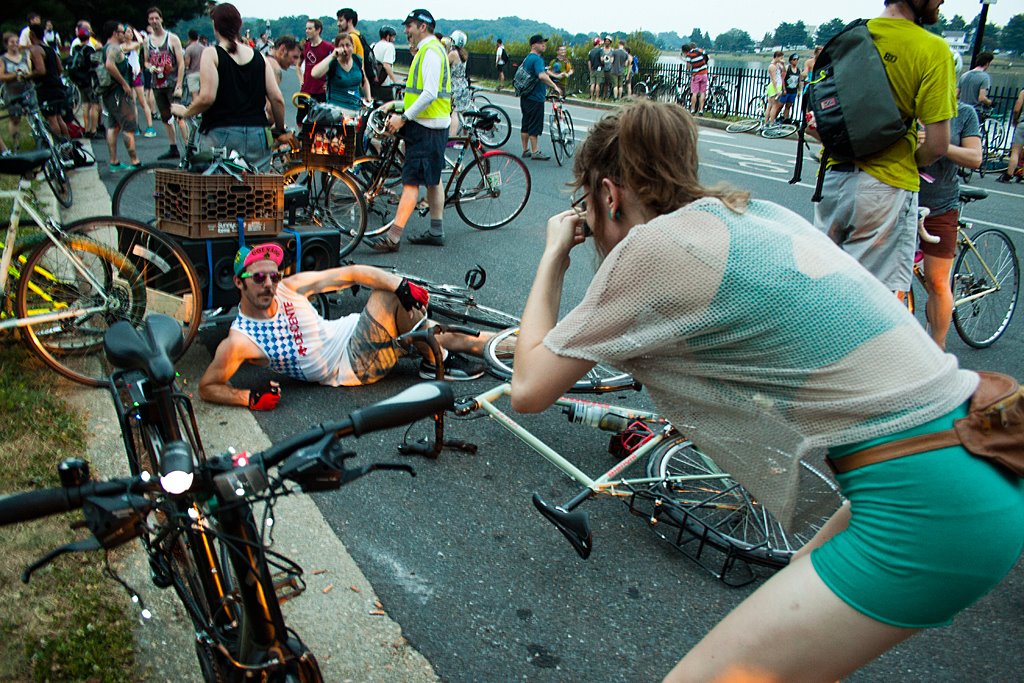
A small spill at Dickeyville

Photo via Flickr thanks to Jim Carson

Adults moved on to more trail riding that wound us through tranquil urban forest. Soon the ride wound through Dickeyville, a serene hamlet set that grew up around paper and woolen mills in the early 19th century. Large stone houses with landscaped gardens (even an expensive-looking sculpture) overlooked a waterfall. My friend fell off her bike gawking.

Navigating streetcar suburbs

Soon we exited the Gwynns Falls Trail into West Baltimore. The neighborhoods along Liberty Heights and Belvedere around Pimlico’s racetrack were well served by streetcars (the #32, 31, and 25) through the 1940s and the style of the large, attractive early 20th century housing stock reflects what was a prosperous community.

Streetcars

Today some of the homes are still maintained by residents; other houses have been burned out and abandoned since the 1960s. Cyclists followed spray-painted arrows on poorly paved roads through this neighborhood, making several wrong turns with the consequence of riding on multi-lane roads with no bike lanes.

Luckily, in a pack, we were decently visible and soon got back on the correct route. These neighborhoods have hemorrhaged population over the past 30 years so we saw many fewer cars than one would expect.

Park-hopping via sidewalk terrain

Now riding on the Jones Falls Trail, we entered Frederick Law Olmstead’s lovely 745-acre Druid Hill Park from Woodberry—checking out the oogle-worthy pool at Clipper Mill’s Assembly Apartments. We attempted to steamroll up the park’s switchbacks, walking for just a bit of the way. After our second of three pit stops, we set off for Patterson Park, continuing on the Jones Fall Trail.

The Jones Falls Trail becomes a cycletrack between Mount Royal Avenue and Center Street, but elsewhere it regresses to sidewalk. It abruptly ends in front of Our Daily Bread after passing by a large prison. Cyclists must stop, cross the street and hop onto the badly-deteriated sidewalk, competing for space with distracted men meandering out of the soup kitchen.

Some blocks south on rutted sidewalk, Baltimore Avenue’s well-marked sharrows led the way to 137-acre Patterson Park, within which bike routes were not well paved but incredibly scenic. The views of Canton rooftops and the city port kicked up a wave of patriotic spirit. We discussed the history of what was Hampstead Hill during the War of 1812. The Hill was stacked with 100 cannons and 20,000 troops—the view of which made the British recoil and retreat. Brian climbed the Pagoda, a 60-foot observation tower built by Charles Latrobe in 1890 (others felt their rear ends were already too sore).

Beer and Burgers

With the sun peeking out, we hightailed it through the Baltimore City harbor (dodging carousing packs of tourists on the shared bike/pedestrian way), biked over the lightrail tracks, and coasted down to Carroll Park. There were burgers, hot dogs, and Brewers Art beer on tap.

final event

We reflected in the shade. It was a comprehensive tour of Baltimore City parks, history, and the growing bicycle infrastructure that’s making cycling not only a once-a-year activity but a daily option for fun and inexpensive transit for many residents in Charm City.

A big thanks to Tour Dem Parks for organizing a safe and fun ride! The proceeds from the ride benefitted parks like Druid Hill, Patterson, Carroll, and the Gwynns Falls Trail Council, plus bicycling organizations like Bikemore, Baltimore Bike Party, Velocipede, and the Cycle Cross in Druid Hill. 
Ride the Baltimore Bike Party: 80s Edition

80s Baltimore Bike Party Baltimore Bike Party invites you to get out your 80s garb and get rad for the second consecutive June. And I'm sure you remember how much fun you had last year:

This year promises more of the same. And this month, the ride will be back to the same bat time, same bat channel start at the Washington Monument. That doesn't mean that there won't be a huge blowout afterwards, though. In fact, there will be an after party at Lexington Market with food from Faidley's Seafood, Mexican Delight, Mem Sahib, and more!

And R. Kelly fans, take note: after the party the party there's an after after party, but it's not in the hotel lobby. Even better -- it's at Alewife, a perennial Bikemore favorite.

You don't want to miss this. RSVP at the event page now.

Put People Ahead of Cars

946897_307832319351545_1467944470_n.jpg

This Op/Ed piece, by Bikemore Executive Director Chris Merriam and Robbyn Lewis, founder of Red Line Now! PAC, will appear in the Baltimore Sun print edition tomorrow.

Put people ahead of cars

Under new leadership, Baltimore's Transportation Department must prioritize bicycling, walking and public transit

By Chris Merriam and Robbyn Lewis

12:37 PM EDT, June 4, 2013

Baltimore City is at a transportation crossroads. We can move in the direction of a safer, healthier, more sustainable and economical city — the direction in which dozens of cities across America are moving — or fall back on prioritizing cars over people.

Mayor Stephanie Rawlings-Blake recently selected William Johnson as the new director of the Baltimore City Department of Transportation. The priorities that the mayor and Mr. Johnson set for Baltimore's transportation future will have a significant impact on neighborhood livability and our ability to retain current residents and attract new ones. Their leadership in following through on recent plans and expanding existing livability initiatives will be critical:

  • The Department of Transportation's Strategic Transportation Safety Plan echoes years of requests from community groups to improve safety on our streets, especially for pedestrians and bicyclists, as key to making communities safe and enjoyable.
  • Baltimore's Sustainability Plan and Climate Action Plan both call for increased walking, bicycling and transit to reduce greenhouse gas emissions and other negative environmental impacts.
  • The city's Healthy Baltimore 2015 plan recognizes the importance of incorporating physical activity into our everyday lives to improve our quality of life and reduce chronic disease.
  • Department of Transportation planners are crafting plans for a Downtown Bicycle Network, which would include the Maryland Avenue Cycletrack, a 2.6-mile, physically separated bikeway between Pratt and 29th streets.

But will we turn these plans into reality? Baltimore cannot and should not compete with the suburbs for wide, car-centric roads and ubiquitous parking. Instead, Baltimore should capitalize on our population density, connected street grid, and diverse economic and cultural nodes to make sure that residents can find work, entertainment, recreation and shopping within a short walk, bicycle ride, or transit trip. It's not about forcing people out of their cars; it's about providing a variety of convenient, safe and affordable transportation options for all Baltimore residents.

Accessible sidewalks; dedicated space for bicycling; and high-quality, modern transit encourage more physical activity and less driving, leading to a healthier, safer and more environmentally sustainable city and more cohesive neighborhoods. Baltimore has made strides in this direction, implementing over 100 miles of on-street bicycle facilities since the development of the 2006 Bicycle Master Plan, contributing to a doubling of bicycle commuters; and committing to build the Red Line. Perceptions are also shifting, as evidenced by the success of the Charm City Circulator and Baltimore Bike Party.

But much more needs to be done to make Baltimore a place where people of all ages and ability levels will feel safe, secure and comfortable walking, bicycling and taking transit for their daily needs.

Political will — not money — is the greatest challenge; most of the changes needed are relatively low-cost. Washington, New York, Philadelphia, Portland, Denver, Seattle, Minneapolis and other American cities have demonstrated the value of investment in a diverse urban transportation system. (Mr. Johnson, in fact, was streets director in Philadelphia when that city began its efforts.) They have reclaimed roadway space for bicyclists and pedestrians, established extensive bicycle sharing systems, supported new transit projects, and focused on pedestrian safety. Chicago's new Complete Streets Guidelines are a great example, clearly stating: "All transportation projects and programs, from scoping to maintenance, will favor pedestrians first, then transit riders, bicyclists, and automobiles."

Baltimore was a streetcar city, built before the automobile came to dominate our environment. We can easily build on the historic framework of connected streets, by making it easier and more enjoyable to get around on foot or by bus or rail. However, that goal can only be accomplished if those modes are given priority in all of our transportation and development decisions.

  • Making this happen will take a team effort on issues including:
  • Partnering with the MTA on transit signal priority and expanded QuickBus service;
  • Fully implementing the city's Complete Streets resolution;
  • Building the Downtown Bicycle Network and a system of "bicycle boulevards";
  • Building the Red Line to create a modern transit network;
  • Developing and implementing a Pedestrian Master Plan;
  • Establishing a public bicycle-sharing system;
  • Executing the Strategic Transportation Safety Plan;
  • Retiming traffic signals to reduce speeding and improve safety; and
  • Pushing for a more progressive regional transportation plan.

We hope that Mayor Rawlings-Blake and the City Council will ask Mr. Johnson and other department heads to give walking, transit and bicycling the highest priority in all transportation and development decisions and help transform the city's ambitious plans into on-the-ground action. Much has been done, but we need to act now to maintain and build on the momentum.

Chris Merriam is executive director of Bikemore and Robbyn Lewis, is founder of the Red Line Now! PAC. Contributing to this article are Carol Silldorff, executive director of Bike Maryland; Susan Sgroi, transportation chair of the Patterson Park Neighborhood Association; Klaus Philipsen, FAIA, president of ArchPlan Inc.; and Rob Bennett, chairman of BMore Streets for People.