Advocacy

Downtown Bike Network Resumes Construction

Downtown Bike Network Construction Timeline (courtesy of BCDOT)

Downtown Bike Network Construction Timeline (courtesy of BCDOT)

The Downtown Bike Network resumes construction this week. For full details, please visit Baltimore City Department of Transportation’s Downtown Bike Network page.

Background

The Downtown Bike Network was originally slated to be completed over a year ago. Construction was halted during the Potomac Street fire access discussion, and the Baltimore City Fire Department required a full re-design of the Downtown Bike Network before construction could resume.

We believe a re-design to comply with arbitrary fire clearance standards was unnecessary, and successfully fought to overturn that piece of fire code to prevent those standards from affecting projects again.

However, this fight occurred alongside the construction halt on Downtown Bike Network. So we worked with Baltimore City Department of Transportation on a re-design that improved significant portions of the design while also maintaining the at-the-time required fire clearance.

New Design Monument/Centre (the good)

The new design creates a fully-separated, two-way bike lane along Centre and Monument Streets from MLK/Eutaw to Washington Street. This will allow direct connections to future separated lanes on Wolfe or Washington Streets to the East, and to the future MLK sidepath and Eutaw Place separated lane.

The design replaces the original protected lane on Madison Street east of Guilford Avenue, replacing it with the two-way facility on Monument.

New Design Madison (not so good/opportunity to improve)

West of Guilford Avenue, Madison Street is planned to have a combination of separated lanes and buffered lanes, the latter being a requirement in portions due to the fire code. This section has been strongly opposed by the Director of Baltimore School for the Arts, and as a result, implementation has been delayed until Summer 2019.

Madison Street needs a re-design that calms traffic along the corridor. It is dangerous and contributes to economic decline of the corridor.

This delay in implementation is both a disappointment and an opportunity. The fire code update will go into effect in the end of October, which gives us the winter to discuss a better design for Madison Avenue that will meet the needs of people biking, the community desire for real traffic calming, and Dr. Ford’s concerns at Baltimore School for the Arts.

However, the delay until Summer 2019 may mean the grant will expire, causing us to lose the money to construct any design on Madison Street. This would be an unacceptable outcome. BCDOT must work to ensure any delay does not end with an expired grant, and must accept that some stakeholders may never accept infrastructure changes, even when they address critical street safety issues.

Changes on Maryland/Cathedral
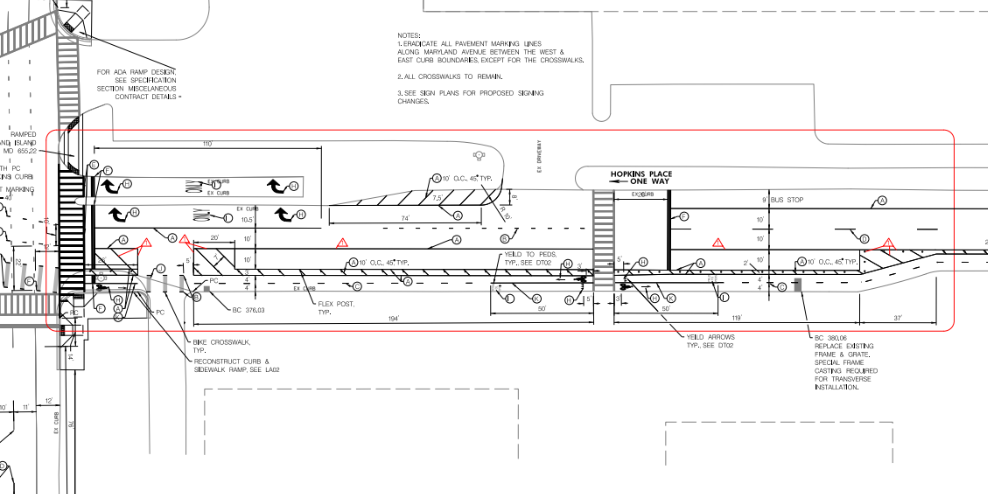
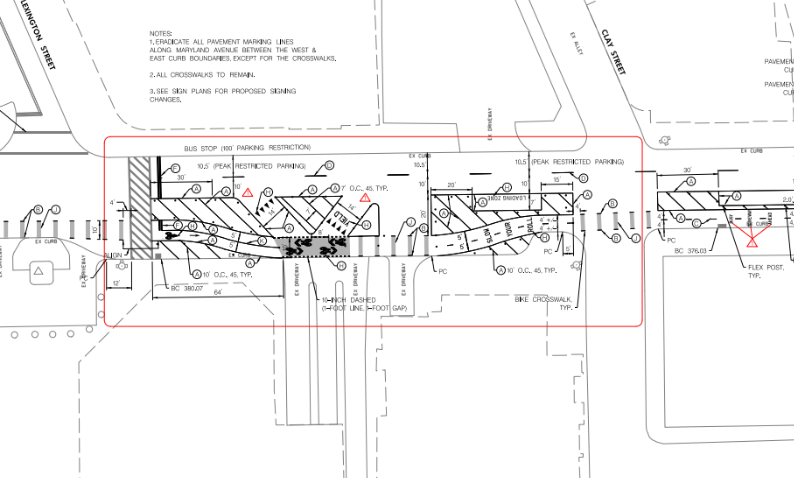
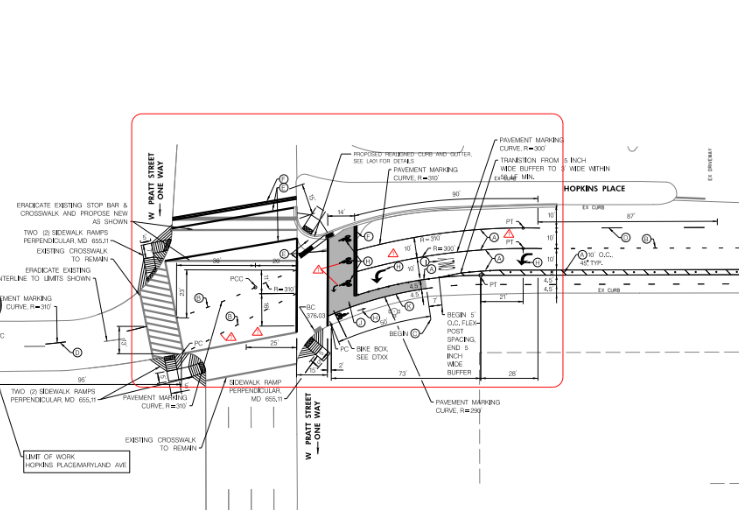
Certain portions of the Maryland Avenue cycle track contain construction errors in the original design, including at the Pratt Street intersection. Other portions are regular conflict points, like at Centre Street and at the Lexington Street parking garage. Resuming construction of the Downtown Bike Network will allow us to fix these sections with correct and/or improved designs that will make the Maryland Avenue cycle track safer for all users.

Overall

The Downtown Bike Network will create a critical cross town connection that can be expanded upon into East and West Baltimore over the next 2-3 years. We’re thankful that BCDOT is taking a bold step in creating another high quality connection, and that they used this delay to think creatively and improve designs.

We will advocate to use the winter to improve the Madison Street design for a spring implementation that does not risk grant expiration.


Complete Streets at the Finish Line

MVIMG_20181010_120558.jpg

Today we’re one step closer to making it the law that streets are designed to prioritize the safety of all people using the street, not just the speed of moving cars — in all Baltimore neighborhoods.

Today, Baltimore City Council’s Land Use and Transportation Committee voted favorable with amendments on Bill #17-0102 Complete Streets.

This moves the Complete Streets bill out of committee, to a full city council vote on Second Reader scheduled for Monday, October 15th and Third Reader for Final Passage on Monday, October 29th.

If the bill is voted favorably on October 29th, it will go to Mayor Pugh’s desk for signature.

Once signed, it will be Baltimore City Department of Transportation’s job to begin implementation of the most progressive, equity-focused complete streets ordinance in the country.

If you are interested in attending either city council meeting, they will begin at 5pm. Please bring a state ID.

Background

Councilman Ryan Dorsey and the Baltimore Complete Streets coalition introduced our Complete Streets Ordinance just over a year ago in July 2017.

Since that time, Councilman Dorsey, the Council President’s Office, Councilman Pinkett, and Bikemore have stewarded the legislation through multiple agency meetings, public information sessions, and community meetings.

In March, we received national recognition for our progress when the National Complete Streets Coalition named Baltimore’s Complete Streets Ordinance one of 2017’s best initiatives and named Councilman Dorsey a complete streets champion. In April, we presented at Intersections 2018, the national conference for complete streets.

Subsequent hearings at the Land Use and Transportation Committee brought experts in street design to testify to City Council. A detailed presentation crafted by the Baltimore Complete Streets Coalition highlighted best practices across the country that were included in the bill, as well as identified locations in the bill where we had negotiated compromise with Baltimore City Department of Transportation.

These hearings led to work sessions in September and October where the Land Use and Transportation Committee adopted a series of technical amendments agreed upon by Councilman Dorsey, the coalition, and Baltimore City Department of Transportation.

At the final work session today, October 10th, the Land Use and Transportation Committee voted the bill favorable with amendments, sending it to the full city council for consideration.

We're winning!

Screen Shot 2018-08-09 at 1.35.41 PM.png

One year ago we were celebrating saving the Potomac Street bike lane. And while that was a victory for bikes, we knew this was just the beginning of the fight to get a long term policy solution to an unfair application of the law.

For 14 months Bikemore staff worked tirelessly to pressure the City to come to a solution. And on Monday we saw that hard work pay off and scored a significant win. Baltimore City Council voted unanimously to remove Appendix D from the Fire Code and state that all new street design must conform to NACTO standards. This means that the Fire Department can no longer arbitrarily block the construction of bike lanes by pointing to a section of the fire code that makes zero sense in an urban environment.

And while we still await the Mayor signing the bill into law, we demonstrated that we are tenacious in our pursuit of a city that’s safe for people who bike. And that because of your support we can deliver groundbreaking wins.

Help us celebrate by making a donation to Bikemore today. Right now we need you more than ever. These wins are only possible because of support from people like you. With 40% of our operating budget funded through grassroots donations, we rely on individuals just like you stepping up and joining the fight for bikes. Help us secure the next win with a donation of $50 or more today.

Already gave? Forward this story to a friend who loves bikes, and let them know why you support Bikemore.


Check out some of our recent press on the issue: 

“It’s important to note that this bill does not change BCFD’s role in project plans review,” she pointed out. “It simply ensures that conversation around fire access begins at a place that fully considers the benefits of designing a city safe for biking and walking.” 
— City council passes bill altering fire code to address stalled bike lane, building projects, Baltimore Fishbowl

“This has been a year-long fight to make sure our city advances in progressive transportation planning,” said Liz Cornish, the director of Bikemore. “We think council made the right move and we look forward to the mayor signing this bill.” 
City Council repeals part of fire code to accommodate bike lanes, development, Baltimore Sun


Two Steps Forward, One Step Back

Residents using the new #BigJumpBaltimore connection

Residents using the new #BigJumpBaltimore connection

A post from Liz Cornish, Bikemore Executive Director

It has been a good couple of weeks for bike advocacy. We saw the installation of #BigJumpBaltimore, a one mile walking and biking path that creates a safe connection across the Jones Falls Expressway. One of the highlights has been hearing from residents of Lakeview Towers who can finally travel to Remington to access amenities on their mobility devices--demonstrating once again how our work is about so much more than bikes. This project represents an innovative partnership between Baltimore City DOT, the office of Councilman Pinkett, PeopleForBikes, and Bikemore. It also demonstrates that the city has the capacity to engineer and install transformative projects quickly when the right folks come to the table. We look forward to advocating for this approach to be applied to other neighborhoods seeking solutions to improve safety, calm traffic, and improve mobility of residents.


City Council Hearing on BCFD video that deployed a truck in front of Liz Cornish's home.

City Council Hearing on BCFD video that deployed a truck in front of Liz Cornish's home.

Councilman Dorsey introduced Council Bill 18-0259 – Fire Code Appendix D Repeal which is scheduled to be voted out of second reader on August 6th. This would resolve the year and a half long struggle to design streets that follow NACTO guidelines by eliminating the overly restrictive portions of the International Fire Code that require 20-26 feet of clear width. The bill has support from both Complete Streets advocates and real estate developers who want to incorporate Complete Streets in new developments.

But we've also seen setbacks, including the press release issued late yesterday evening from Baltimore City DOT regarding next steps for Roland Avenue. After three years of protracted debate, fiery public meetings, multiple perspectives from residents being shared, and countless DOT resources expended, the Baltimore City DOT has announced they are hiring a consultant to continue the process of finding a permanent solution for Roland Avenue. 

Interim steps will include a pilot to reduce sections of the road to one lane and retention of two speed cameras along the corridor, both of which we support. The plan also calls for restoration of curbside parking on several blocks along the facility, which we do not support. These blocks happen to be where establishments attended by the largest critics of bicycle infrastructure are located. Piecemeal removal of protection on the Roland Avenue facility cripples the all-ages nature of the design and makes a confusing mess for all road users to navigate. New riders won't try biking on Roland Avenue, and existing users will face increased danger. It is a choice to value the convenience of curbside parking over the safety of vulnerable road users.

The opportunity was there for Baltimore City DOT to make a decisive move and select their own preferred option. It had strong citywide and Roland Park community support, and would have reduced the corridor to one lane and widened both the parking and bike lane. This solution addressed all valid stakeholder concerns and would have cost the city significantly less than a full redesign. We see the decision to devote more time and resources to this project as wasteful. DOT has allowed the circus around this small section of street to go on far past what’s appropriate to make neighbors feel heard and included in decision making. It has emboldened residents citywide into believing  if they just shout loud enough, if they deploy egregious scare tactics and disrupt public meetings, that they can get their way. That’s not good community engagement. That’s not how you create an equitable transportation system that considers all users.

Sunset at Lake Montebello

Sunset at Lake Montebello

Last night, I stood out on the edge of Lake Montebello in the evening and counted over a hundred people riding bikes. There was a small child on a pink bike with streamers in the handle bars and training wheels riding ahead of her family walking along the lake. There were dozens of residents using Rec and Parks Ride Around the Reservoir bikes. There were men and women fully kitted out on fancy road bikes. And in one of the most touching displays, a woman pedaled by on a bike that had been adapted so that she could push a young person who I assume is otherwise confined to a wheelchair around the lake, allowing him to enjoy the breeze in his face and a really nice sunset. It’s unlikely these folks even know me or Bikemore’s work. For them, biking isn’t something they even wish to fight for, it’s just a joyful experience they want to share with people they love.

Our work is about ensuring that joy is accessible to every resident of Baltimore, no matter what zip code you live in. Bringing health and joy to Baltimore residents should be an easy choice, not one that sparks endless, divisive debate. Our advocacy for Roland Avenue moving forward will include continued support to neighborhood leaders who have already demonstrated the groundswell of support for a protected lane. We will continue to attend meetings with Baltimore City DOT, including the Mayor’s Bicycle Advisory Commission, and voice our opinion on appropriate design and next steps. But we can no longer in good conscious continue to direct our limited staff resources to attending every public meeting to push back against residents determined to prioritize their own personal convenience above collaborative solutions that address everyone’s concerns and improve safety for all.

We know many of our members will be impacted by DOT’s decision to remove some of the lane. We know we have supporters who own homes in Roland Park whose quality of life includes having a safe place for their kids to bike to school. We’re going to do our best to continue to advocate for traffic calming and an all-ages protected facility on Roland Avenue, but not at the expense of directing our work in neighborhoods that are excited to re-imagine public space and build inclusive, safe streets for all.

I can’t get that image of the woman at Lake Montebello out of my mind, pedaling for over an hour to allow her child to enjoy the outdoors. There are families facing hardships in neighborhoods throughout the city that want and deserve that access to recreation, that safety, and that mobility. I’m disappointed that the conversations around streets can’t seem to center their experience and needs. With the #BigJumpBaltimore, the City has demonstrated its ability to do innovative work that improves the safety of people who need it most. That should be the standard they are held to moving forward.

It's Happening! Big Jump Project Update

"For decades, road design has prioritized car commuting through the 7th district over residents' ability to access the assets and opportunities that exist both within and outside our district by foot, bicycle, or public transit. People for Bikes' Big Jump Project is an opportunity to re-focus our priorities on improving quality of life for people living in and around Reservoir Hill, making jobs to the east and our world-class Druid Hill Park to the north safely accessible to residents who choose to walk, bike, or take transit." 

Councilman Leon Pinkett, 7th District

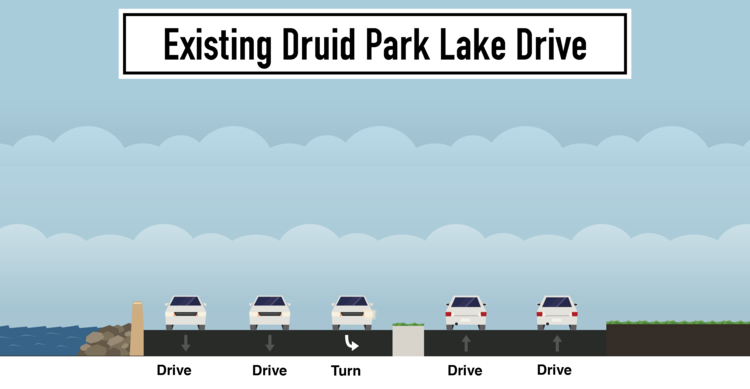
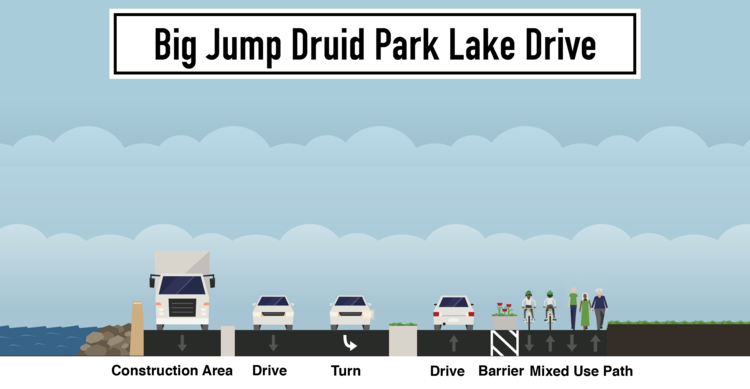
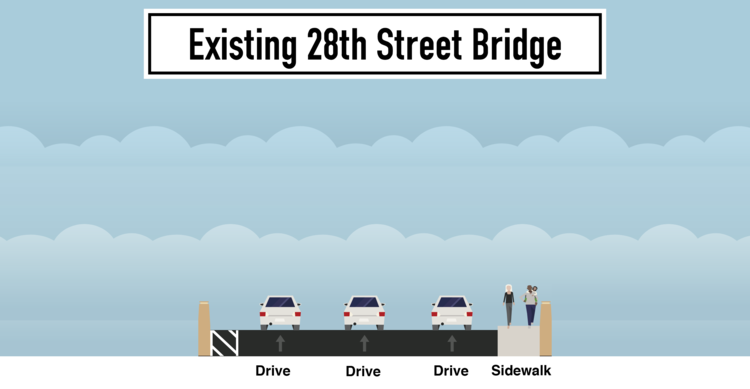
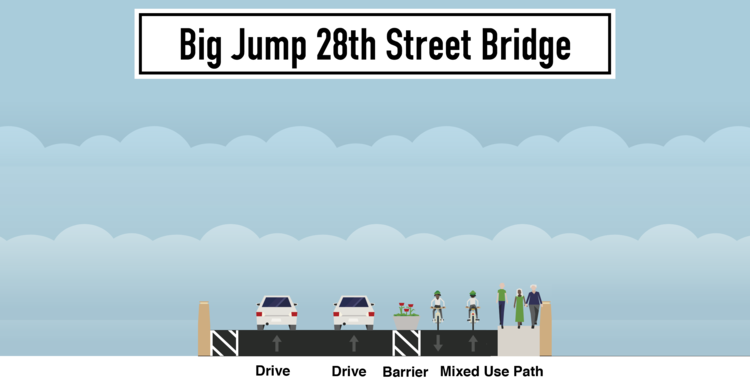
Today, water-filled barriers are being installed on Druid Park Lake Drive and 28th Street, creating a wide walking and biking path connecting the neighborhoods of Penn North, Reservoir Hill, and Remington. Turning north at Sisson and 28th Street, the path will continue as a sidewalk and two-way separated bike lane to Wyman Park Drive, connecting to the Jones Falls Trail.

This installation is part of a larger grant Baltimore City won from PeopleForBikes, called The Big Jump Project. Full details of the project are available in our past posts here and here

We will be writing more in-depth about this project in the coming weeks, as well as working on a large public launch event to celebrate this new safe pathway between previously disconnected communities. 

If you want to get involved in event planning, come to our weekly planning happy hour!

In the meantime, we are celebrating this huge win for Baltimore, made possible by creative Baltimore City Department of Transportation staff and clear, committed leadership from Councilman Leon Pinkett.

This work wouldn't be possible without your continued financial support.