Bike Lanes

We're winning!

Screen Shot 2018-08-09 at 1.35.41 PM.png

One year ago we were celebrating saving the Potomac Street bike lane. And while that was a victory for bikes, we knew this was just the beginning of the fight to get a long term policy solution to an unfair application of the law.

For 14 months Bikemore staff worked tirelessly to pressure the City to come to a solution. And on Monday we saw that hard work pay off and scored a significant win. Baltimore City Council voted unanimously to remove Appendix D from the Fire Code and state that all new street design must conform to NACTO standards. This means that the Fire Department can no longer arbitrarily block the construction of bike lanes by pointing to a section of the fire code that makes zero sense in an urban environment.

And while we still await the Mayor signing the bill into law, we demonstrated that we are tenacious in our pursuit of a city that’s safe for people who bike. And that because of your support we can deliver groundbreaking wins.

Help us celebrate by making a donation to Bikemore today. Right now we need you more than ever. These wins are only possible because of support from people like you. With 40% of our operating budget funded through grassroots donations, we rely on individuals just like you stepping up and joining the fight for bikes. Help us secure the next win with a donation of $50 or more today.

Donate Today

Already gave? Forward this story to a friend who loves bikes, and let them know why you support Bikemore.


Check out some of our recent press on the issue: 

“It’s important to note that this bill does not change BCFD’s role in project plans review,” she pointed out. “It simply ensures that conversation around fire access begins at a place that fully considers the benefits of designing a city safe for biking and walking.” 
— City council passes bill altering fire code to address stalled bike lane, building projects, Baltimore Fishbowl

“This has been a year-long fight to make sure our city advances in progressive transportation planning,” said Liz Cornish, the director of Bikemore. “We think council made the right move and we look forward to the mayor signing this bill.” 
City Council repeals part of fire code to accommodate bike lanes, development, Baltimore Sun
 

It's Happening! Big Jump Project Update

"For decades, road design has prioritized car commuting through the 7th district over residents' ability to access the assets and opportunities that exist both within and outside our district by foot, bicycle, or public transit. People for Bikes' Big Jump Project is an opportunity to re-focus our priorities on improving quality of life for people living in and around Reservoir Hill, making jobs to the east and our world-class Druid Hill Park to the north safely accessible to residents who choose to walk, bike, or take transit." 

Councilman Leon Pinkett, 7th District

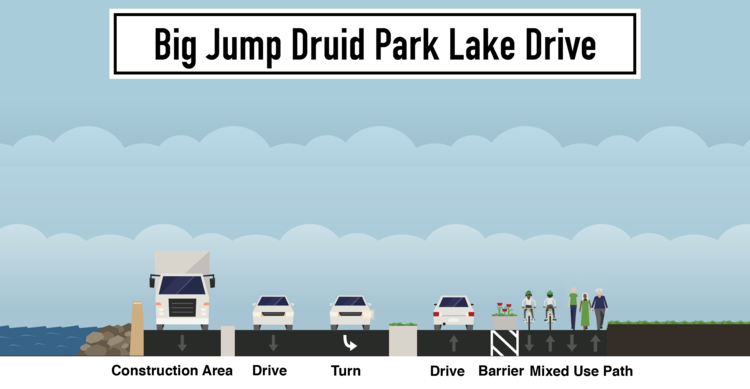
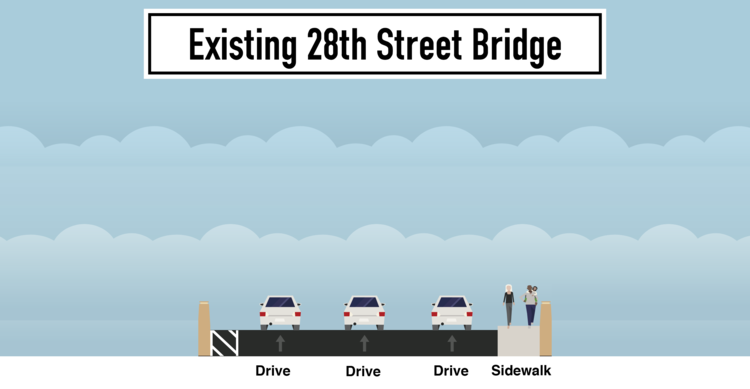
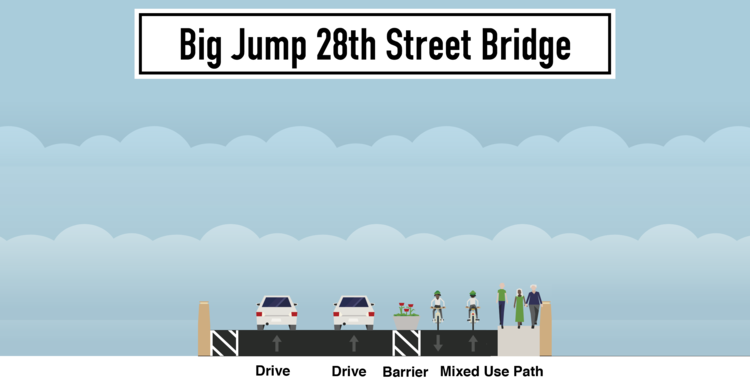
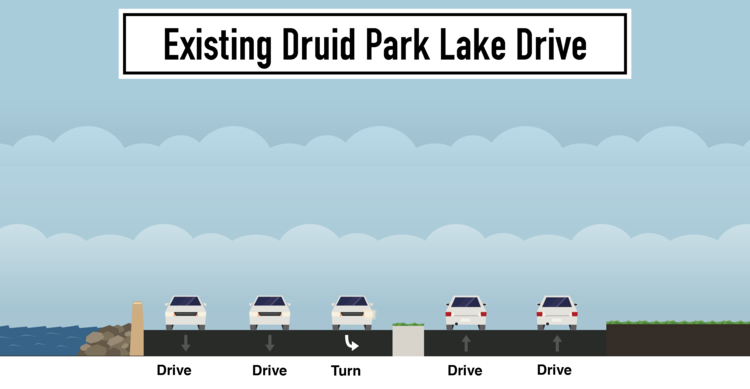
Today, water-filled barriers are being installed on Druid Park Lake Drive and 28th Street, creating a wide walking and biking path connecting the neighborhoods of Penn North, Reservoir Hill, and Remington. Turning north at Sisson and 28th Street, the path will continue as a sidewalk and two-way separated bike lane to Wyman Park Drive, connecting to the Jones Falls Trail.

This installation is part of a larger grant Baltimore City won from PeopleForBikes, called The Big Jump Project. Full details of the project are available in our past posts here and here

We will be writing more in-depth about this project in the coming weeks, as well as working on a large public launch event to celebrate this new safe pathway between previously disconnected communities. 

If you want to get involved in event planning, come to our weekly planning happy hour!

In the meantime, we are celebrating this huge win for Baltimore, made possible by creative Baltimore City Department of Transportation staff and clear, committed leadership from Councilman Leon Pinkett.

This work wouldn't be possible without your continued financial support.

Donate to Bikemore

An Update on Roland Avenue

UPDATE to the Update: 

Last week, BCDOT presented options for revision of Roland Avenue. Their “preferred option” is a road diet that takes Roland Avenue down to one lane in each direction. This would slow traffic while allowing for a wider parking lane, reducing parking intrusion into the bike lane. This design would solve  It also is by far the most cost-effective and quickest to implement solution.

While several other designs presented would maintain an all-ages bike lane, they would cost in excess of a million dollars, money that can and should be spent building infrastructure in the rest of our city where it is desperately needed.

Two designs were presented that would remove protected, all-ages lanes entirely. Removing protected infrastructure on streets where our city-adopted plans require it is a dangerous and likely illegal move that we cannot support.

You can see the presentation and the options here.

Please use the below tool to send comments in support of the preferred option, #1:


image005.jpg

In brief

On Thursday at 6:00pm at Roland Park Elementary School, Baltimore City Department of Transportation will be hosting yet another meeting on potential design revisions for Roland Avenue. It's likely that BCDOT will present at least one design option that is incompatible with adopted city guidance and removes parking protection and the all-ages classification of Roland Avenue. Please come out and show your support for a revised design that reduces a travel lane and keeps an all-ages, curbside protected bike lane on Roland Avenue.

Background: Roland Ave needs a road diet

Cars continue to speed on Roland Avenue, causing dangerous conditions for people walking, biking, or trying to enter and exit parked cars. This is not an issue with a bike lane, it's an issue with inconsiderate, speeding drivers. Luckily, it's solvable.

From day one, we have advocated for a road diet on Roland Avenue that would reduce the street to a single travel lane, a wider parking lane, and a wider curbside protected bike lane in each direction. This design is proven to slow vehicular travel speeds, by far the number one complaint about the current design on Roland Avenue. It is also the #1 design alternative listed in Roland Park Civic League's own commissioned Alta Planning report. 

Any new design for Roland Avenue must maintain an all-ages, physically separated bike facility. Baltimore City Department of Transportation's own guidance states this, as does our city-adopted Bike Master Plan and Separated Bike Network Addendum. 

Slide from the original BCDOT presentation on Roland Avenue, showing that traffic volumes and speeds on Roland Avenue require a physically separated bike facility.

Slide from the original BCDOT presentation on Roland Avenue, showing that traffic volumes and speeds on Roland Avenue require a physically separated bike facility.

Some say tear it out

Some neighbors in Roland Park continue to advocate for removal of the curbside bike lane and restoration of curbside parking.

Restoration of curbside parking would create a remaining area that is visually massive, contributing further to speeding cars along Roland Avenue. The Roland Park Civic League commissioned Alta Planning Report agrees with our assessment: "The travel lane may not seem narrower...and therefore will not calm traffic to the same degree as modification #1."

Returning parking curbside would require installation of a new median-side bike lane separated only by flex posts, or striping of a standard buffered bike lane, against BCDOT guidance. Either design would remove the all-ages, parking-separated nature of the original facility, a step backward in safety for people who bike.

Tearing it out has a cost

While additional striping for a road diet that keeps the bike lane curbside is cheap, returning parking curbside would require milling and resurfacing of Roland Avenue to install a significantly different striping pattern. This would cost upwards of $500,000 of local dollars.

For comparison, the local dollar contribution for BCDOT to build the entire separated bike network plan for West Baltimore is $464,848.

11.5 miles of separated and supporting facilities in West Baltimore could be built for the cost of returning parking curbside on Roland Avenue.

11.5 miles of separated and supporting facilities in West Baltimore could be built for the cost of returning parking curbside on Roland Avenue.

Enough is enough

Baltimore City Department of Transportation has now spent years meeting with a vocal minority of Roland Park residents. The only reasonable and safe solution to their complaints happens to be the cheapest solution: striping a road diet and keeping a protected bike lane curbside. 

Any more time or dollars spent on this project = time or dollars that could be spent on increasing access to opportunity to residents most in need of it.

If Baltimore City Department of Transportation dares spend $500,000 on resurfacing Roland Avenue to make the street less safe for people biking instead of investing that money into expanding bike access into West Baltimore per the city's own adopted Separated Bike Lane Network Plan, they will be exacerbating inequity and doubling down on our city's well documented history of structurally racist infrastructure spending.

A Brief Update on Fire Access

A project before the planning commission tomorrow that does not comply with BCFD's interpretation of Appendix D of the International Fire Code.

A project before the planning commission tomorrow that does not comply with BCFD's interpretation of Appendix D of the International Fire Code.

The mayor's office has committed to resolving the ongoing discrepancies in Baltimore City Fire Department's interpretation of Appendix D of the International Fire Code. We believe that the likely resolution will be in the form of an emergency access commission that reviews and grants or rejects exceptions to the current interpretation of Appendix D. We have a number of concerns with this approach, including that it will inevitably lead to inconsistency as major developers will spend the time to lobby for exemptions while smaller development projects or city projects like street re-design likely will simply stick with the code as written--which will be bad for urban design and street safety.

As we continue to discuss a permanent resolution, inconsistency is rampant. The Fire Department demanded a re-design of Potomac Street, adjacent to two story rowhomes, but demanded no such re-design for Preston Gardens, adjacent to several hundred foot tall buildings, despite clear width on these streets being the same.

We have sent the below letter to the Baltimore City Planning Commission about several major development projects on the commission agenda tomorrow that fail to meet BCFD's current interpretation of Appendix D of the IFC.

We want to be clear that we support good urban development. We don't want the fire code to hold these projects up either. But we just don't understand how these projects can move forward while BCFD demands re-design of major bicycle infrastructure projects that would have created similar or even better fire access conditions than these developments.

Downtown Bike Network Update

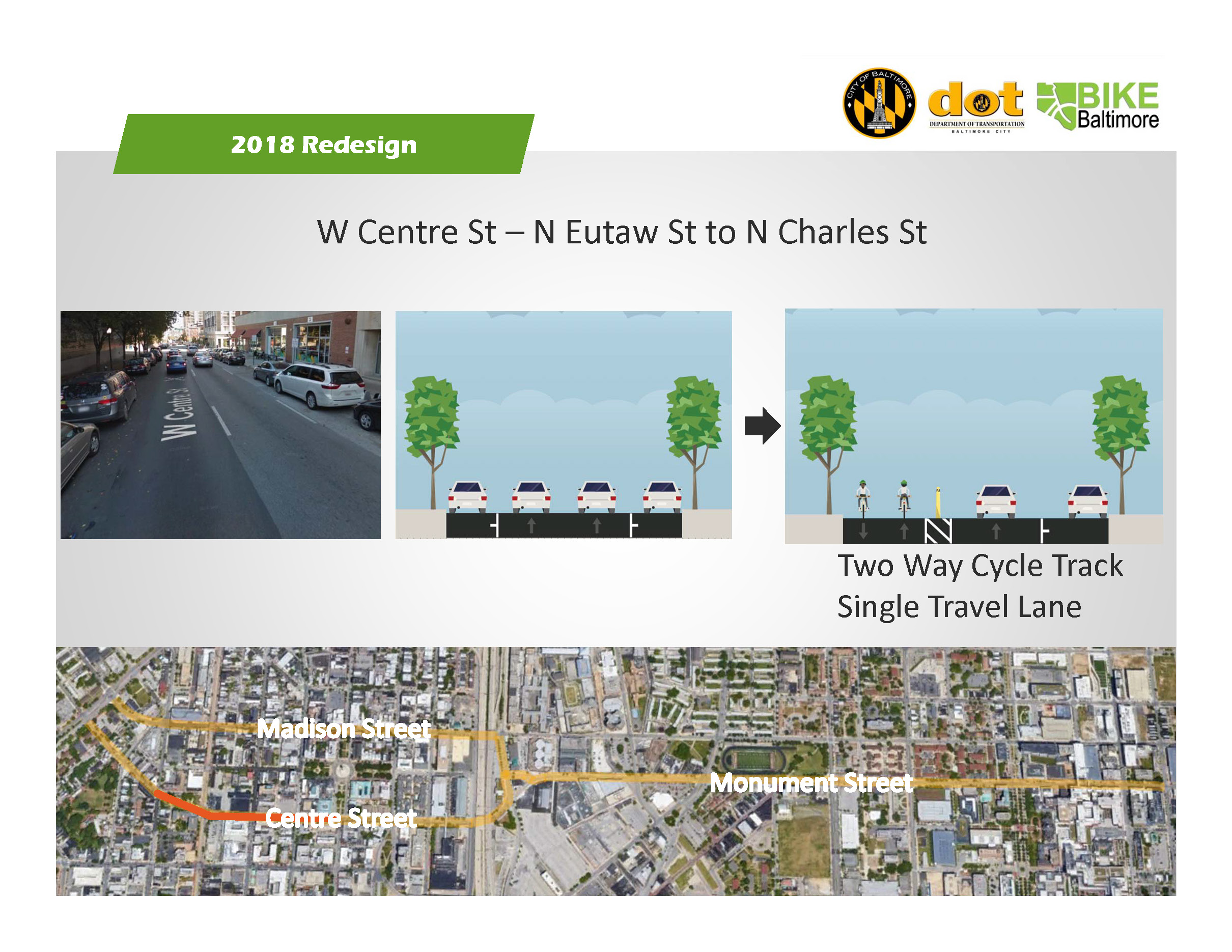
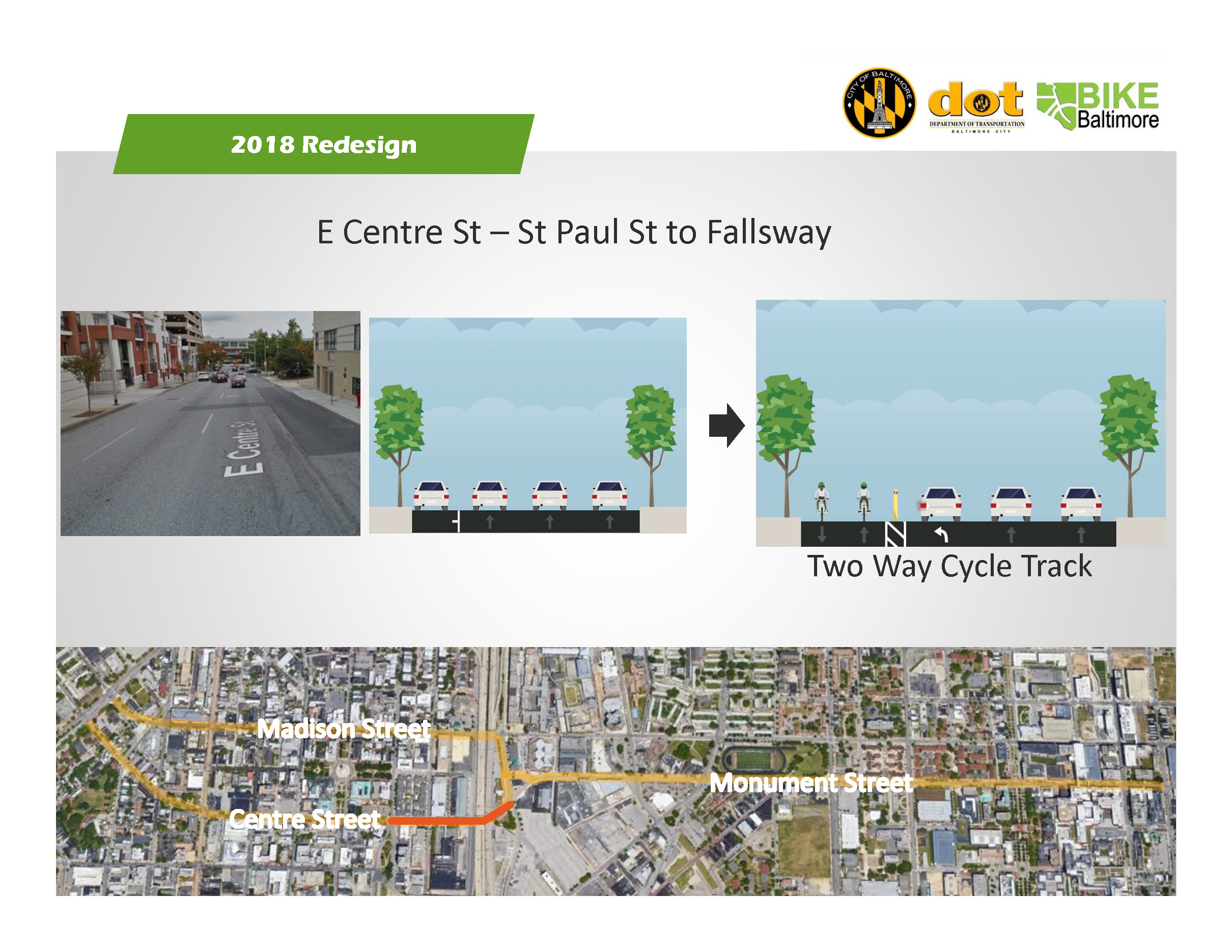
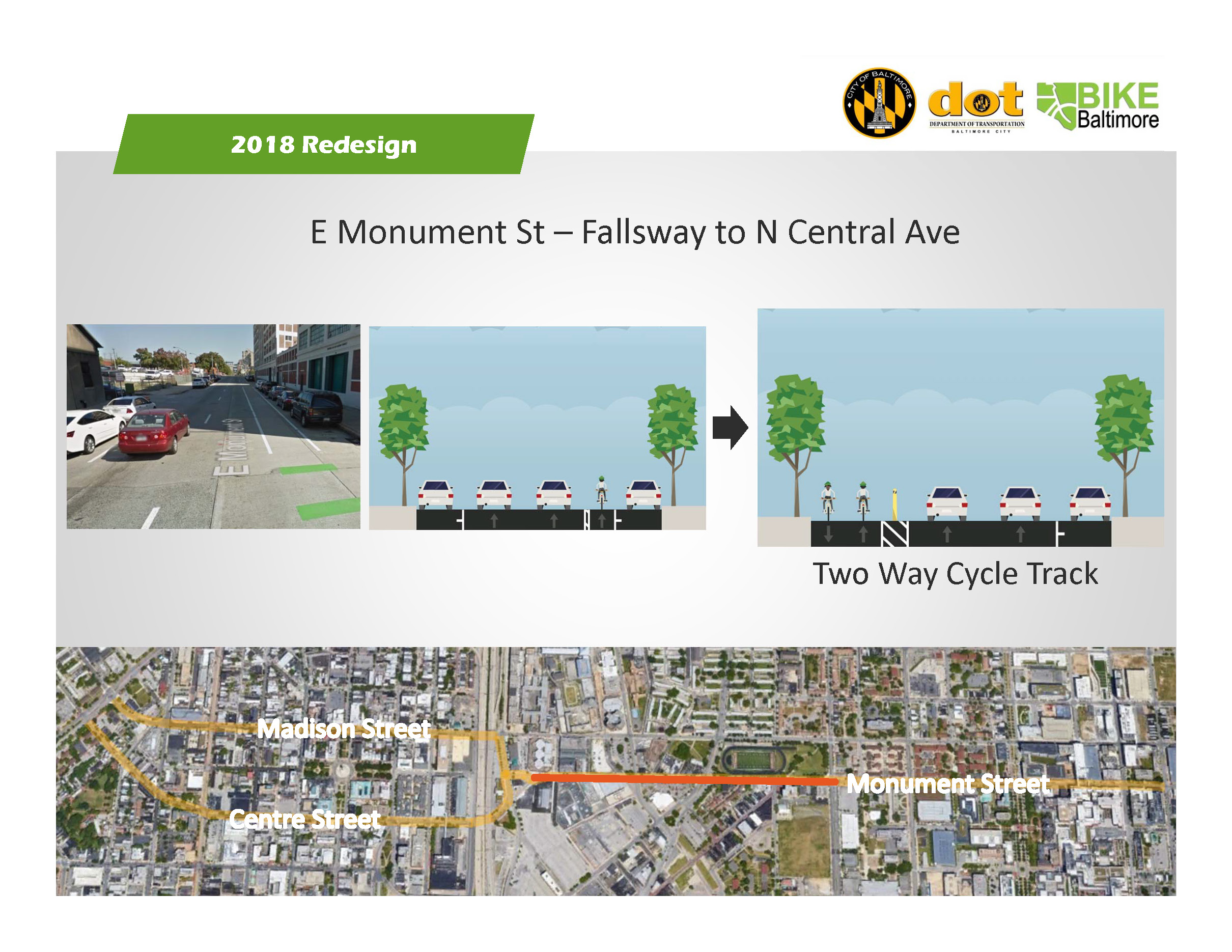
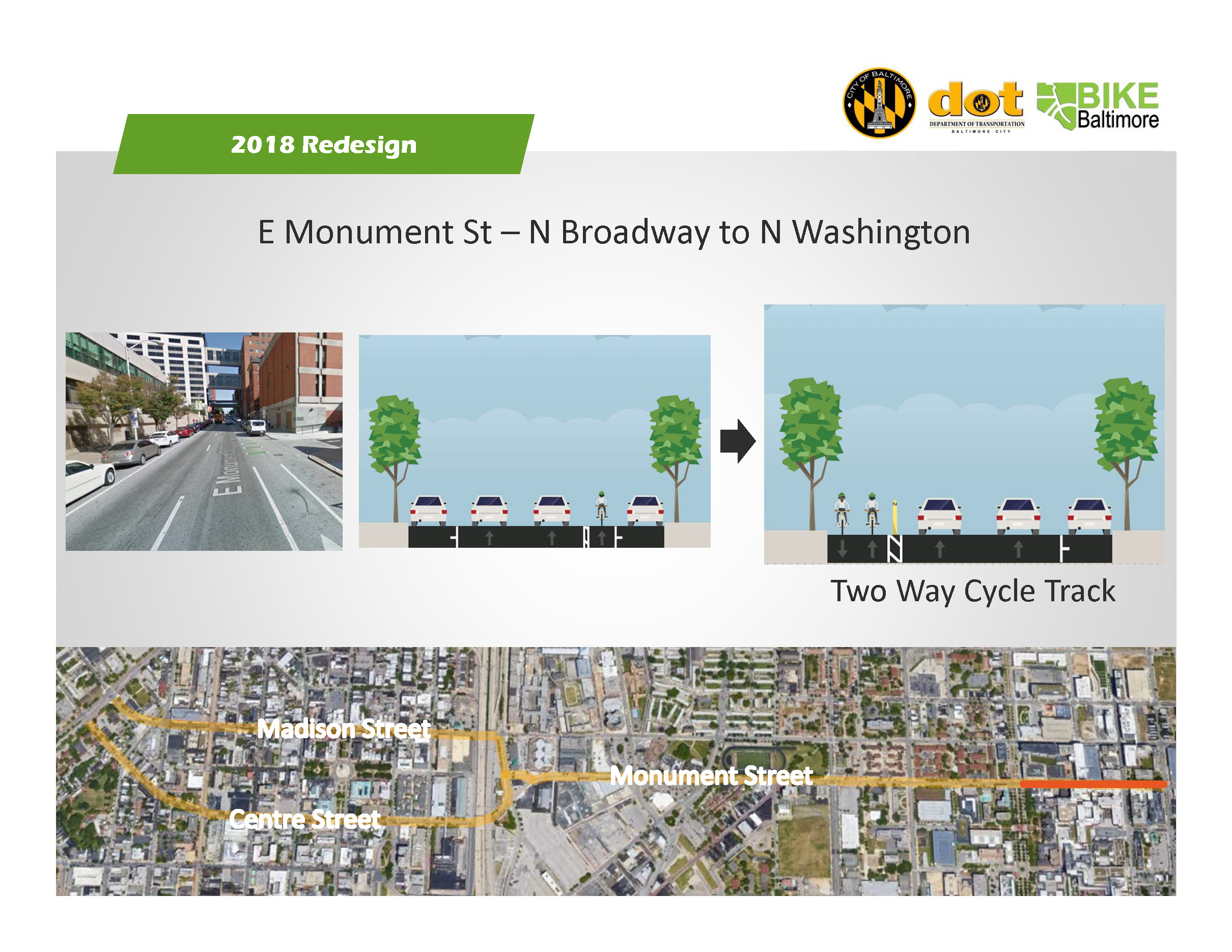
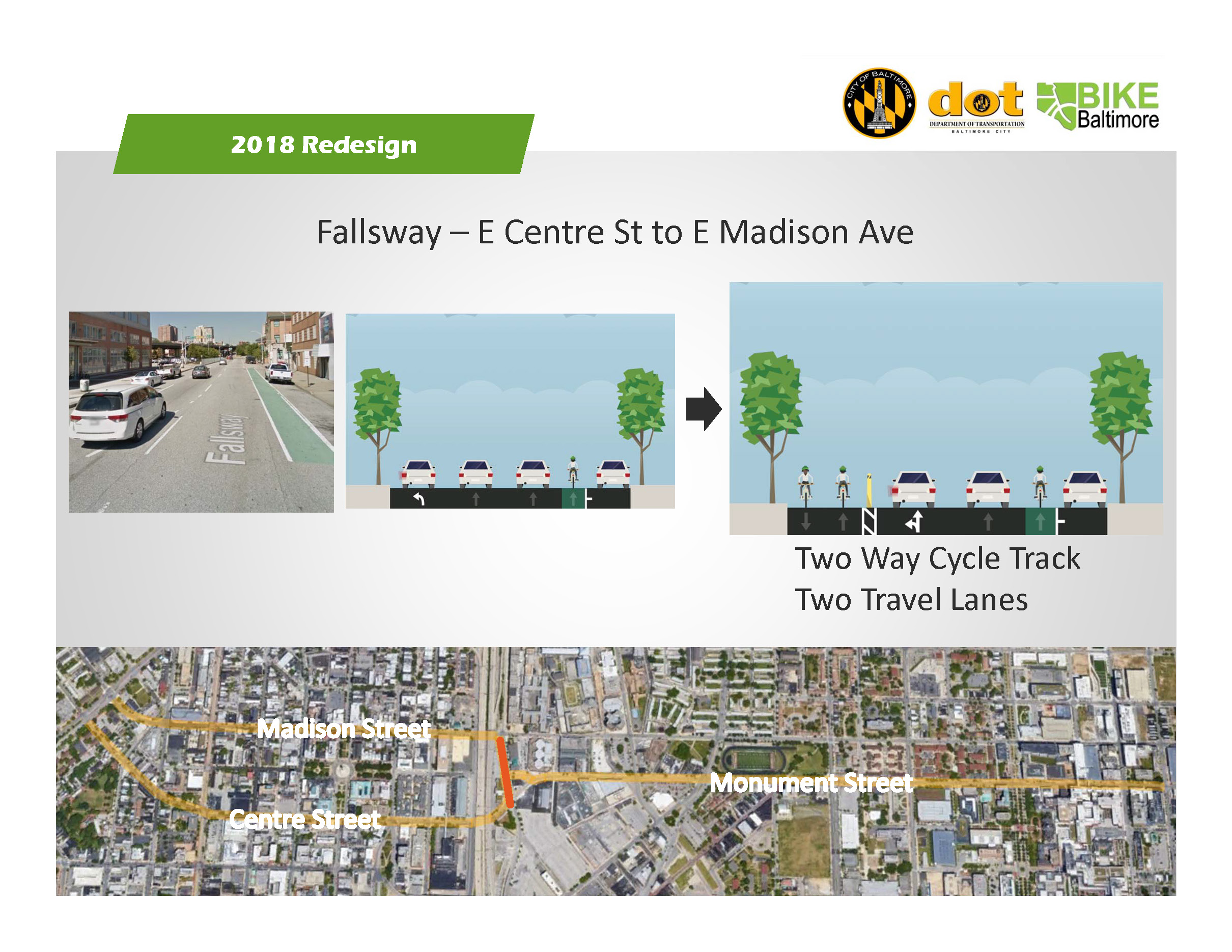
The Downtown Bike Network, previously on construction hold due to Baltimore City Fire Department's unique interpretation of International Fire Code, has been re-designed with that interpretation in mind by Baltimore City Department of Transportation.

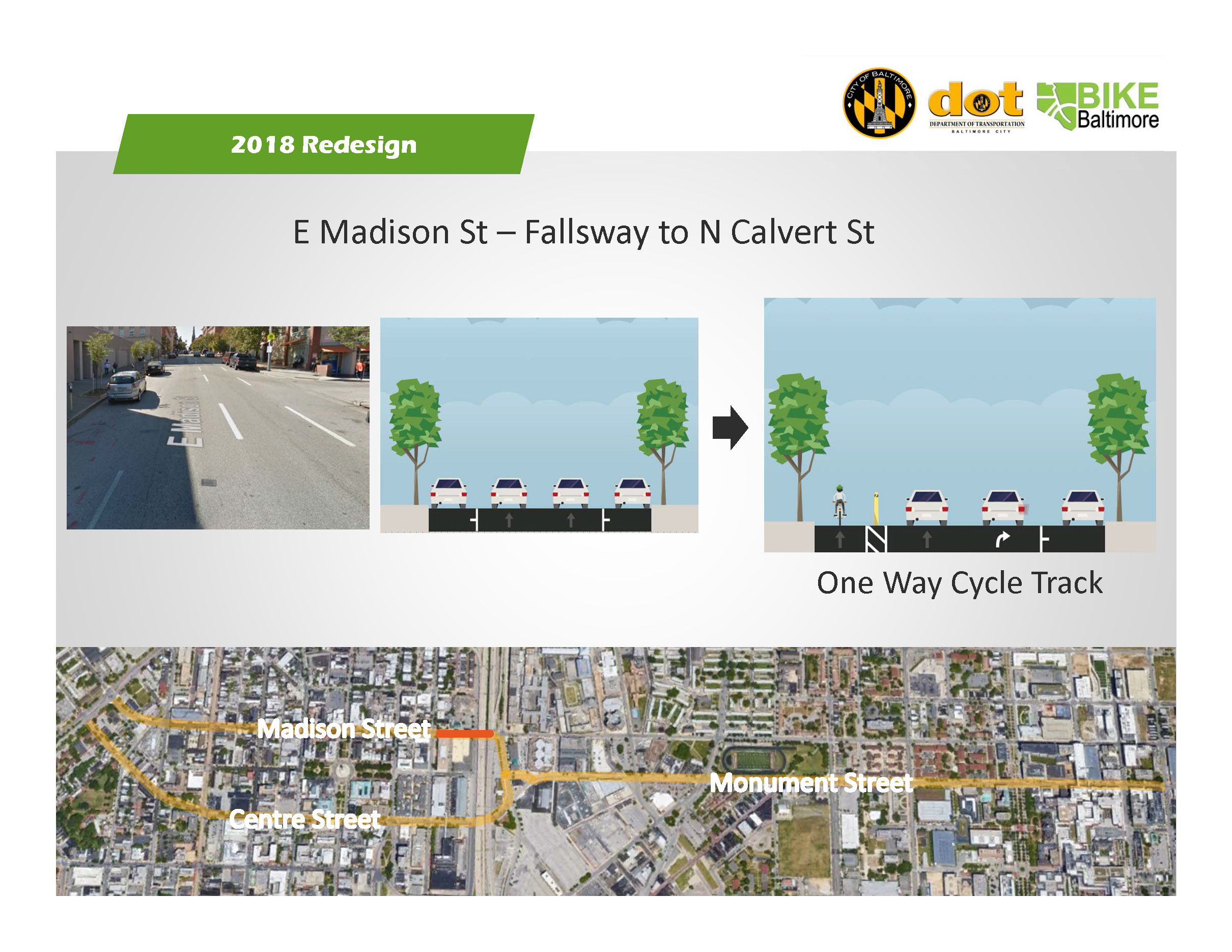
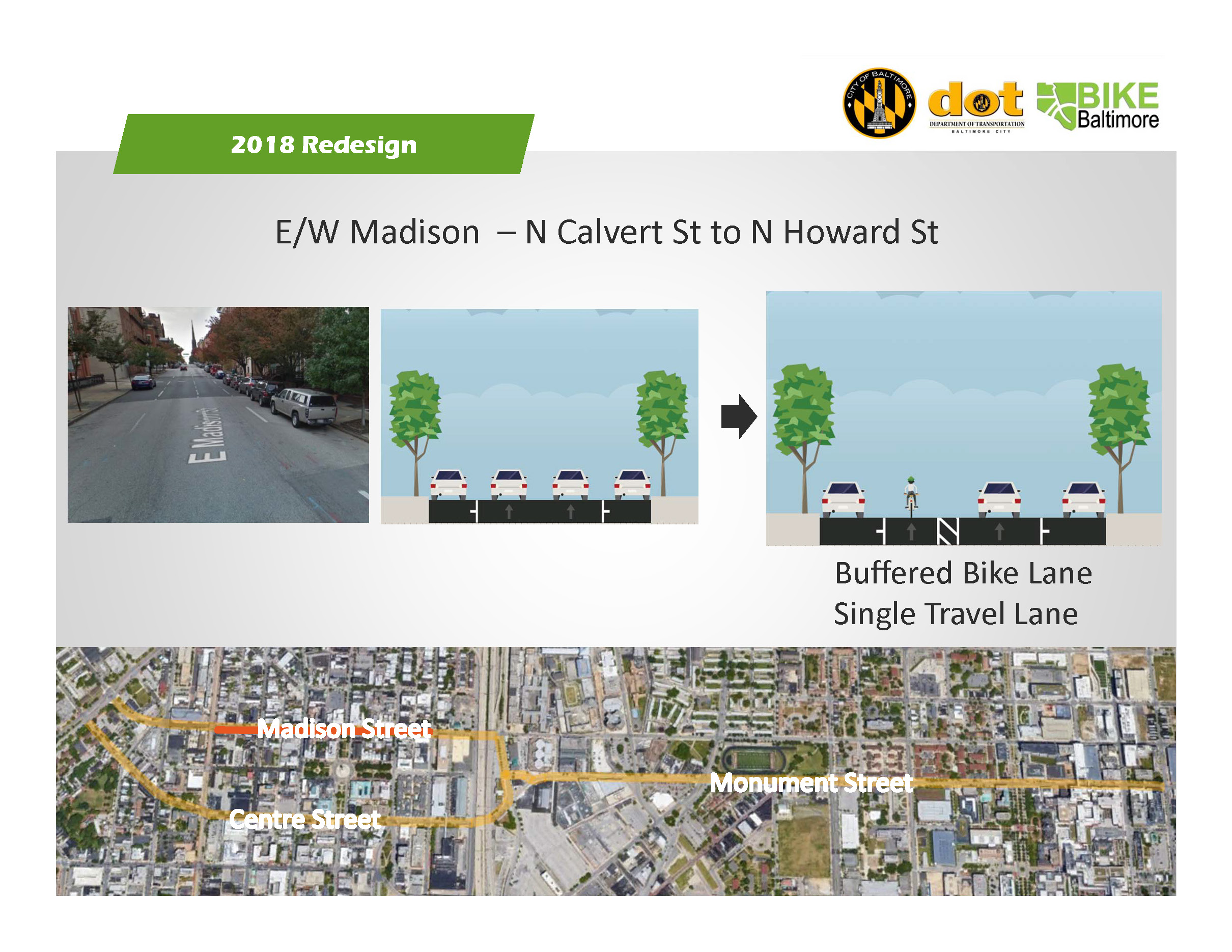
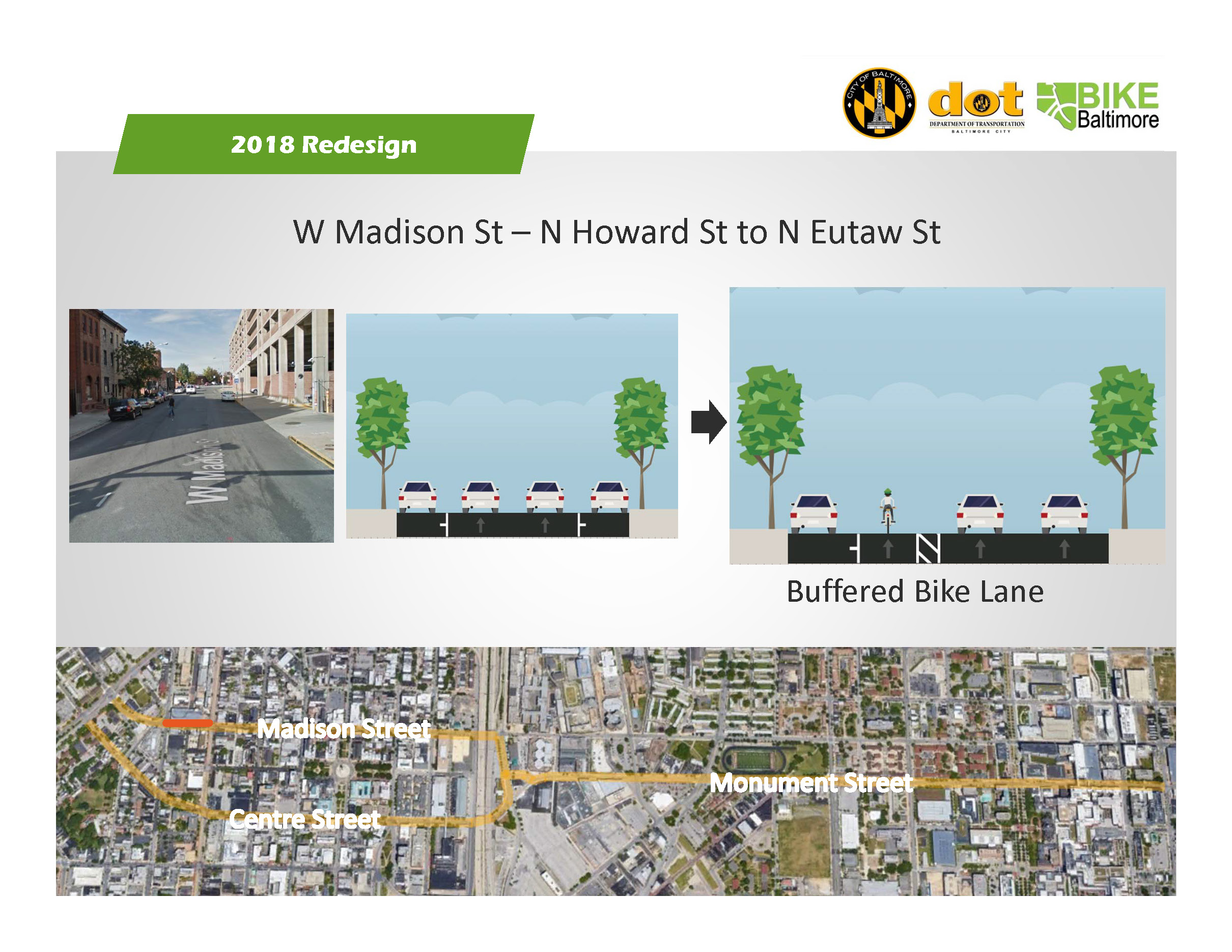
The new design switches from one-way pairs of infrastructure along Madison and Monument Streets to a fully-separated two-way bike lane along Centre and Monument Streets. This is a major improvement over the original design, providing a fully separated corridor along the length of the project. A buffered bike lane on Madison in Mount Vernon is maintained to provide traffic calming long requested by the Mount Vernon Belvedere Association.

In no place are existing condition street widths being reduced, and in many locations clear widths are being increased, so there should be no issue with Baltimore City Fire Department approval. If approved by Baltimore City Fire Department, the project construction will resume and hopefully be complete by end of Summer 2018.

We thank Baltimore City Department of Transportation for their effort in this re-design, which manages to both address unreasonable fire access demands while improving the separation of the facility.