Bike Lanes

Update on Roland Avenue

Screen Shot 2019-04-24 at 5.08.36 PM.png

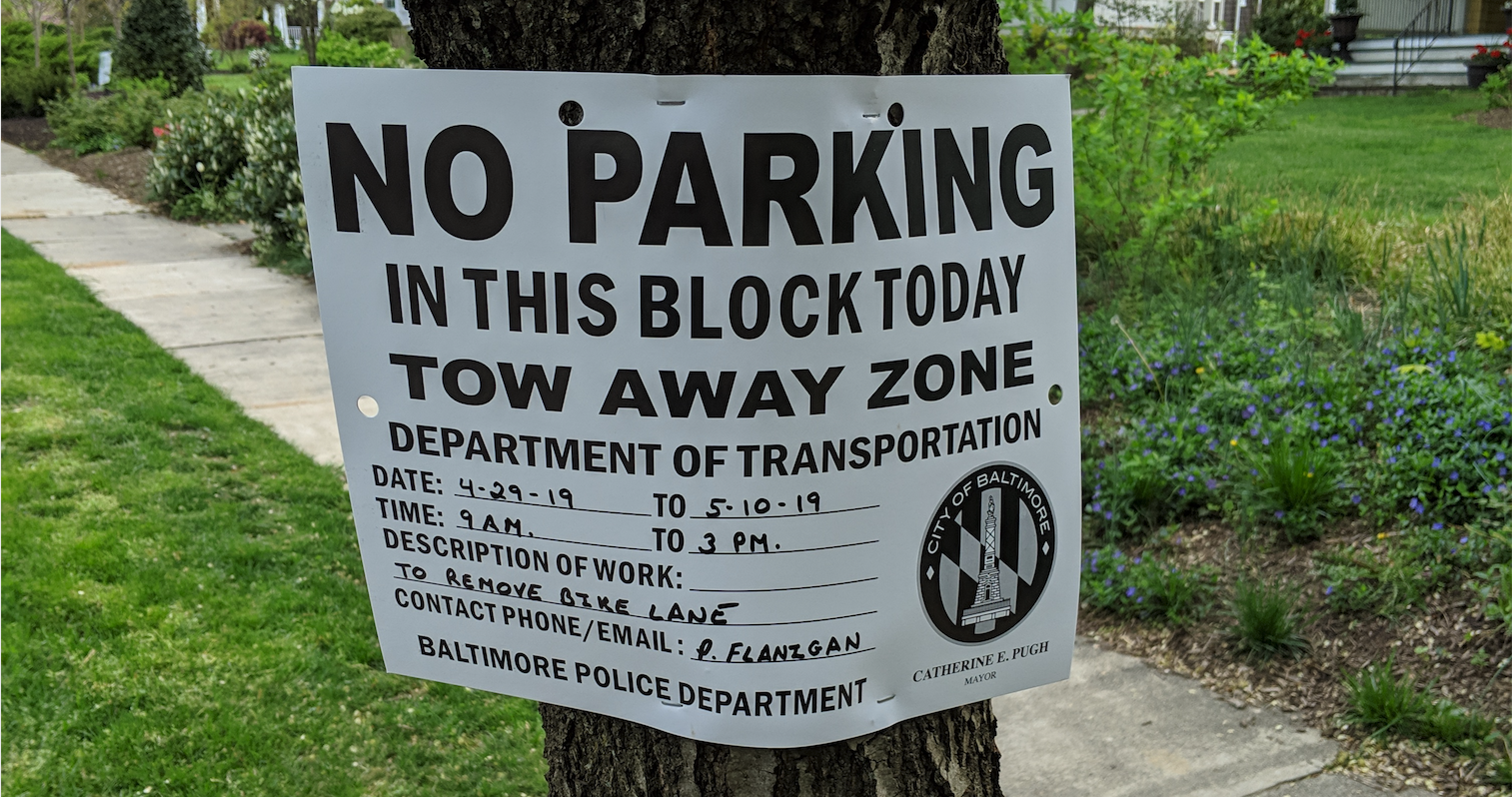
Baltimore City Department of Transportation has decided to move forward on a directive from an absentee mayor to tear out the Roland Avenue protected bike lane and revert it back to the original design. In the Mayor’s Bicycle Advisory Commission meeting today, we learned that this phase of removal will cost at least $140,000.00. Mayor Pugh’s directive also included the placement of green paint on an indefinite timeline that will extend down University Parkway, adding significantly to projected costs.

At today’s meeting, we publicly confirmed with Department of Transportation staff that traffic volumes and speeds on Roland Avenue require a separated facility based on DOT’s own adopted guidance and national best practice documents codified into city law under the Baltimore Complete Streets ordinance.

For four years, we have shown up to meetings. We helped organize neighbors who believe that people of all ages and abilities should be able to bike on that stretch of road. We have received verbal threats. It has put Bikemore in an impossible position of going head to head with some of the most influential residents in the city. It has misdirected City resources. It created a contentious divide among neighbors. This project has caused unnecessary harm.

It is a failure of leadership when something as relatively insignificant as paint on a street receives this amount of resources and exposure. There are challenges facing this city that eclipse the needs on this one mile stretch of road, and it is our opinion that it is time to move on. Everyone has had their say. The next step should be to implement change that creates the safest, most fiscally responsible option. Removing the bike lane is not that.

We take our responsibility to push for streets that are proven to increase safety seriously, and and we will continue to do so. And the people that bike in this city, including the people who bike on Roland Avenue, are committed to lifting up the causes and leaders who address the multitude of problems facing our city. Streets built for people who bike, walk, and take transit are part of that effort.

The love we have for Baltimore is fierce. How can it not be? We see the city up close every single day. We are your kids’ teachers, we are your doctors, we are the political organizers fighting for affordable housing, we are in City Hall, we are your pastors, we are kids popping wheelies, we are the racers doing laps around Lake Montebello — all adding to the things that make Baltimore unique and beautiful. We are among those building a city where people want to live. The way a handful of people, who in many other instances have proven to be incredibly altruistic, have other-ized their neighbors and people who bike is inexcusable.

We want to apologize on behalf of everyone that is part of this contentious situation. Bikemore is for everyone, and safe streets should be too.

And finally we want to apologize to Rachel and everyone that knew and loved Tom Palermo. This project, as small as it was, had the potential to demonstrate the City’s commitment to preventing a tragedy like that from happening again. It had the potential to build a safe place to do the thing Tom loved most—riding bikes.

We know there are some of you wondering if we are going to sue to halt the removal of the bike lane. It is certainly an arrow in our quiver and one we have demonstrated we are not afraid to use. It is also unsustainable, and is the express reason we championed the Complete Streets Bill. This is a bill the Mayor signed into law, the same Mayor who has given this directive. And this directive is being carried out by the same agency that stood beside us celebrating the law’s passage. What other laws has Mayor Pugh signed with no intention to follow?

It is a challenging time for the City, making it especially important to do the right thing. We ask that the City evaluate the costs of the redesign, the risk of making this arbitrary decision, and the clear compromise to safety this directive will cause, and immediately stop work. To do otherwise would continue to put us on this path of confusion, contention and wastefulness.

The City must take seriously its responsibility as outlined in the Complete Streets ordinance, including the stated directive to promote biking to “the greatest extent possible.” And we will continue to fight until they do.

Statement on Mayor Pugh's Decision to Remove Protected Bike Lanes on Roland Avenue

IMG_20180412_171125.jpg

Today, Mayor Pugh announced the cancellation of the Roland Avenue lane elimination pilot. Instead, Baltimore City Department of Transportation will remove the all-ages protected bike lane on Roland Avenue, return parking to the curbside, and install a standard green painted bicycle lane next to two automobile travel lanes.

We are disappointed that voices behind closed doors were able to influence this decision, despite a PIA request from a Roland Park neighbor showing 62% support for the road diet plan.

We still believe the pilot project should move forward. Why wouldn’t we test a design that could possibly make the street safer for everyone, before committing to spending between $700,000 and $1.4 million to restore a design proven to be unsafe, a design that couldn’t prevent the death of Tom Palermo just a few blocks north?

The meeting to discuss the pilot was supposed to happen Monday night. Since our blog post yesterday, over 100 people have written to Council Vice President Middleton supporting the pilot project, saying that no matter what, separated bike lanes have to remain on Roland Avenue. We have also heard from dozens of Roland Park residents directly who feel the same way, residents excited about the pilot, residents who purchased homes in Roland Park because of the protected lanes, residents scared of what may happen next.

We haven’t determined our next steps. But our position is this:

Baltimore City Department of Transportation must maintain an all-ages, protected bike lane on Roland Avenue, as called for in the Separated Lane Network Plan, and as required by national separated bike lane guidance adopted in ordinance and in policy by the City of Baltimore.

ACTION ALERT: Support the Pilot on Roland Ave


A letter from Liz Cornish, Executive Director, Bikemore

Next Monday DOT will host a meeting to discuss whether or not to put down orange barrels for one mile on Roland Ave for four weeks. The idea is to determine if reducing that stretch of road to one lane is viable. If successful, it will demonstrate that it is possible to design a street that calms traffic, makes it safer get out of your car while parked in the street, and creates a wider, safer protected bike lane. Everyone has waited years for an improved design. We are ready to move forward.

Tell the City you support moving forward with the pilot. Tell the City that you support a protected bike lane on Roland Avenue.

Take action by sending an email to Councilwoman Sharon Green Middleton using this form:

Four years ago Tom Palermo, a beloved member of the bicycling community, and most importantly a husband and father, was killed on Roland Avenue using a bike lane on the outside of the curbside parking by Heather Cook. Cook was drunk, texting, and operating a vehicle without regard for human life. Bikemore existed before then, but there is no denying Tom’s death was a catalyzing moment for bike advocacy in Baltimore.

Shortly thereafter construction for a resurfacing and streetscaping project on Roland Avenue began, one planned long before Tom’s death. DOT moved forward with the existing design for three reasons: The Roland Park Civic League asked for a protected bike lane in their Master Plan, NACTO guidelines recommend it on streets where average vehicle speed and traffic volumes match that of Roland Avenue, and at the time it seemed unviable to garner public support for the removal of a traffic lane. There is also no doubt that Tom’s tragic death just mere blocks from the project also influenced their decision to build a protected bike lane.

Very few people are happy with the current configuration — including me. But over time a narrative emerged that people advocating for a bike lane were intruders. That only long standing residents should have a say. People with access to power typically have the upper hand. And so it was. Tensions ran high, public meetings were fraught, and the whole thing became absurd.

In this instance some people became blind with rage when their own extraneous interests weren’t given top priority. It also demonstrated that the City is still a long way from being able to respond to controversy fairly and with precision.

This is out of hand. The folks driving this controversy are no longer acting in good faith. People have been given four years to share their perspective. It’s time for a final decision to be made and move on.

I hope folks that attend the meeting take a step back and check the nastiness at the door. I hope everyone looks at the plans DOT drew up to put some barrels down on the street for four weeks and shrug their shoulders and say, ok.

There’s enough space on that street to make cars drive slower, to make it safer to exit your car when it’s parked on the street, and make a protected lane that people of all ages can safely and comfortably enjoy. Anyone that says different has decided to do so only to win a fight of their own making.

Making a public street that prioritizes the safety of all people over the convenience of cars is the best thing for everyone — even people who have made it clear that they disagree. Opponents have lots of tactics. They want more data — plenty exists. They want more time — they’ve had four years. They evoke concerns that stoke fear, like emergency response — that have no basis. They ask us to think of the children getting dropped off in cars — without regard to the kids who would like to bike but cannot do so safely. They say clearly that the road should be designed with only the people that use it the most in mind — rather than those most likely to be injured or killed. They say cyclists don’t deserve a bike lane since they already don’t follow the law — completely disregarding that in the case of people like Tom and too many others, it is the DRIVER WHO BROKE THE LAW AND KILLED SOMEONE.

I shake my head when people tell me I should stay away, not engage, not fan the flames. They forget this isn’t some pet cause or a hobby. This is advocacy for something that is proven to make people healthier and safer — something proven to save lives.

Update on the Bike Budget (It's Bad)

Bikemore Executive Director Liz Cornish, Councilman Leon Pinkett, Councilman Ryan Dorsey, and MBAC Chair Jon Laria testifying at Planning Commission.

Bikemore Executive Director Liz Cornish, Councilman Leon Pinkett, Councilman Ryan Dorsey, and MBAC Chair Jon Laria testifying at Planning Commission.

A month ago, Baltimore City Department of Transportation released a FY2020-2025 Capital Improvement Program that totally eliminated the line item for bicycle infrastructure for all six years.

Three weeks ago, we testified at the Planning Commission alongside Councilman Dorsey, Councilman Pinkett, and Mayor's Bicycle Advisory Commission Chair Jon Laria about this disparity, and members of the Planning Commission suggested BCDOT come back with a budget that reflects the adopted plan.

Yesterday BCDOT did the opposite, by presenting a plan to the Mayor's Bicycle Advisory Commission to build only about six miles of infrastructure by 2025.

BCDOTs revised CIP at a meeting yesterday. The 12.7 miles listed are “lane miles” not road miles, which means DOT is counting bike infrastructure in both directions on a street to inflate their numbers.

BCDOTs revised CIP at a meeting yesterday. The 12.7 miles listed are “lane miles” not road miles, which means DOT is counting bike infrastructure in both directions on a street to inflate their numbers.

The Separated Lane Network Plan calls for building 77 road miles of infrastructure from 2018-2022, using $5 million in local dollars to match federal and state grants totaling about $27 million dollars over those five years.

BCDOT instead proposes building 6.35 road miles of infrastructure from 2020-2025, using just $3 million of local and federal dollars total. About 3 miles of this proposal are facilities that should have been built back in 2017.

If we’re being generous and count all 6.35 miles of infrastructure, BCDOT plans to ignore 92% of the plan they paid to develop and asked the Planning Commission to adopt. At the pace they propose, it will take over 70 years to implement the 5 year Separated Lane Network Plan.

After overwhelmingly negative feedback at the Mayor’s Bicycle Advisory Commission yesterday, it’s possible BCDOT will again revise their CIP request for today’s Planning Commission hearing.

But here’s where we’re at right now:

  • A BCDOT budget that blatantly ignores adopted city plans

  • A bicycle program over 20 miles behind schedule and a clear plan to fall further behind

  • Constant threats to downgrade and remove existing bike infrastructure

  • A missed deadline on the very first Complete Streets Ordinance update

  • A mass departure of talented BCDOT staff

  • Rising injury and death on our roadways

Even if the CIP is revised to show everything we want on paper, how can the Director be trusted to faithfully implement it, given these past two presentations, where we were told there was no capacity or intent to do that very implementation? How can we trust this agency to act in good faith when all the signs listed above prove they’re failing on nearly every front?

Baltimore City Department of Transportation will present their revised CIP at 3:00PM today, with public comment to follow. We plan to be there to highlight our concerns, and welcome citizens to join us.

Baltimore City DOT CIP Follow-Up | 417 E. Fayette Street, 8th Floor | 3:00PM until comments conclude

If you can’t join us, you’re also welcome to send an email expressing your concerns and the meaningful affect of bicycle infrastructure on your choice to live, work, and play in Baltimore to the Planning Department for inclusion in the Commission file (deptofplanning@baltimorecity.gov) and BCDOT Director Pourciau (michelle.pourciau@baltimorecity.gov).

Downtown Bike Network Resumes Construction

Downtown Bike Network Construction Timeline (courtesy of BCDOT)

Downtown Bike Network Construction Timeline (courtesy of BCDOT)

The Downtown Bike Network resumes construction this week. For full details, please visit Baltimore City Department of Transportation’s Downtown Bike Network page.

Background

The Downtown Bike Network was originally slated to be completed over a year ago. Construction was halted during the Potomac Street fire access discussion, and the Baltimore City Fire Department required a full re-design of the Downtown Bike Network before construction could resume.

We believe a re-design to comply with arbitrary fire clearance standards was unnecessary, and successfully fought to overturn that piece of fire code to prevent those standards from affecting projects again.

However, this fight occurred alongside the construction halt on Downtown Bike Network. So we worked with Baltimore City Department of Transportation on a re-design that improved significant portions of the design while also maintaining the at-the-time required fire clearance.

New Design Monument/Centre (the good)

The new design creates a fully-separated, two-way bike lane along Centre and Monument Streets from MLK/Eutaw to Washington Street. This will allow direct connections to future separated lanes on Wolfe or Washington Streets to the East, and to the future MLK sidepath and Eutaw Place separated lane.

The design replaces the original protected lane on Madison Street east of Guilford Avenue, replacing it with the two-way facility on Monument.

New Design Madison (not so good/opportunity to improve)

West of Guilford Avenue, Madison Street is planned to have a combination of separated lanes and buffered lanes, the latter being a requirement in portions due to the fire code. This section has been strongly opposed by the Director of Baltimore School for the Arts, and as a result, implementation has been delayed until Summer 2019.

Madison Street needs a re-design that calms traffic along the corridor. It is dangerous and contributes to economic decline of the corridor.

This delay in implementation is both a disappointment and an opportunity. The fire code update will go into effect in the end of October, which gives us the winter to discuss a better design for Madison Avenue that will meet the needs of people biking, the community desire for real traffic calming, and Dr. Ford’s concerns at Baltimore School for the Arts.

However, the delay until Summer 2019 may mean the grant will expire, causing us to lose the money to construct any design on Madison Street. This would be an unacceptable outcome. BCDOT must work to ensure any delay does not end with an expired grant, and must accept that some stakeholders may never accept infrastructure changes, even when they address critical street safety issues.

Changes on Maryland/Cathedral

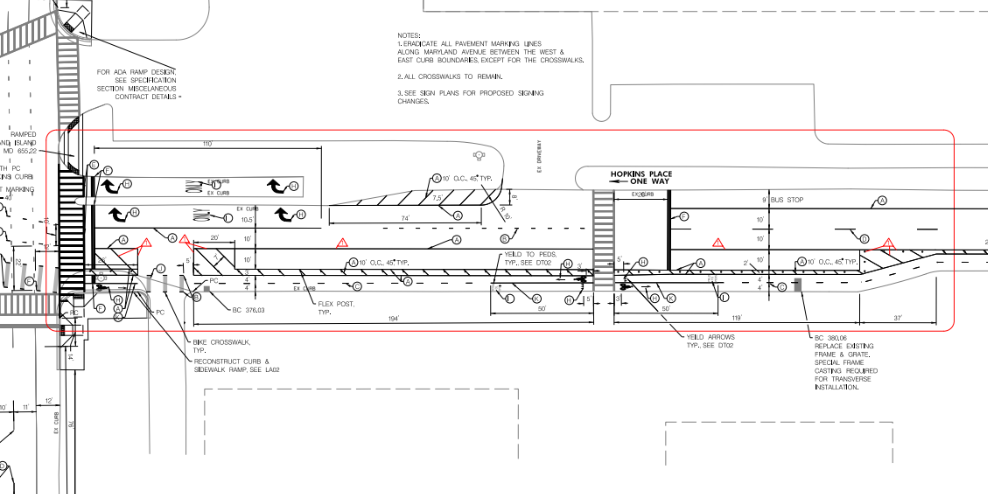
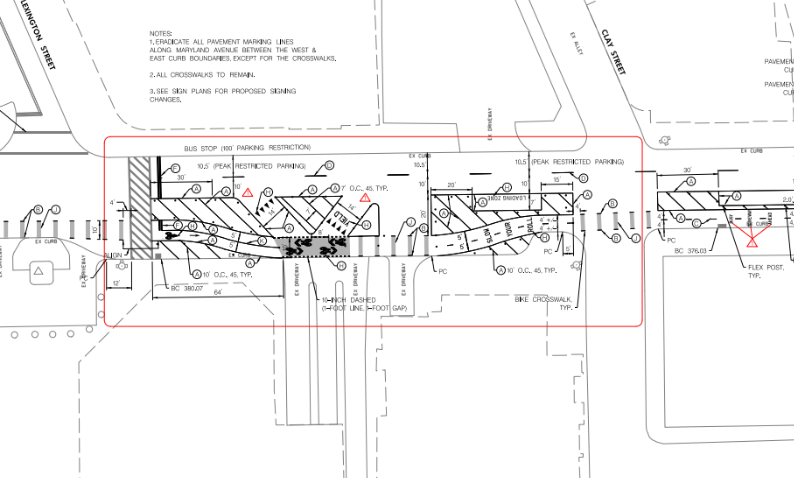
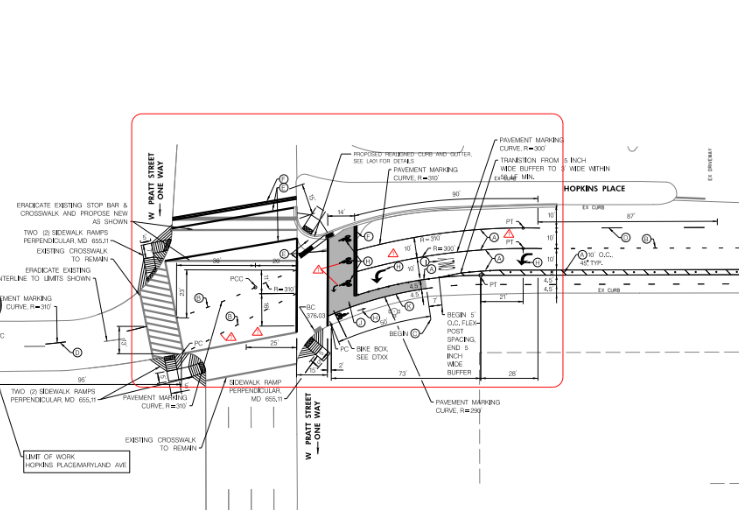
Certain portions of the Maryland Avenue cycle track contain construction errors in the original design, including at the Pratt Street intersection. Other portions are regular conflict points, like at Centre Street and at the Lexington Street parking garage. Resuming construction of the Downtown Bike Network will allow us to fix these sections with correct and/or improved designs that will make the Maryland Avenue cycle track safer for all users.

Overall

The Downtown Bike Network will create a critical cross town connection that can be expanded upon into East and West Baltimore over the next 2-3 years. We’re thankful that BCDOT is taking a bold step in creating another high quality connection, and that they used this delay to think creatively and improve designs.

We will advocate to use the winter to improve the Madison Street design for a spring implementation that does not risk grant expiration.