Bike Lanes

Big Jump Detour for Druid Hill Reservoir Construction

BigJumpWeb_51_1G7A2050.jpg

Background

The ongoing Department of Public Works construction project in Druid Hill Park to install tanks to store treated city drinking water is moving to a phase of pipe construction to connect the two tanks our water system. The pipe will cross Druid Park Lake Drive at Linden Avenue, and follow the roadway along the median east to the JFX on-ramps. To make this connection, DPW will need to dig a trench in the median of Druid Park Lake Drive.

In between the original plans for this construction and today, Baltimore City Department of Transportation received a grant from People For Bikes called The Big Jump, to install a temporary shared use pathway along Druid Park Lake Drive and across the 28th Street bridge, a road diet and protected bike lanes on Huntingdon Avenue and 25th Street, a bike boulevard on 27th Street, and bike lanes on Remington Avenue.

Of those grant funded projects, only the most important one—the connection across Druid Park Lake Drive and the 28th Street bridge—has been constructed. The shared use path, installed in June 2018, allows people to walk, bike, skate, and use a wheelchair or mobility device to safely cross from Reservoir Hill to Remington for the first time.

The Detour

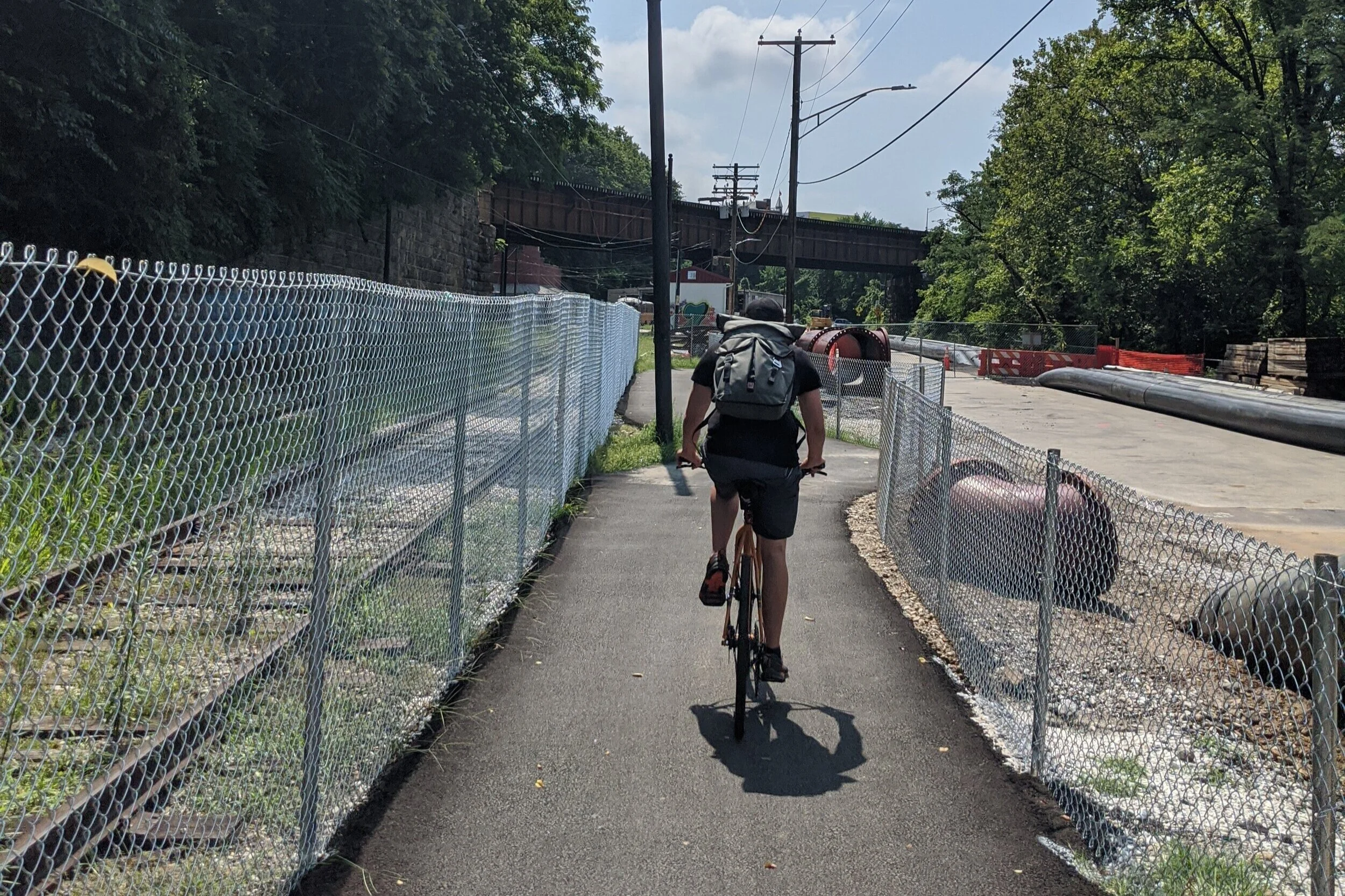
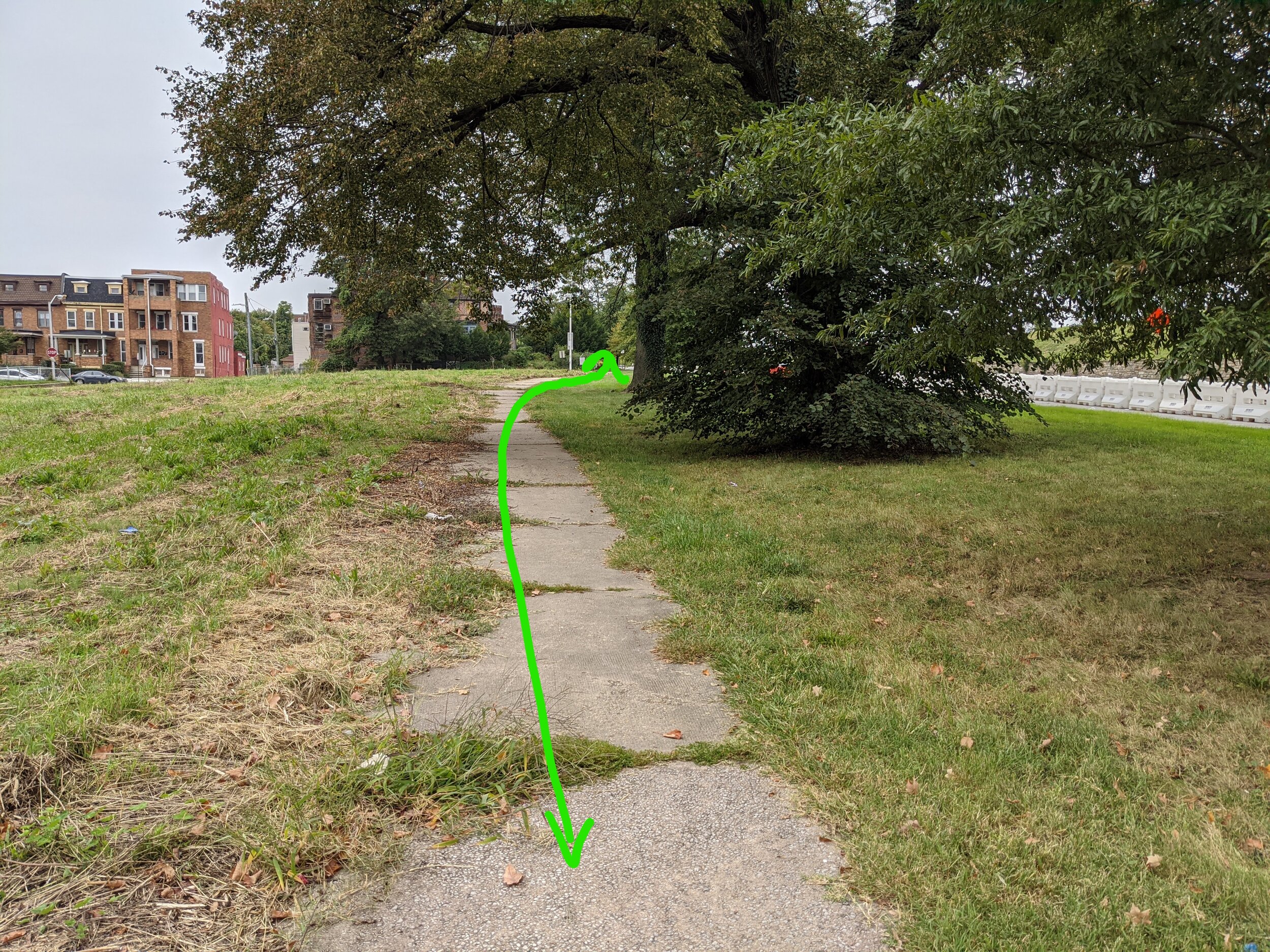
The trench work for the Druid Hill Reservoir will require detour of The Big Jump for approximately one year, and work will begin as soon as September 28, 2020. Motor vehicle traffic will move to the existing travel lane utilized by The Big Jump from Linden Avenue to the Mount Royal Avenue slip lane. Water filled barriers along this portion of roadway will be replaced with concrete barriers. The Big Jump will be relocated to an adjacent 8 foot sidewalk, which DOT is working to clear of weeds and debris.

The existing Big Jump route is shown in red. The detour route is shown in green.
The existing Big Jump route is shown in red. The detour route is shown in green.

The Big Jump will follow an 8 foot sidewalk from Linden Avenue to Lakeview Avenue. DOT is working to mow and clear debris.

The Big Jump will follow an 8 foot sidewalk from Linden Avenue to Lakeview Avenue. DOT is working to mow and clear debris.

At Lakeview Avenue, The Big Jump will move to the northern side of the street adjacent to Lakeview Towers, repurposing an existing parking lane. It will then cross over to the existing pathway on the 28th Street bridge through a newly created curb cut underneath the existing non-ADA accessible pedestrian overpass from Druid Park Lake Drive to 28th Street. To facilitate safe crossing at this location, the Mount Royal slip lane will be closed to motor vehicle traffic with physical barriers—a huge safety improvement.

The Big Jump detour from Lakeview Avenue past the Lakeview Towers to the Mount Royal slip lane.

The Big Jump detour from Lakeview Avenue past the Lakeview Towers to the Mount Royal slip lane.

The Big Jump detour will connect back to the original Big Jump path through the Mount Royal slip lane, which will be closed to motor vehicle traffic.

The Big Jump detour will connect back to the original Big Jump path through the Mount Royal slip lane, which will be closed to motor vehicle traffic.

What’s next

While the sidewalk element of this detour is not ideal, there are very encouraging opportunities that the trench work unlocks. Since the existing water filled barriers are being replaced with concrete barriers through the duration of the detour, it’s possible we could keep the concrete barriers in place when The Big Jump returns to the street, improving safety and reducing maintenance. It’s also possible to reconfigure and resurface the motor vehicle travel lanes along Druid Park Lake Drive. This will further reinforce The Big Jump as a semi-permanent pathway.

Also coming up is the release of the Big Jump evaluation report. It’s exciting in that it reveals The Big Jump had almost no effect on traffic conditions—one of the major vocal complaints from drivers.

Long-term, Baltimore City Department of Transportation has committed to a corridor realignment study to propose a complete redesign or removal of the highways that separate Druid Hill Park from communities. None of this work would have been possible without community partners and the leadership of Councilman Leon Pinkett. Neighbors and advocates are organizing around the corridor realignment study under the banner of The Access Project: Druid Hill Park. You can read more at TAP Druid Hill.

Detours Done Well

In the infrastructure world, it’s called “Maintenance of Traffic.” Really, it’s just a detour. And traditionally, it’s something that’s been awful in Baltimore.

We’ve all experienced it. You’re riding down a protected bike lane, and suddenly there’s construction blocking the lane and nowhere for you to go. Or you’re walking down a sidewalk and suddenly there’s a sign that says “sidewalk closed, use other side” but no crosswalk or curb cut to get you there.

It’s against the law to do this. Baltimore City Department of Transportation has Maintenance of Traffic regulations for contractors that require them to provide a safe detour around construction that closes sidewalks and bike lanes. This usually means closing the adjacent car parking or travel lane to allow pedestrians or bicyclists to use it to go around the construction. But in practice, this rarely happens. Instead, we see dangerous closures like this:

Baltimore City Department of Transportation needs more and better trained inspectors to regularly issue fines for this kind of illegal, dangerous work. And, our city needs to aggressively collect those fines from some of our biggest offenders. The agency is working on a new street cuts manual, and we have advocated for increased fines and more diligent inspections, as well as for the additional resources the agency needs to follow through.

But we also wanted to use this post to show some examples of great maintenance of traffic implementations—exactly the kind of work that contractors should be doing and Baltimore City Department of Transportation should be demanding.

The first is the utility work along the Jones Falls Trail on Falls Road by the Baltimore Streetcar Museum. On prior trail-adjacent projects like the Druid Hill Reservoir tank construction and the Edmondson Avenue bridge replacement, trails were and continue to be closed without detour for years. Contrast that failure with Falls Road, where the street was closed to car traffic and a detour was created to ensure the Jones Falls Trail remains accessible:

Falls Road Maintenance of Traffic

Falls Road Maintenance of Traffic

Another recent example is the Harbor Promenade closure for construction by Aliceanna and Wolfe Streets. In the past, the promenade has been closed for construction without adequate detours. At first, this closure looked like it would be a similar situation. But thanks to advocacy from neighbors, community associations, Councilman Zeke Cohen, and Delegate Brooke Lierman, a high quality, physically separated detour was put in place along Aliceanna Street for people biking, walking, and rolling.

Aliceanna Maintenance of Traffic

Aliceanna Maintenance of Traffic

We’re happy to see great examples of proper, safe detours adjacent to construction being implemented in Baltimore City, as the law requires. And, we will continue to advocate for more resources for Baltimore City Department of Transportation so they can adequately enforce quality work in our roadways.

President Street Bike Lane Improvements

The Baltimore Complete Streets ordinance requires Baltimore City Department of Transportation to retrofit improved walking, biking, and transit infrastructure onto streets during routine resurfacing.

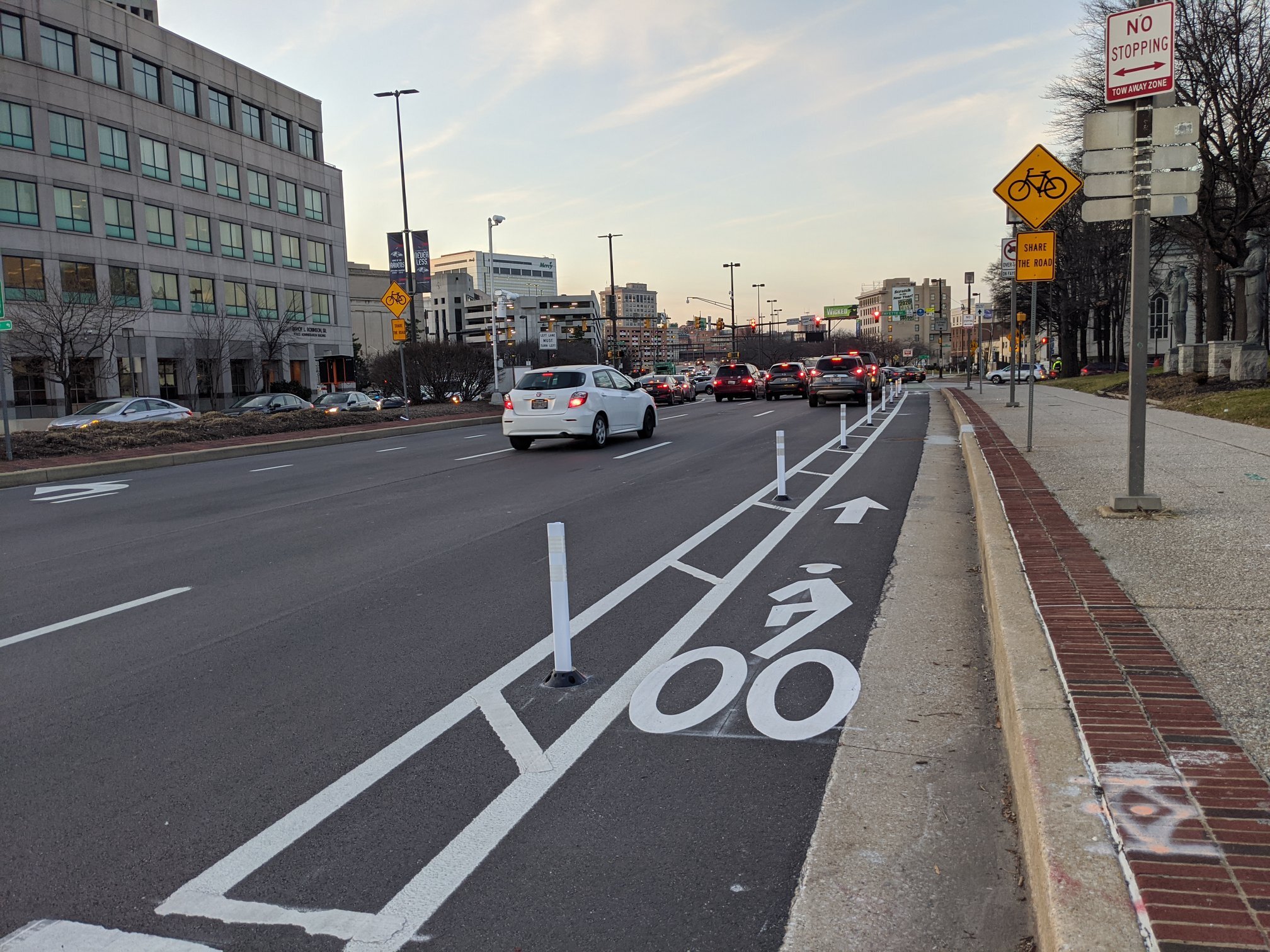
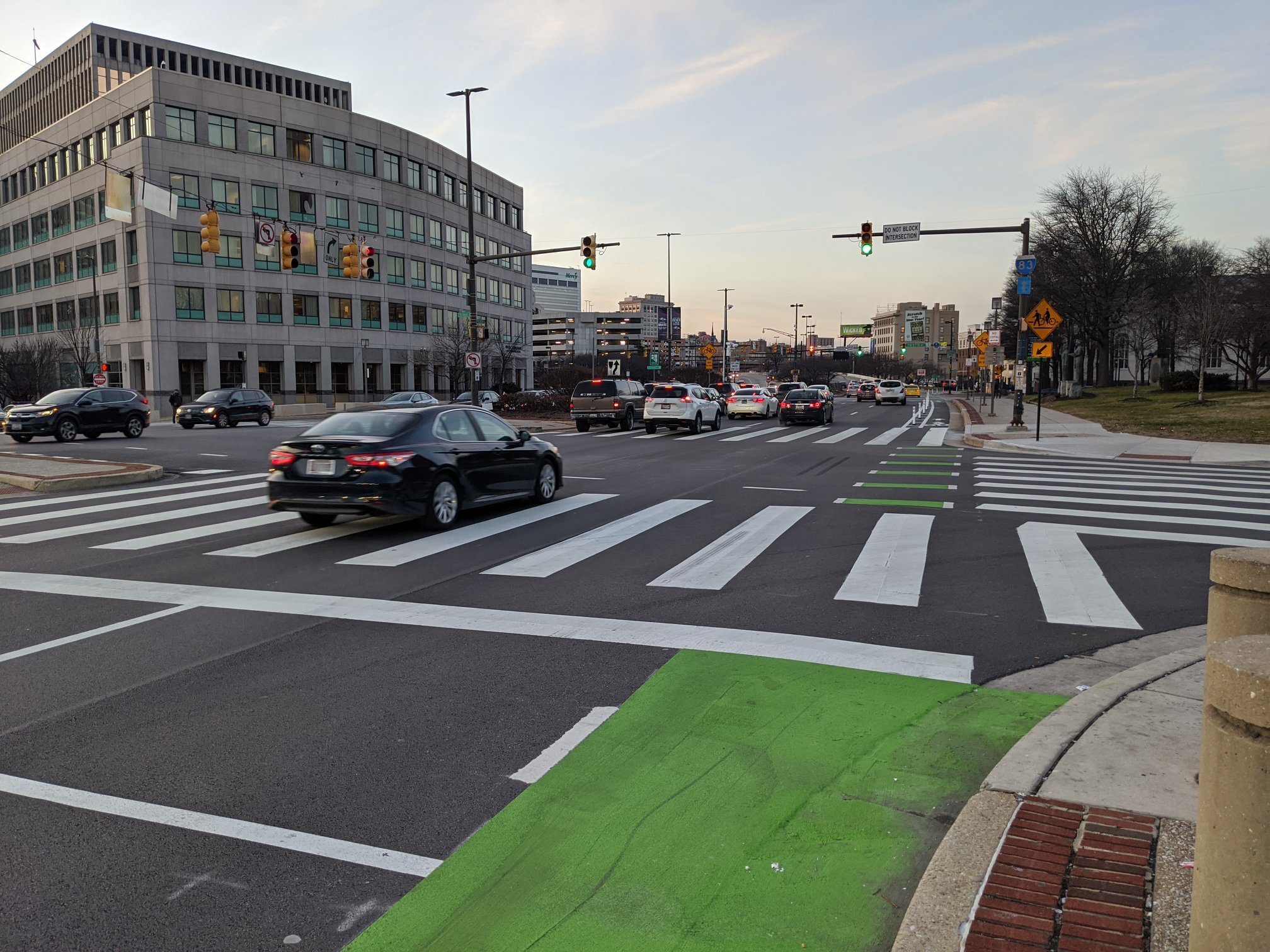
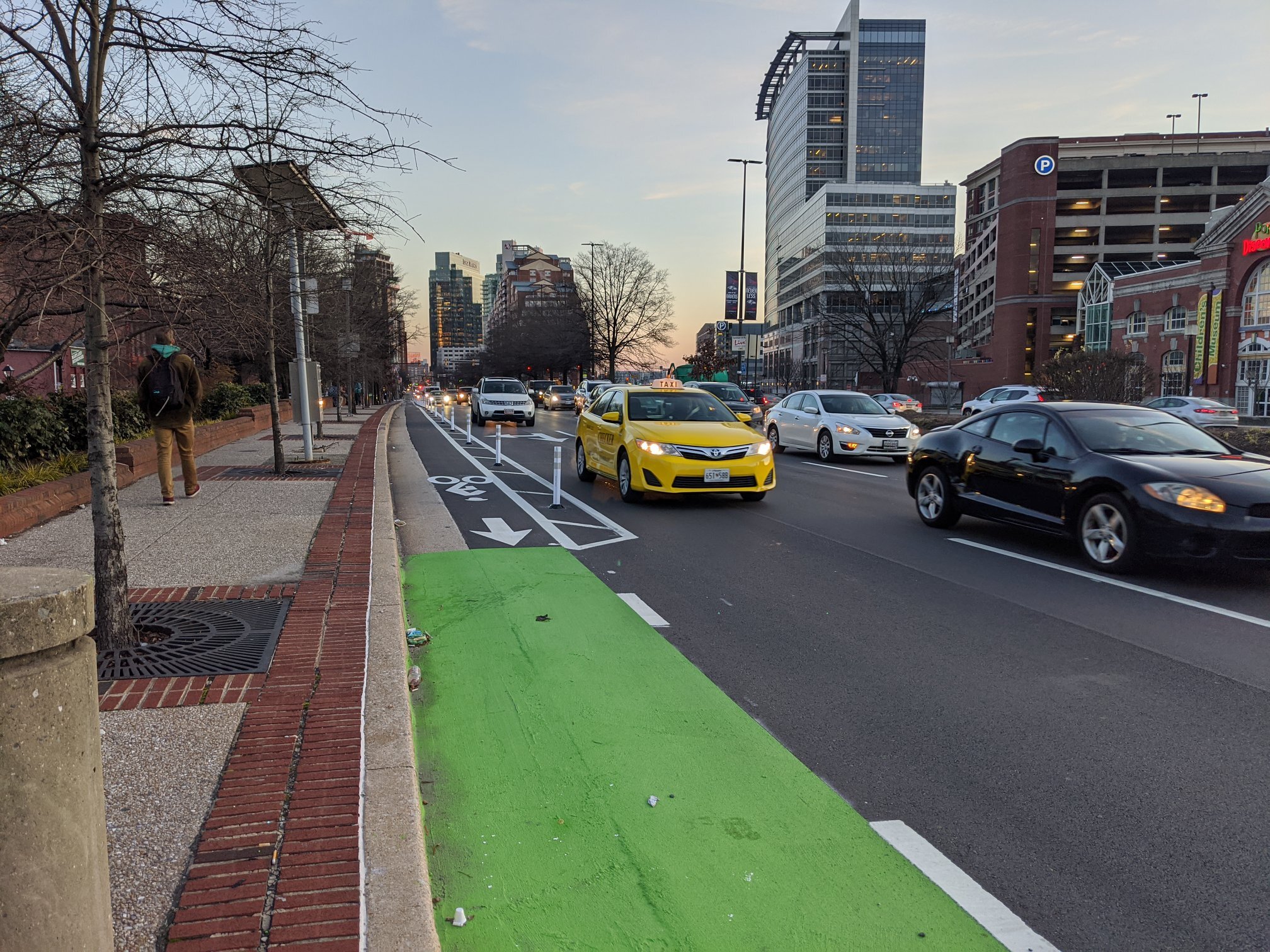
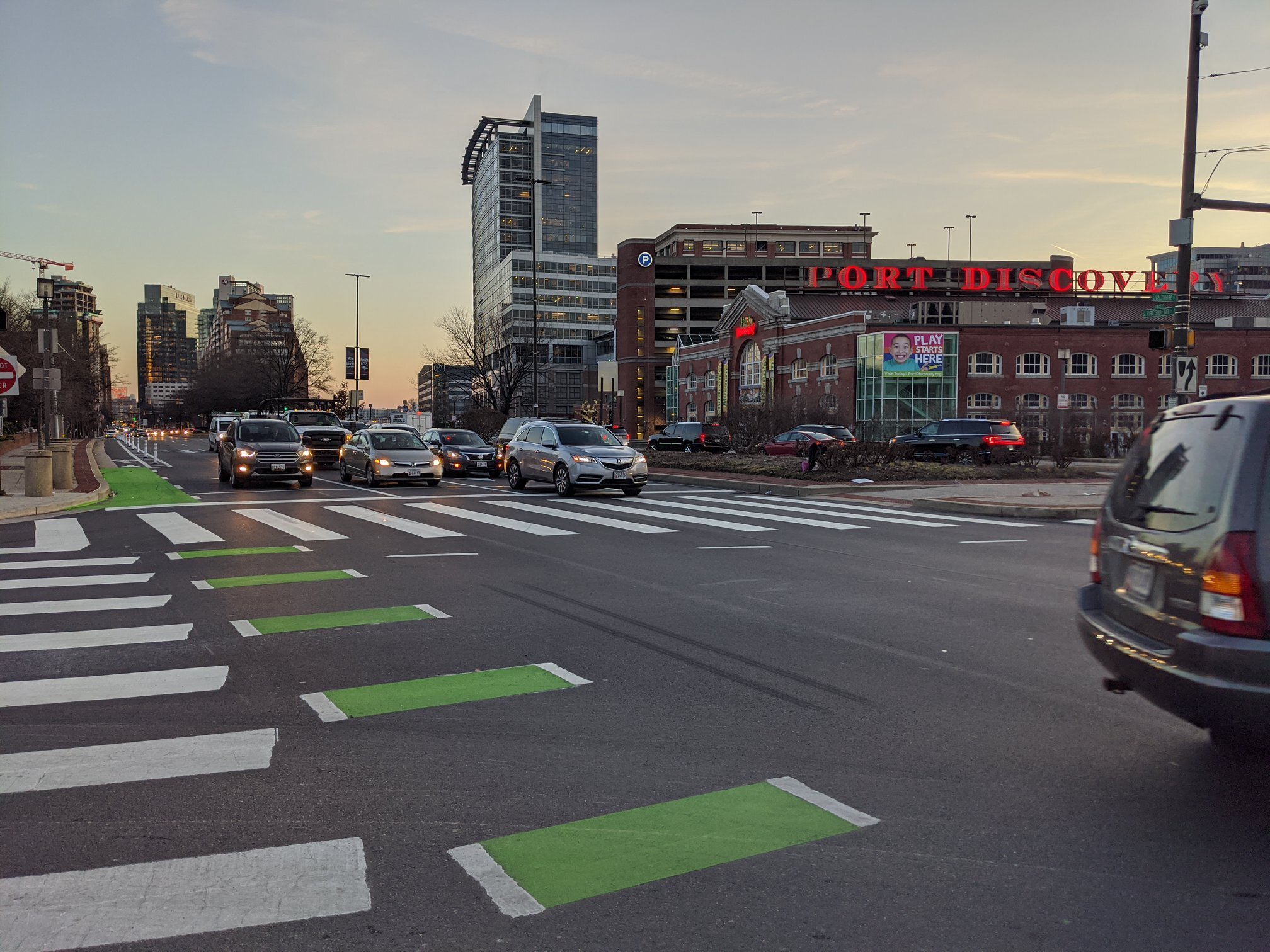
President Street began resurfacing prior to the ordinance taking effect, but BCDOT was able to make some last minute changes in the design to add high visibility crosswalks and a flex post buffer to the previous substandard bike lane.

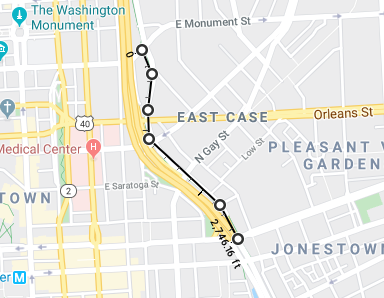
While President Street is still far from a safe, all-ages street, we are thankful for these improvements. We will continue to advocate for BCDOT to extend this separated treatment up Fallsway, creating a more visible and safer Jones Falls Trail while connecting to existing protected bike lanes on Centre and Monument Streets.

We must build streets for people.

MVIMG_20190531_111612.jpg

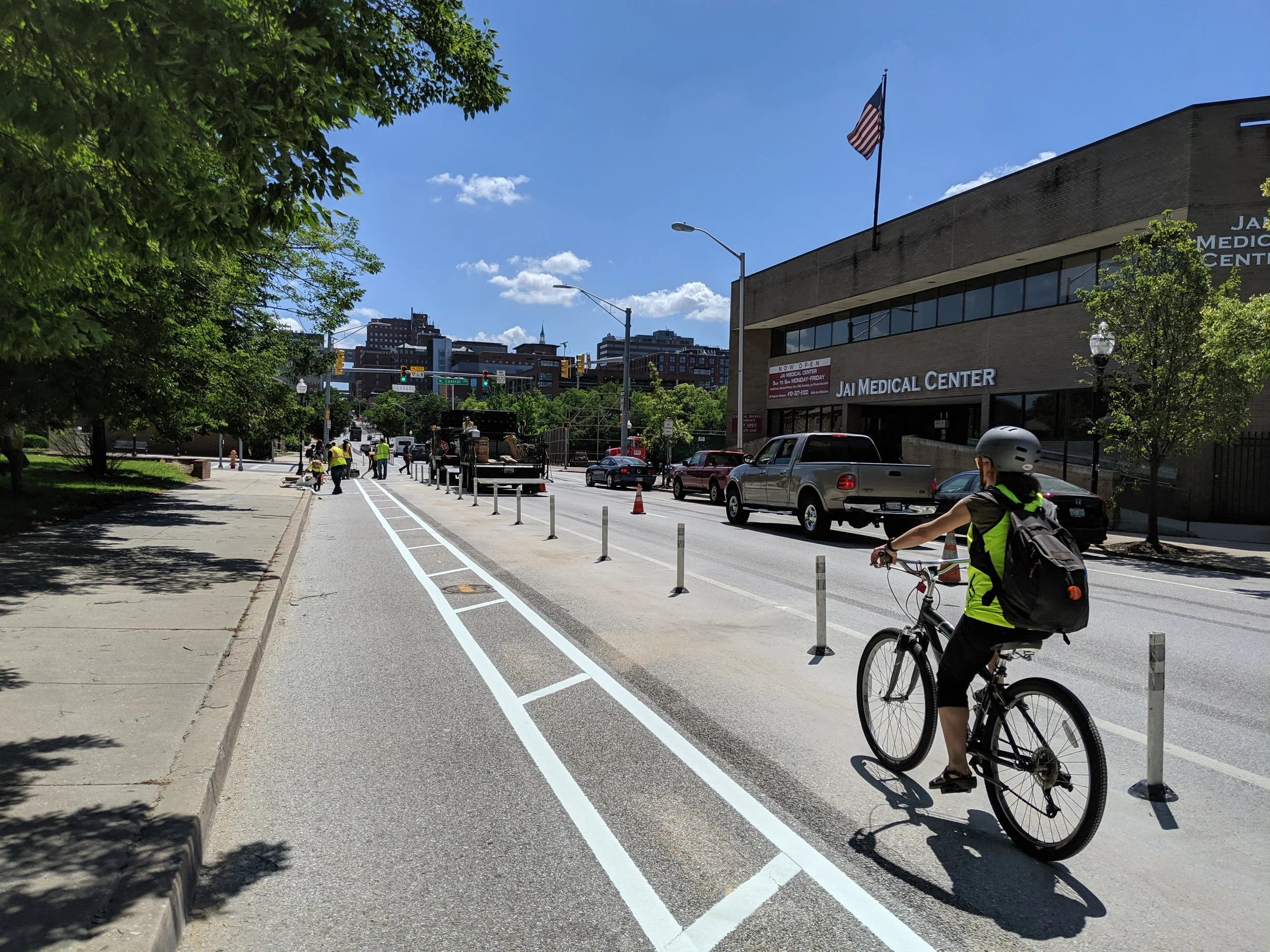
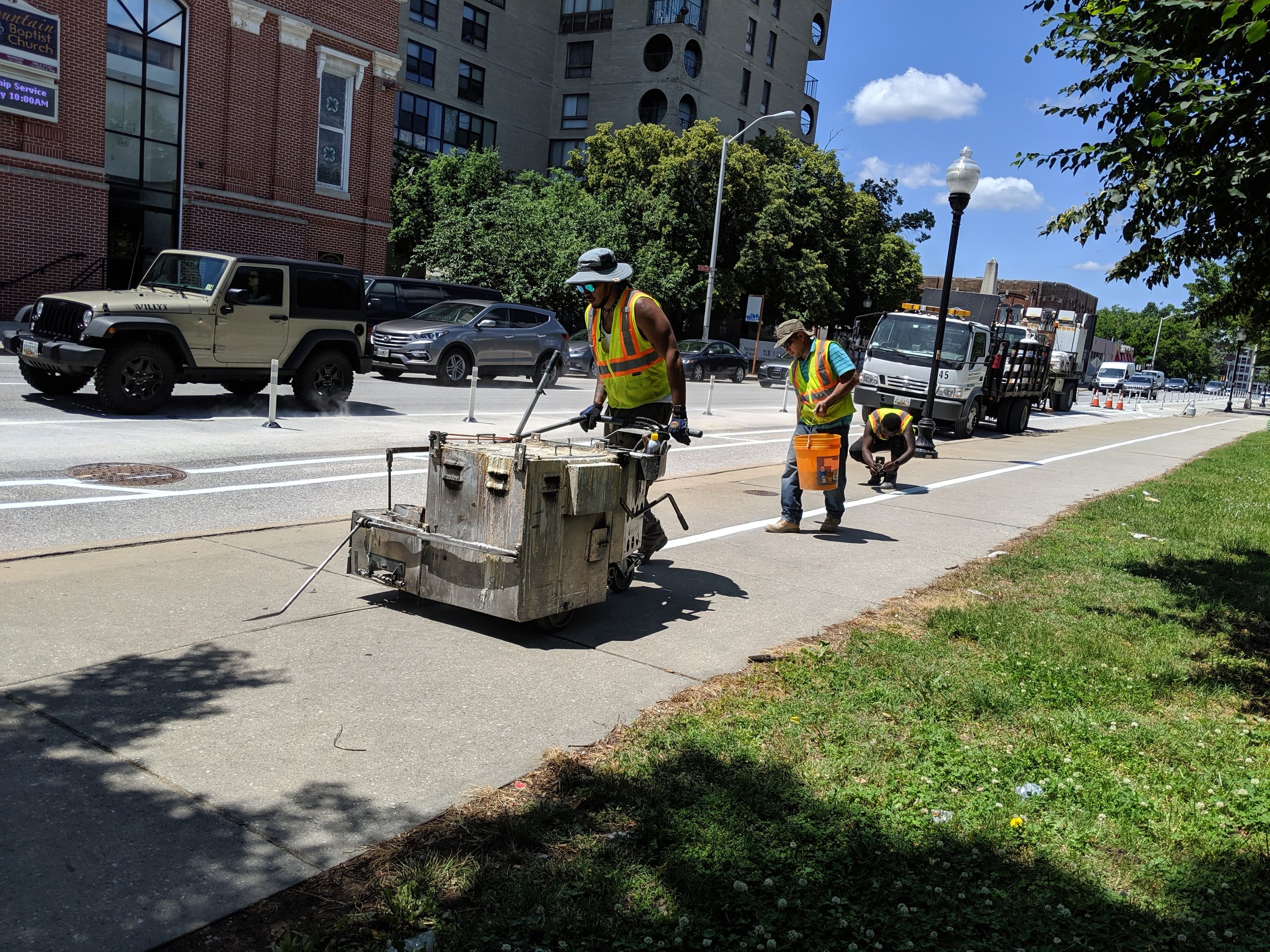
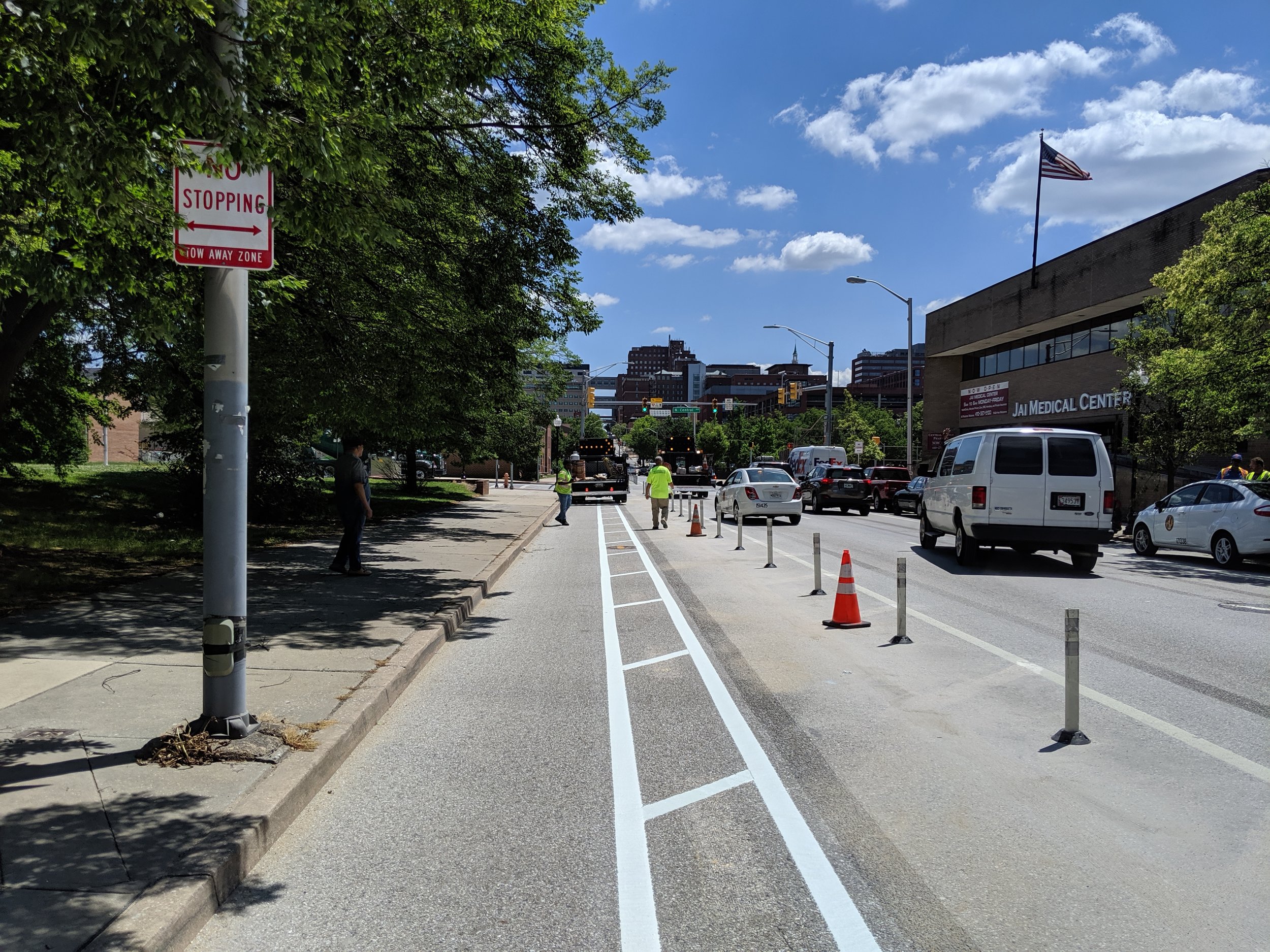
Today construction began to modify a half block of the two way protected bike lane at the intersection Monument Street and Central Avenue. This modification was prompted by neighborhood stakeholders that requested 12 parking spaces be restored on the north side of the street. This is a clear violation of the Complete Streets law.

This modification was opposed by the Mayor’s Bicycle Advisory Commission through a motion at the meeting this past Wednesday, May 29th. It received the attention and advocacy of State Delegate Robbyn Lewis, who pursued all avenues available and met with key stakeholders, including church leadership. It also garnered 744 letters of opposition to Mayor Young and Frank Murphy, Interim Director of the Department of Transportation. Many alternative designs were suggested that would retain the current design and increase parking near a place of worship, who wanted to ensure their elderly congregants can safely get from their car to the church.

It’s important to note that there were opportunities for compromise that precluded this change in the lane, and even restored additional street parking. Efforts are even underway to assist with negotiating use of a parking lot next door to the church. These alternative solutions were declined by both neighborhood stakeholders and city officials. This was a unilateral decision that did not allow additional stakeholders like Bikemore and the thousands of constituents we represent to have equal consideration.

We are sensitive to the challenges these changes to public spaces face. We understand and want to be respectful and acknowledge that these changes intersect with many other challenges that Baltimore faces, most notably race and class. But these complex issues demand deep reflection and intentional discussions, not knee jerk reactions. Not decisions that leave out the people who stand the most to lose, their safety. That is what occurred here. While this change is small, it has much broader implications. It signifies that that the people that rely on safe places like this bike lane are less important than cars. It puts Baltimore City in jeopardy of losing state and federal funding for transportation, funding that is necessary to continue to design streets for people.

It also sends a clear message to other institutions or groups of people with power who want to oppose changes that make streets safer for everyone, including people driving cars: in order to undo years of planning, millions of dollars of investment, and facilities that serve thousands of residents — all you need to do is call power brokers in city government.

We spent hours at the facility this week observing its use. And we want to make something clear. The loudest voices in bike advocacy aren’t currently representative of our majority black city and certainly not representative of the diverse groups of people that benefit from these lanes. That is something that is problematic and something we are actively working to address. Today we posted three new opportunities of employment at Bikemore, the first time we have had the resources to hire new staff since 2016. Two of these positions will be actively focused on community organizing and outreach across the city in order to lift up the voices often left out of the discussions around Complete Streets. They create an opportunity to build a more diverse workforce. They will also allow us to deliver more programs that do what we feel is the best organizing tool of all, riding bikes together.

We have reached out to the Mayor to request a meeting. While this one section of road is being changed, continuing the conversation about how we move forward to build a city for people is more important than ever. The 744 people that have voiced their opposition to this change deserve an official response.

We also want to make sure people realize our work is ongoing and so much more than the online chatter and news stories that always seem to accompany advocacy actions like this. Tomorrow we will be at the Boundary Block Party in Penn North fixing bikes to get people back on two wheels. We are coordinating with neighbors in Cherry Hill to offer ride support on an upcoming event. We are continuing to work with neighbors in Reservoir Hill and Auchentoroly Terrace to ensure they have the resources available to engage in the traffic study process that will dictate the future of Druid Park Lake Drive. Last Saturday we celebrated the installation of a public art project that was created by artists who reside in Reservoir Hill, artists that were selected by residents of Reservoir Hill.

This is the long slow work of advocacy. It doesn’t make headlines. It doesn’t spark public meetings where emotions run wild. But it is the heart and soul of who we are. We fight because the people that use bike lanes are worth fighting for. They are affordable housing advocates, nurses, City employees, construction workers, restaurant employees, artists, parents shuttling their kids to daycare, senior citizens, the blind, people hauling grocery carts and pushing strollers. It’s a kid learning to ride a bike in a safe space. They are people we know. They are people who pay taxes. They are people that vote. And by way of just being human, they deserve the dignity of using our streets without fear.

We could not do what we do without the support of so many people. Let’s keep our heads up. Let’s keep fighting for streets for people.


ACTION ALERT: Monument Street

Tell Mayor Young to halt deconstruction of a half block of newly installed protected bike lane on Monument Street:

Background

Today the City plans to move forward with the removal and modification of a half block of the Monument Street two-way protected bike lane. Between Aisquith and Central Avenue, DOT will remove the portion of the bike lane dedicated for westbound bike traffic and force riders onto the sidewalk located on the north side, adjacent to Dunbar High School’s fields. This $50,000 change is occurring to restore 12 parking spots on the north side of Monument Street.

Bikemore strongly opposes this removal. For the past six months, when it became clear that the City was moving forward with this change, we repeatedly asked for the designs so we could give feedback. These designs were never made available to either Bikemore or the Mayor’s Bicycle Advisory Commission despite the multiple requests. No public meetings were held about this change. We first learned of the design and removal timeline on the same day everyone else did: May 15th. Thirteen days ago, one day short of the required 14 days notice.

This is unacceptable, and puts advocates in a position that forces us to be reactive versus collaborative. It is an act of bad faith, and if we are to move forward as a City that values streets designed for people over cars, we need the Department of Transportation to do better.

This change on Monument Street is problematic for a variety of reasons. But the main ones are that it violates the recently adopted Complete Streets law and further prohibits the City’s ability to be awarded state and federal transportation dollars.

The Complete Street law requires the City:

    1. Comply with State and Federal funding requirements. Alteration and removal of portions of Monument Street go against the state funded and approved design. Maryland Department of Transportation has said enough is enough, and will not continue to provide grants for complete streets infrastructure in Baltimore as long as we continue to remove or alter those facilities for political reasons.

    2. Promote walking, biking, and transit to the greatest extent possible. By forcing bike traffic onto the sidewalk it makes walking and biking on that section of street less safe. It creates conflict between people walking and people biking, and places people biking in a position that makes them less predictable to people driving cars.

    3. Ensure equity by actively pursuing the elimination of health, economic, and access disparities. We know that 33% of the city lacks access to a car, and according to census data over 75% of households lack access to a car along the Monument Street corridor where changes are proposed. Removing infrastructure proven to reduce access disparity and improve health outcomes to install parking is deeply inequitable.

Future State and Federal funding is on the line:

The majority of funding that improves walking, biking, and transit in the City comes from State and Federal money. Given the City’s current budget priorities it is unlikely, at least in the short term, that this situation will change. When the City destroys projects constructed with State funds, it is no wonder the State is now looking to other Maryland communities to support over Baltimore. This money doesn’t only fund bike lanes, it can be used to fund recreation trails, bike parking, traffic calming, and a variety of other infrastructure that improves the safety and quality of life of Baltimore City residents.

By deciding to remove this section of Monument Street, the Mayor is sending a message to residents that short term responses to a handful of people complaining about parking is more important than long term investment in transportation for the entire city.

If they care about improved community outreach, if they care about equitable investment in recreation and transportation across all neighborhoods, they will pause the planned deconstruction and respond to our concerns.

There are solutions available to the parking concerns that don’t cost $50K and threaten future state and federal transportation funding. It is a Mayor’s job to consider the entire city and make decisions that are strategic, not reactive. The decision to remove this portion of the bike lane to restore parking is short sighted. It doesn’t matter who put these decisions in motion or that they began prior to Mayor Young taking office. This is ultimately his decision. We believe there is a way for him to bring folks together on this issue. It starts with asking the Department of Transportation to stop the removal today.