
Recreation

Protecting the Jones Falls Valley from Future Industrial uses

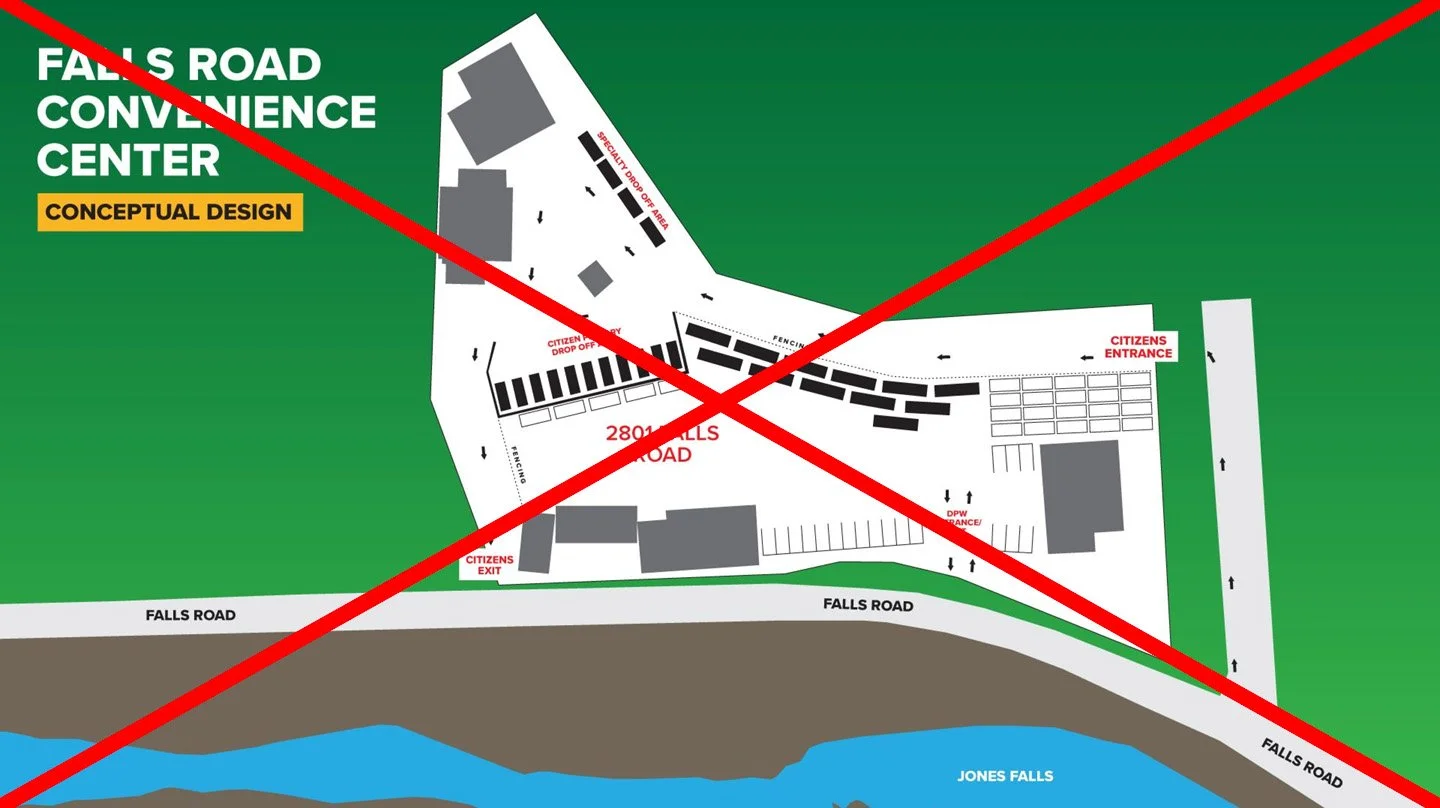
an image of the falls road convenience center proposal with a red x through it

In August, we asked you to share opposition to plans to relocate the Sisson Street Convenience Center to the Jones Falls Valley.

As a result of your advocacy, the Sisson Street Task Force was formed, and Bikemore was asked to join to advise on traffic safety and represent the interests of bicyclists and pedestrians.

In a November task force meeting, Bikemore Executive Director Jed Weeks motioned to remove the Falls Road site from consideration, and the task force unanimously voted in favor of that motion.

While we expect the mayor to accept the recommendations of the task force, this vote was only advisory. And even if the city never planned to relocate to the Falls Road location, there was still a huge risk: the sites are zoned industrial and owned by Potts & Callahan. In theory, nothing could prevent them from selling or leasing the property to another industrial use, including a private waste facility.
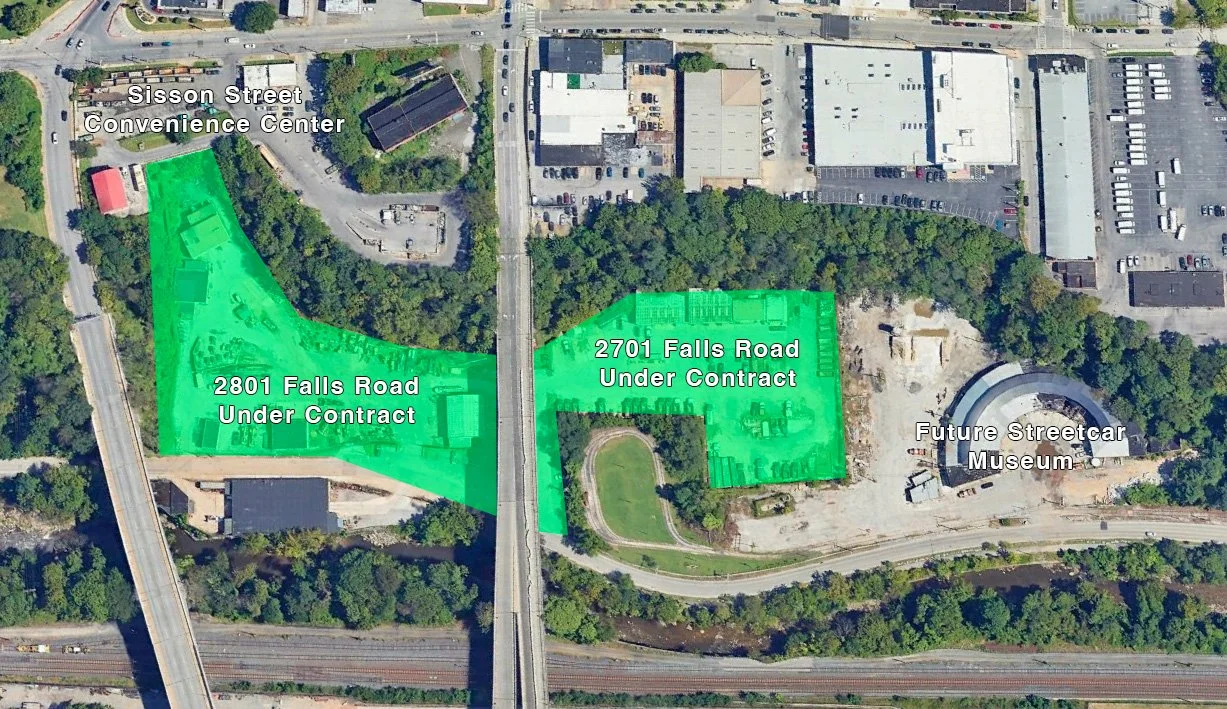
an image showing the 2801 and 2701 Falls Road sites in the context of the Sisson Street Convenience Center

Today, Seawall Development announced that they are under contract on 2801 and 2701 Falls Road, both of the active Potts & Callahan industrial sites.

If their purchase is successful, Seawall Development has committed to advocates and neighbors, including Bikemore, Blue Water Baltimore, Friends of the Jones Falls, and the Greater Remington Improvement Association that they will prevent industrial uses on these sites, and instead work collaboratively with us to re-imagine both sites to meet the desires of Baltimoreans to see the Jones Falls Valley realized as a world-class linear park, flanked by walkable, mixed use development in Remington.

Challenges to protecting these sites remain. The financial viability of this sale is likely predicated on the ability to re-develop the existing Sisson Street Convenience Center, as connectivity between Remington and the Jones Falls Valley between the two sites would only be possible through that re-development. The industrial zoning is still in place, and a comprehensive rezoning of both the Falls Road and Sisson Street sites to allow appropriate human scale redevelopment (and restrict uses like big box stores and parking lots from the Sisson Street sites) would likely be necessary.

If the Sisson Street Task Force moves toward Option 2, the phased closure of Sisson Street Convenience Center, Bikemore will advocate for the report to include these recommendations.

If realized, these efforts would take the largest remaining industrial uses in the lower Jones Falls Valley off the table permanently, protect the site from a potential future convenience center, eliminate dumping and runoff concerns from the existing Sisson Street facility, and facilitate a much stronger connection between communities and the Jones Falls Valley.

Seawall Development will be hosting public visioning sessions for Baltimoreans to share what they’d like to see these sites become, and we will share that information as it becomes available.

What Slow Streets Can Teach Us

Slow street on 27th St. in Remington. The wooden barrier with Slow Street signage is to the left. A small child riding a tricycle, wearing a bright green shirt and blue helmet is to the right.

This summer, in response to legislation introduced by Council President Scott and unanimously supported by Baltimore City Council, the Baltimore City Department of Transportation started its Slow Streets program. Yellow barriers began popping up around town discouraging through traffic and encouraging slower speeds on neighborhood streets. This concept is being implemented in cities across the country due to an ever increasing demand for public space. People are home more. Our usual gathering spaces have been limited. So what better way to increase places to be than activating the largest amount of public space the City of Baltimore owns--our streets?

The program has had its challenges, challenges that have been seen in implementations across the country. these interventions need to be paired with widespread public communication so people understand their purpose, and programmed in ways that invite people to see the streets as a new front yard.. Local neighborhood champions have also been critical to success, and it has been encouraging to see neighbors step up in their communities to steward the program. 

For Bikemore, Slow Streets has helped us explain the benefits of calming traffic on neighborhood streets. Too often Complete Streets advocacy is full of jargon that is hard to relate to. No rendering or sketch can do as good a job explaining the benefits of traffic calming than when folks can stand outside of their house and experience it themselves. For that reason alone, the Department of Transportation should be commended for investing in this program. 

This became evident last Saturday while spending time in Curtis Bay. South Baltimore is so often overlooked when it comes to investment. But the City Council and the Department of Transportation have been intentional to ensure each council district receives a Slow Street. 

We were spending time with neighbors at the Filbert Street Garden, getting feedback on the Slow Street recently installed on Filbert Street and discussing future programming to activate the space. In between falling in love with Ed the Goat and Marshmallow the Chicken, and marveling at all the late summer crops that neighbors have nurtured, I walked across the street to meet a neighbor mowing her lawn. 

Over the years she’s put a lot of effort into her home. Her lawn, flowers and trees are beautiful. She proudly displays a sign noting that she won second place this year in the Curtis Bay yard competition. As we stood there chatting, multiple cars drove through the intersection where the Slow Streets barriers had been placed. We noted how even while speeding to the intersection, each car had to stop and look carefully before going through the stop sign. We both sighed at how it both worked to slow down cars there, but did little to prevent speeding just a few car lengths up the road. We brainstormed different ideas about how it could be better. What struck me was that after asking a simple question, “What do you think of these barriers?” Her insight spoke directly to the purpose of the program. She noted how kids are out playing in the street more now that we are all at home. And that the barriers make it safer for them to be outside. And she said she wanted to see more traffic calming in her neighborhood. 

Before the barriers I know that conversation would have gone differently. I would ask about traffic on someone’s street. They would agree that traffic could go slower. But it was hard for them to imagine interventions beyond speed humps--something that is costly and not always appropriate for the street. And too often that is where the conversation would end. Any other solution would inevitably be seen as intrusive and not something that the community requested. Not because they don’t want traffic to go slower, but because the community input process is designed to fail. 

Citizens shouldn’t be responsible for dreaming up solutions to problems the City already knows how to fix. The City shouldn’t create impossible thresholds of community support before we try something new to make a street safer for people who walk, bike, and take transit. What the City can do is double down on what Slow Streets has demonstrated works really well. Install temporary ways to calm traffic. These experiences should be the beginning of the community input process, not the end result. Prioritize providing neighbors with experiences to make informed decisions. 

Neighbors are the experts of what they need in their community. And for too many streets in this City, the need is for people driving cars to slow down. Allowing neighbors the ability to experience a variety of solutions first-hand means that whatever the solution is, people understand what to expect. Fear of change and the unknown is often the biggest barrier to make our streets better. 

It’s unrealistic to believe that every Slow Street in the city will lead to lasting change. But my hope is that it has provided a better starting point for that change to occur. It demonstrates the best of what DOT has to offer--equitable distribution of resources, low cost solutions that are easily replicated, and changes to the street that help people reimagine what is possible. It begins to answer the question, “How do we build streets for people?”

by Liz Cornish, Executive Director

What’s a pump track?

access to recreation.png

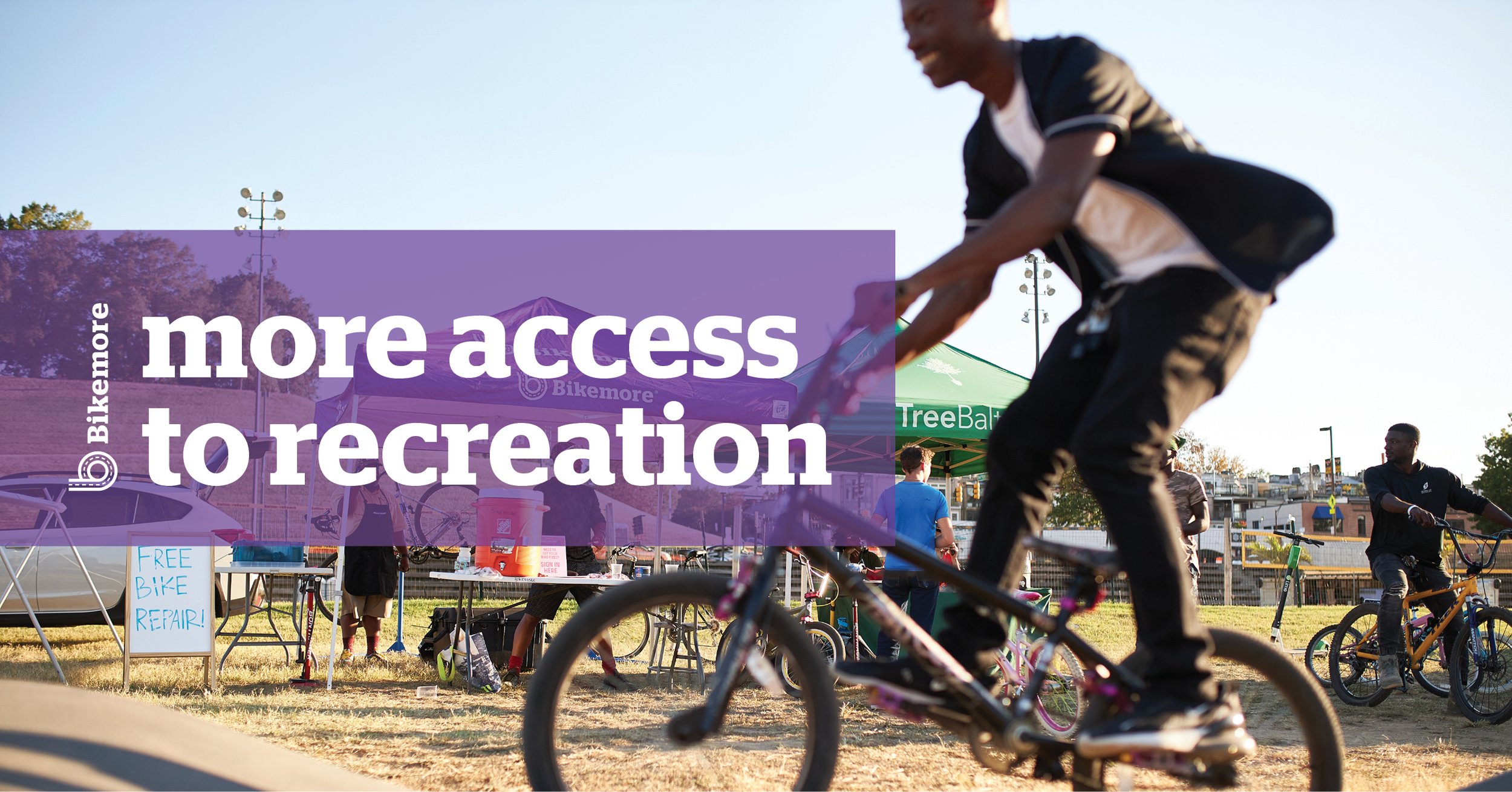
At the pump track we’ve seen a little girl riding a scooter with her mom nearby, a teenager learning how to ride a bmx bike, a bike commuter stopping by on his way home from work, and a skateboarder trying new moves. They were all curious and excited to ride. They shared the space, gave each other pointers, and laughed together when one of them fell. Access to recreation in public spaces brings people together. It gives people a chance to exercise, meet new people, feel like you have ownership of public space. It builds community, and helps us together build the neighborhoods that we want to live in.

And that’s one of the reasons we were so excited that this fall, Baltimore Rec and Parks purchased a modular pump track that can be placed in neighborhoods across the city. A pump track (pictured below) is a circular track with dips in it. Once you get the hang of it, you can pump your bike up and down for momentum and ride it without a lot of pedaling. It’s fun to ride on a bmx bike, skate board, or scooter and we’ve seen people of all ages on it.

Over the years, we’ve heard communities asking for a pump track. We’ve been working with Councilman Pinkett for two years to identify properties and funds to build one, and in January of 2019 we worked with South Baltimore Gateway Partnership to study the viability of building one in South Baltimore.

But when Molly Gallant from Rec and Parks proposed the idea of purchasing a modular pump track, we knew this would open up opportunities. By having a pump track that could be easily moved between various locations, it meant that communities across the city could have access to it, and it meant we can try out locations, gauge the response, and build support for a permanent one. It meant that it would be a tool to connect with neighbors across the city.

Momentum from our study, Councilman Pinkett’s support, along with a lot of leg work by Molly and her team laid the groundwork for Bikemore to be able to advocate for the City to purchase the pump track. It was first installed on Rash Field during the National Recreation and Parks Association conference in September and was an instant success. We hosted three Mobile Bike Shops next to it that week, and it got a ton of use. In late October the pump track was moved to in Easterwood Park, and at the opening celebration it was welcomed by more than 40 skateboarders and bike riders.

We’ve demonstrated the success of an investment like this, and of what Bikemore’s partnership with city departments can look like.

Building a city for people means creating spaces where people can come together. All City agencies have a role to play in building a city for people not just cars. A large part of that is ensuring that the spaces where people are most likely to ride a bike for the first time, like a city park, have the resources they need to deliver high quality programs. When you make a donation to Bikemore you increase our ability to advocate for City agencies, like Rec and Parks, to get more people on bikes and to build a city for people.

Create more access to recreation by donating to Bikemore today.


Make a Direct Action Donation (501c4)

Direct Action donations are our greatest need. They can fund everything we do, including directly lobbying elected officials, running grassroots organizing campaigns, and advocating for or against legislation. They are not tax-deductible.

Make a Charitable Donation (501c3)

Charitable donations fund our education, organizing, and programming, and may be tax-deductible.

IMG_3208.jpg