Advocacy

2025 in Shared Mobility

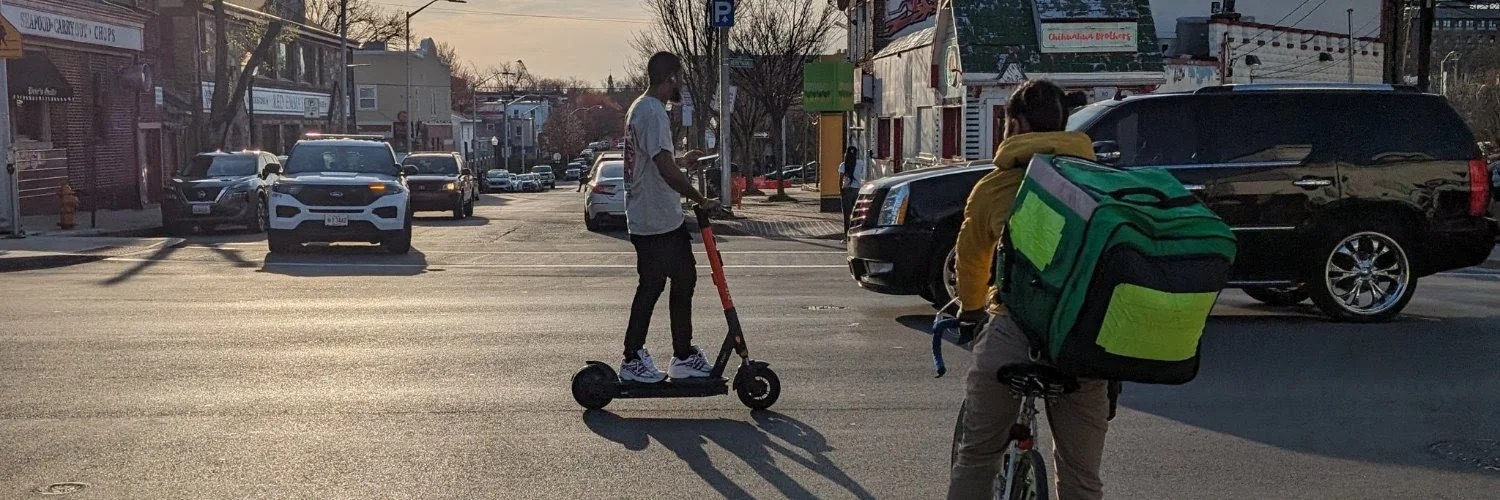
a man rides up Greenmount Ave on a scooter as a food delivery worker on a bike waits to cross the street.

In Baltimore, 2025 was the best year for our city's shared mobility program to date.

As a city, we took over 3 million rides during the year, reaching over 3.9 million miles covered on shared e-bikes and scooters. This is nearly double the rides Baltimore took in 2024!

Rides were also more equitably distributed, with ride origins from 2024-2025 increasing by 144% in East Baltimore, 163% in Southwest Baltimore, and 133% in Northwest Baltimore.

We saw the introduction of a new model of e-bike across the city, which adds a throttle option, making it easier for riders of all abilities to get around the city. There have also been many painted corrals installed around the city, making parking and placement easier, as well as decluttering our streets and sidewalks, perhaps the biggest problem the public sees with shared micromobility.

Additionally, we’ve had a major uptick in the enrollment and usage of the Access Program discounts, which waive unlock fees and discount the per-minute fees of the rides by 80%. These access programs are available to anyone who is enrolled in any form of government assistance; more information about the programs can be found at bikemore.net/enroll. In my work at Bikemore, I have directly enrolled upwards of 50 individuals into this program while going out into the community to provide information about it.

Finally, Lime and the League of American Bicyclists released a report Building Safer and More Friendly Streets: Lessons from Lime Data on Infrastructure, Safety, and Transit Access. The report looked at 5 million rides across 3 cities: Baltimore, Nashville, and Phoenix. It clearly shows that all-ages, separated infrastructure increases ridership and drives safety. 

In Baltimore, Lime analyzed ridership between 2022-2025 on newly installed separated bike lanes, and the increases in Lime ridership were dramatic. 28th Street saw a 526% increase, Harford Road saw a 423% increase, and Central Avenue saw a 229% increase in ridership. 

One piece of separated infrastructure can bridge divides and dramatically expand access for riders. For example, the map below shows the trip routes riders utilizing the 28th Street separated bike lane took this past year.
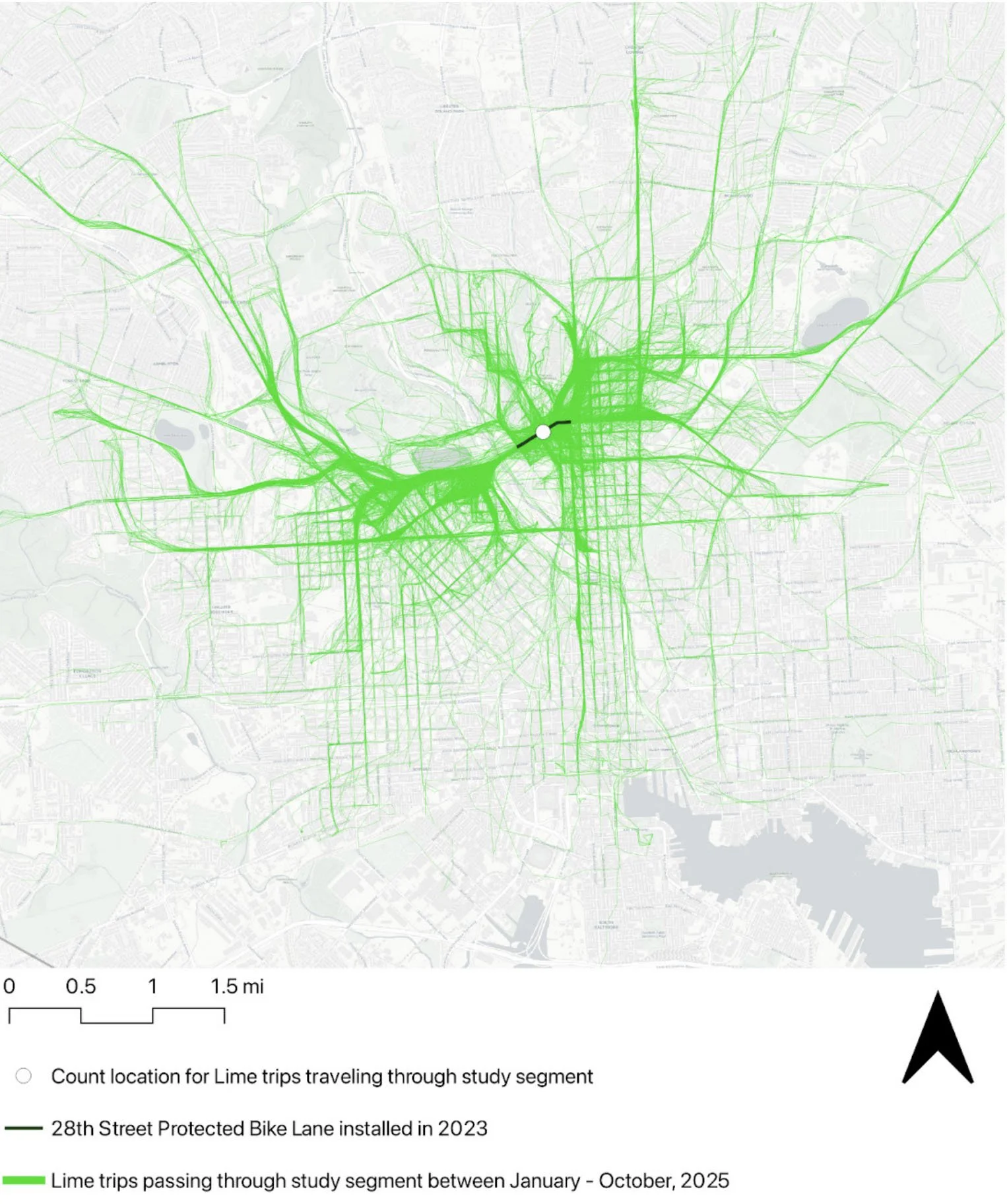
an image of thousands of trips passing through a fixed point along the 28th Street bike lane, showing how those trips branch out deep into East and West Baltimore.

Looking forward, we hope for continued expansion of the micromobility program from both providers, especially their equity programs, and for the city to consider directly subsidizing trip costs for all riders.

Public access to anonymized trip data, which we successfully advocated for in Baltimore's permit legislation, makes it easier to tell stories on the impact this program has on transportation access in Baltimore.

We are grateful for both Lime and Spin for their help in our continued efforts to advocate for safer streets that have separated infrastructure to improve access for all Baltimoreans.
Bikemore Launches Baltimore Families for Safe Streets Chapter

Bikemore has launched a local chapter of Families for Safe Streets!

Visit the website at www.baltimorefss.org and read the introduction from our newly hired organizer below!

My name is Amril “Amery” Hamer, and I am reaching out to formally introduce myself as the new Organizer for Baltimore Families for Safe Streets.

I am incredibly excited to join this vital movement, which confronts the preventable epidemic of traffic violence by advocating for life-saving changes and providing support to those impacted by traffic violence.

As a former organizer at Transportation Alternatives working alongside Families for Safe Streets in the Bronx, I have witnessed the devastating impact traffic violence has on families and their community.

My 'why' is to prevent others from experiencing a preventable tragedy. I'm here to help push for real solutions—like lower speed limits and Vision Zero designed streets—to build a safer future together.

My Role
In my capacity as Organizer, I will be focused on several key areas:

  • Empowering those affected by crashes through emotional support, advocacy training, and community building.

  • Channeling collective grief and trauma into action, ensuring that your voices/stories are powerful and make a difference as we demand safer roads together.

  • Advocating for evidence-based solutions like safe speeds, safer road designs, and safer vehicles, with the ultimate goal of achieving Vision Zero—where no loss of life to traffic violence is acceptable.

Get Involved & Connect
I am eager to connect and learn from your experiences and insights. I believe that by working together, we can achieve substantial, life-saving changes in our community.

Attend a Gathering:  We offer support gatherings and peer mentorship opportunities to connect with others who have been impacted.

Share Your Story: Your story is a powerful tool for change. I would be honored to hear it and explore how we can share it to advocate for specific changes in Baltimore.

Reach Out: Please feel free to email me at amril@baltimorefss.org with any questions, ideas, or just to say hello.

If you have been personally impacted by or have lost a loved one to traffic violence, please click below and let us know.

I look forward to working alongside you to make Baltimore's streets safer for everyone.

Support Zoning and Land Use Reforms for More Accessible and Affordable Housing

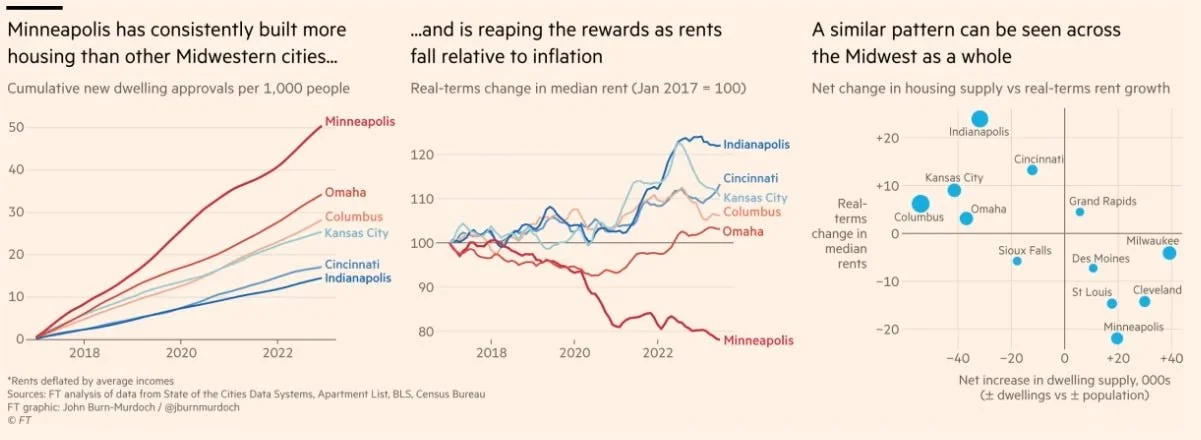
a chart showing the benefits of Minneapolis housing and zoning reforms

Earlier this summer, the Housing Options and Opportunity Act was introduced in Baltimore City Council. It is a part of a package of five bills aimed at making it easier to build more (and more affordable) housing in Baltimore City, three of which will be heard by the Baltimore City Council Land Use and Transportation Committee this month. 

The five bills would:

  • make permissible single-stair apartment buildings, which would allow for easier creation of family-sized apartment units and make it easier to ensure every bedroom in an apartment has a window,

  • allow for both smaller and larger units in more areas, and adjust yard requirements to make buildings fit better into the urban fabric,

  • move the Zoning Administrator under the Department of Planning, which would, amongst other things, help solve a longstanding zoning enforcement challenge with bike parking,

  • eliminate off-street parking minimums for the few remaining categories where they apply, allowing for more affordable construction and more pedestrian-oriented design,

  • legalize smaller multi-family homes where only single-family homes are currently permitted, allowing more families access to opportunity in more neighborhoods.

Legislation like this has been incredibly successful in other cities.

“Reform lowered housing cost growth in the five years following implementation: home prices were 16% to 34% lower, while rents were 17.5% to 34% lower relative to a counterfactual Minneapolis constructed from similar metro areas.” - Zoning Reforms and Housing Affordability: Evidence form the Minneapolis 2040 Plan

“Single-stairway four-to-six-story buildings with relatively small floor plates cost 6% to 13% less to construct than similar dual-stairway buildings. They can also fit on smaller infill lots, potentially increasing the supply of apartments in high-opportunity urban and suburban neighborhoods. And to the degree that these modern buildings replace older, riskier buildings, or enable residents to move out of older housing, single-stairway apartments will actually increase fire safety.” - Small Single-Stairway Apartment Buildings Have Strong Safety Record: Revised building codes could encourage construction, boost supply of lower-cost homes

Bikemore in Action is supporting this full package of bills, and we encourage you to support them as well. 

You can help right now by sending an email in support of bills being heard this month.

Keep the Jones Falls Valley Safe for Everyone

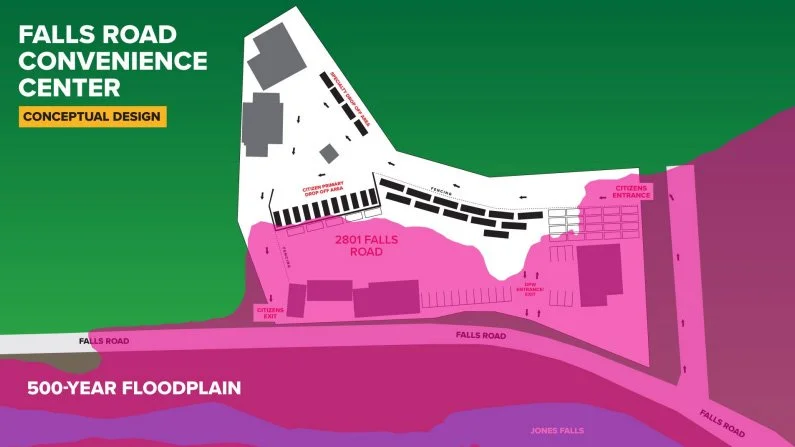
A map of the proposed relocation site with the floodplain overlay

Baltimore City is proposing relocating the Sisson Street Transfer Station to the Jones Falls Valley. There are numerous concerns around this proposal from adjacent neighborhood residents, stakeholder groups like Friends of the Jones Falls, and environmental advocates concerned about the overlap with the floodplain.

At Bikemore, we believe the Jones Falls Valley can and should be realized as a world-class linear park. We don't believe relocation of a waste transfer facility fits into that vision.

But if the city is insistent on relocating the facility despite the conflict with this vision and community concerns, the corridor must be safe for people of all ages and abilities walking and biking. Safe access for these users must increase.

In fact, that's a vision the Mayor's Office and Baltimore City Department of Transportation has long promised adjacent communities, a promise they have not made good on. Now is the time to make good on that promise, regardless of the outcome of the relocation proposal.

Below is a letter to send to your elected officials. It focuses on the bare minimum safety improvements required for a walking and biking corridor to safely exist with relocation.

To be clear, we think the proposed relocation site is a bad one. So if you have opinions on the relocation proposal itself, please customize the letter to include them.

Bikemore Files Maryland Supreme Court Amicus Brief in Support of Vulnerable Road Users

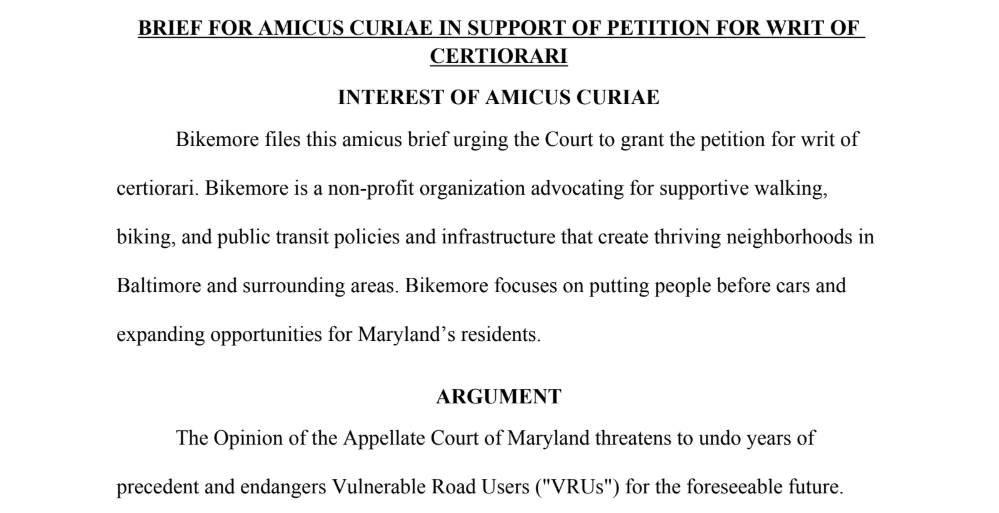
an image of the Brief for Amicus Curiae filed by Bikemore

For decades, Maryland's Boulevard Rule has played a vital role in protecting pedestrians and cyclists by reinforcing their right-of-way when crossing or entering major roads. But a recent appellate court decision (PDF) threatens to upend this longstanding precedent, opening the door for drivers to shift blame onto vulnerable road users, even when those individuals were lawfully asserting their rights.

This shift has serious implications. It risks making our legal system more hostile to the very people Maryland is trying to encourage to walk and bike through increased investments in complete streets infrastructure. If pedestrians and cyclists cannot count on legal protections when harmed by negligent drivers, the promise of safe streets remains out of reach.

That's why Bikemore is standing alongside Delegate Embry to advocate for a legislative fix, specifically, a contributory negligence carveout for vulnerable road users. And it's also why we filed an amicus brief urging the Maryland Supreme Court to hear the appeal filed by the legal team at Kramon & Graham.

Kramon & Graham's attorneys are leading a vital fight to restore the Boulevard Rule and ensure it continues to serve as a meaningful safeguard for people walking and biking. Their appeal asks the Maryland Supreme Court to reverse the lower court's ruling and reaffirm the principle that those entering a boulevard must yield to traffic, including pedestrians and cyclists, already in the intersection. We are proud to support this effort through our amicus filing, which underscores the broader public policy implications and the real-world risks that vulnerable road users face every day.

This is a crucial moment. As Maryland works to reduce traffic violence and make our roads safer for all, the law must reflect the reality on the ground: people outside of cars face disproportionate danger and deserve legal protections that recognize that imbalance.

To better understand how this legal precedent affects injury claims and accountability, we recommend this excellent explainer from Bikemore board chair Juan Carlos, an attorney at Saiontz & Kirk, P.A.

We believe that legal doctrine like the Boulevard Rule must evolve to protect—not endanger—those who are most vulnerable when traveling along our streets and roads. They deserve nothing less.

Read the full brief below: