A City Built For People: Bikemore Impact Stories

We’re starting 2026 with our final impact story for the winter season about family biking and a brighter future for all. Take a moment out of your day and consider donating to our organization. Help us start the new year with a few extra dollars to help pay our staff and keep Bikemore running for years to come. Happy New Year!

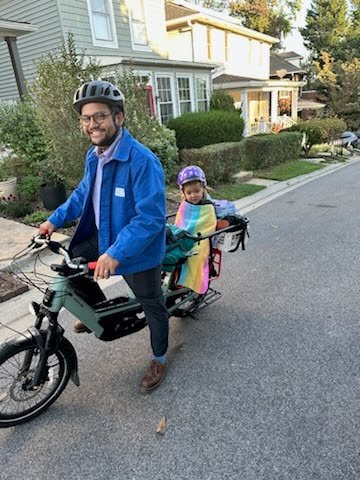
Love and kindness are central to Juan Carlos Puga’s life.

An immigrant, lawyer, and the president of the Bikemore board at just 34, Puga has discovered the secret to life at such an early age. He adores his wife, his friends, and most of all his daughter Isa. Love is a lesson that many in this world deserve and desperately need. It teaches us empathy. It teaches us compassion. It teaches us perspective. Love is your daughter, your mother, a tender touch, your bicycle, your lover, the singing man who dances with a stick at the corner of Broadway and Eastern, a plate of food, a cup of tea.

Without love, Puga may not be the man he is today. 

I used to bike with my daughter on [the] front tube seat [of my Crust Nor’Easter bicycle]…I loved it, and I always wanted to keep her on the front tube seat because it feels interactive, fun, where you’re [able to talk to] her. Right when she was getting too big for [the front tube seat] we bought the e-bike.

Puga rides with his family on their e-cargo bikes, a Surly Skidloader and Cannondale Cargo Wagon, because of the ultimate joy it provides them. It’s binding, almost entrancing really, how much it reveals the beauty of the city, especially through the eyes of a child.

[My daughter Isa] talks about bike riding. Not about the bike.

There’s a misunderstanding about the cost of an e-bike, but the Puga family figured out quite simply what the best option was.

We did the math, and one year’s worth of car insurance was the equivalent of [an e-bike].

Puga teaches us another vital lesson to take into the new year: patience. Too many things in this world happen too quickly, without caution, without care, and regardless of the powers that be of which continue to force us to adhere to the status quo, it is up to those like Puga who approach life with unrestricted empathy to create a better city. 

The reality is we don’t live in a city where it has to be all or nothing. It doesn’t have to be black or white… Life, humans, transportation [are] grey, complex, and [very] different.

Consider donating to Bikemore to help us in our mission of creating an empathic, fluid, and compassionate city for its people.

Bikemore’s success is only possible thanks to our donors. Individual donations help us pay our staff, organize our events, and advocate for safer streets. Start your new year with a donation to Bikemore so that one day more families like Puga’s can ride through the streets of Baltimore with safety paramount above all.
Call for Submissions for Bikemore's Inaugural Literary Magazine!

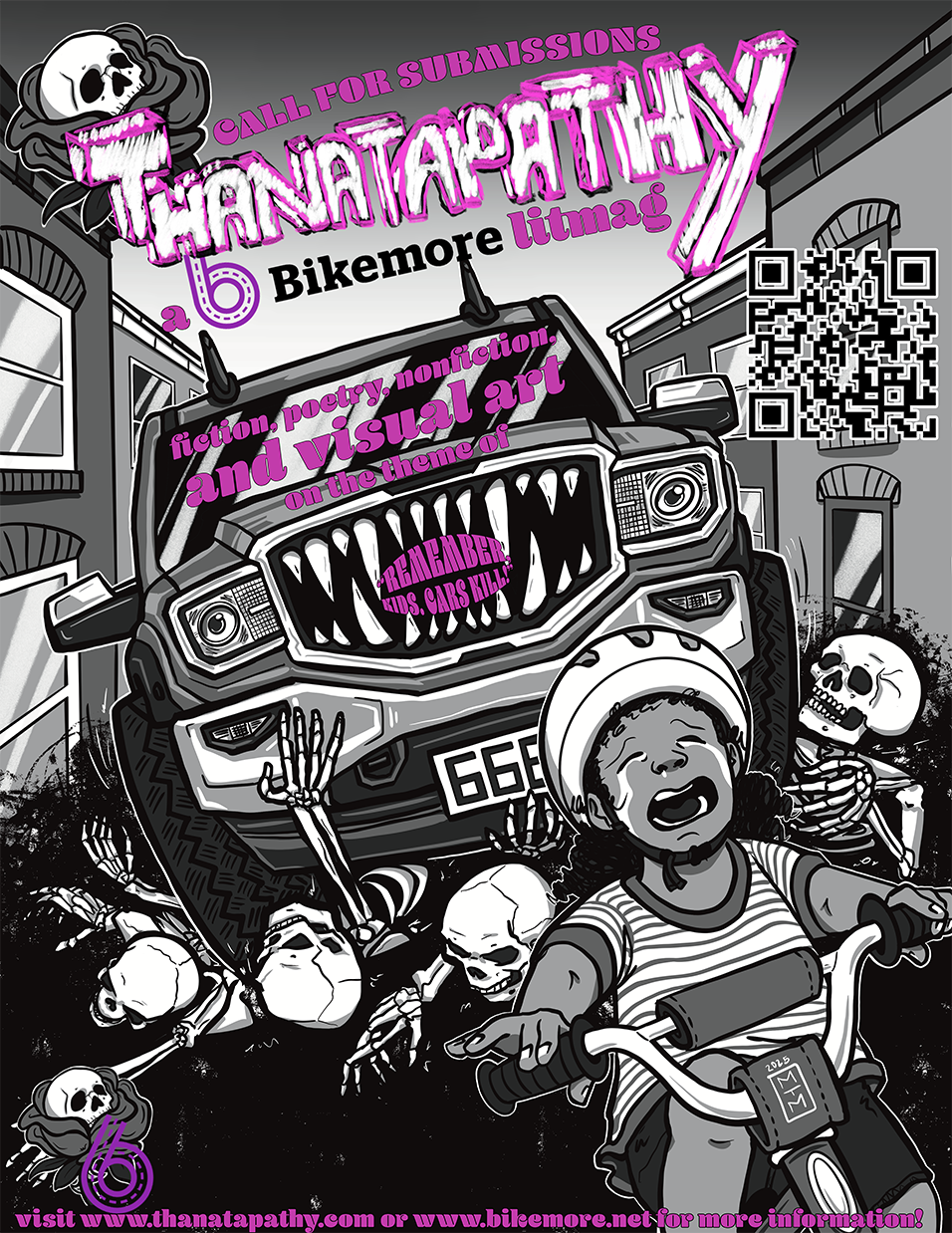
Bikemore is proud to present our limited literary magazine called THANATAPATHY made by our family biking coordinator Cora Karim for her capstone project through the Chesapeake Conservation and Climate Corps.

Submissions are officially open today, January 15, 2026, and we invite one and all to submit their prose, poetry, and visual art to be a part of this macabre and symbolic project on the theme of "REMEMBER, KIDS. CARS KILL!"

Take the time to review the website by clicking the button below. We look forward to seeing all the art submitted!

Spread the word! Tell your friends, your families, your dogs, and the sewer rats, too! Tell your enemies, your allies, the creature that lurks in your closet, tell them all, spread the word, and remind everyone, everybody, that cars kill!

2025 in Shared Mobility

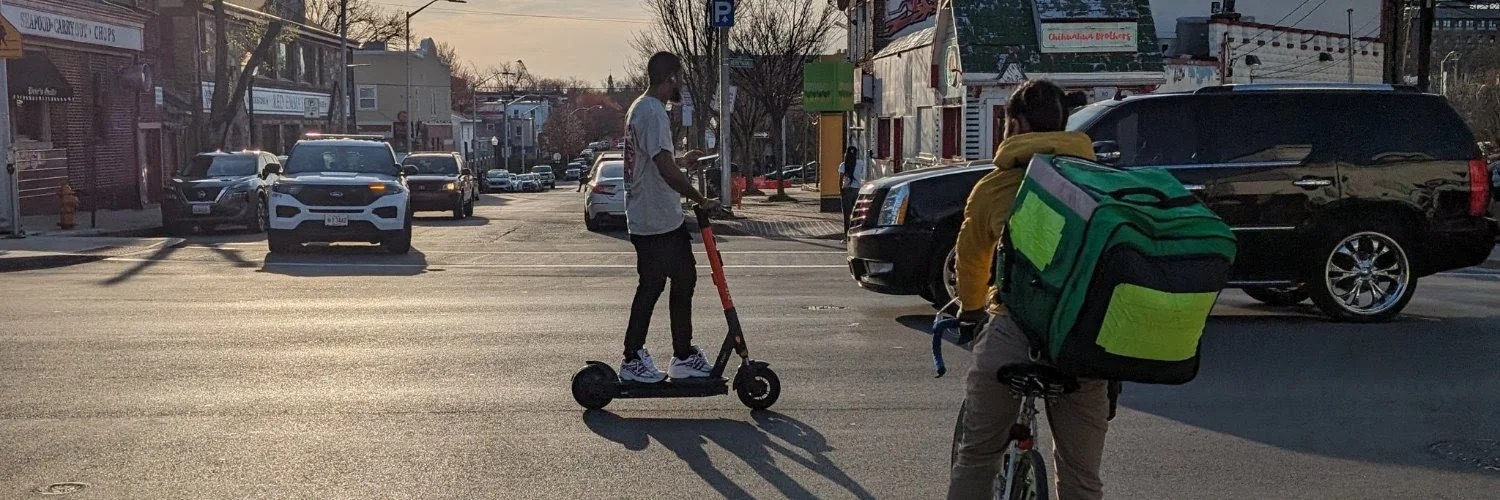
a man rides up Greenmount Ave on a scooter as a food delivery worker on a bike waits to cross the street.

In Baltimore, 2025 was the best year for our city's shared mobility program to date.

As a city, we took over 3 million rides during the year, reaching over 3.9 million miles covered on shared e-bikes and scooters. This is nearly double the rides Baltimore took in 2024!

Rides were also more equitably distributed, with ride origins from 2024-2025 increasing by 144% in East Baltimore, 163% in Southwest Baltimore, and 133% in Northwest Baltimore.

We saw the introduction of a new model of e-bike across the city, which adds a throttle option, making it easier for riders of all abilities to get around the city. There have also been many painted corrals installed around the city, making parking and placement easier, as well as decluttering our streets and sidewalks, perhaps the biggest problem the public sees with shared micromobility.

Additionally, we’ve had a major uptick in the enrollment and usage of the Access Program discounts, which waive unlock fees and discount the per-minute fees of the rides by 80%. These access programs are available to anyone who is enrolled in any form of government assistance; more information about the programs can be found at bikemore.net/enroll. In my work at Bikemore, I have directly enrolled upwards of 50 individuals into this program while going out into the community to provide information about it.

Finally, Lime and the League of American Bicyclists released a report Building Safer and More Friendly Streets: Lessons from Lime Data on Infrastructure, Safety, and Transit Access. The report looked at 5 million rides across 3 cities: Baltimore, Nashville, and Phoenix. It clearly shows that all-ages, separated infrastructure increases ridership and drives safety. 

In Baltimore, Lime analyzed ridership between 2022-2025 on newly installed separated bike lanes, and the increases in Lime ridership were dramatic. 28th Street saw a 526% increase, Harford Road saw a 423% increase, and Central Avenue saw a 229% increase in ridership. 

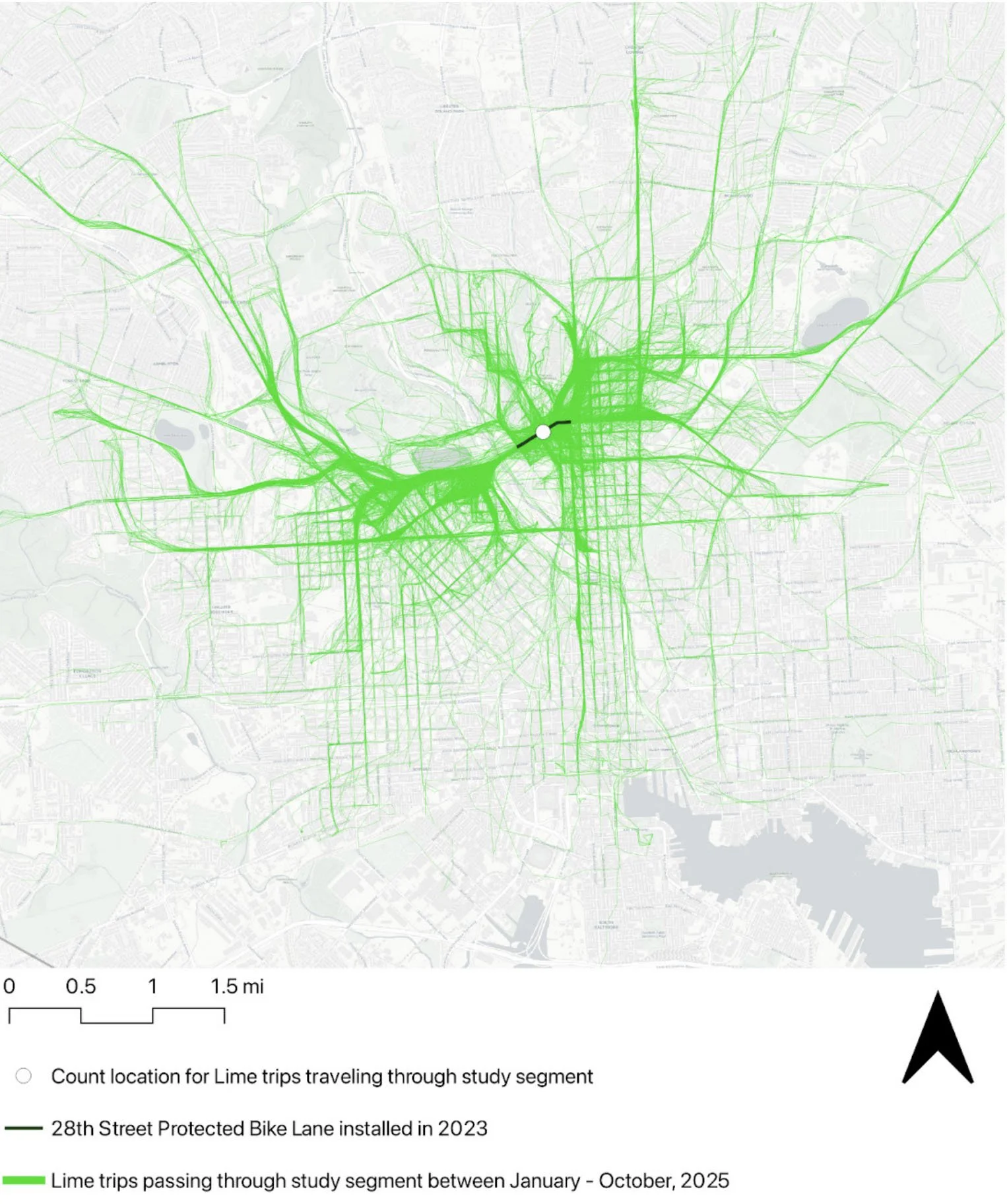
One piece of separated infrastructure can bridge divides and dramatically expand access for riders. For example, the map below shows the trip routes riders utilizing the 28th Street separated bike lane took this past year.

an image of thousands of trips passing through a fixed point along the 28th Street bike lane, showing how those trips branch out deep into East and West Baltimore.

Looking forward, we hope for continued expansion of the micromobility program from both providers, especially their equity programs, and for the city to consider directly subsidizing trip costs for all riders.

Public access to anonymized trip data, which we successfully advocated for in Baltimore's permit legislation, makes it easier to tell stories on the impact this program has on transportation access in Baltimore.

We are grateful for both Lime and Spin for their help in our continued efforts to advocate for safer streets that have separated infrastructure to improve access for all Baltimoreans.