
Sharing the Road with Buses in Baltimore

Today, a video is making the rounds on the internet of a person on a bike being passed too closely by a Charm City Circulator bus. We are choosing to share and make our public comment here, as a local news outlet has already picked up the story. When Bikemore first learned of the video, we immediately alerted Baltimore City Department of Transportation that operates Charm City Circulator. We got an immediate response from the city notifying us that officials at Transdev, the contractor that operates the circulator and trains and employs the drivers, had been contacted. We are confident that both the City of Baltimore and Transdev are taking this incident seriously, and we look forward to receiving a full report of actions taken to ensure these type of incidents do not occur again.

As people who ride bikes in the city, getting passed too closely by a bus, whether it is a city operated Circulator, Maryland Transit Administration bus, or a college shuttle is a frequent occurrence. As bicyclists, we have full rights to the road, but in Maryland that means riding your bike as far to the right of the road as practicable, except in certain cases, including where lane widths are too narrow that it would be unsafe to share the lane with another vehicle side by side. Which incidentally, frequently creates a conflict between bicyclists riding closely to bus stops, and bus operators trying to meet their schedules and pick up and load passengers in a timely manner.

While Baltimore City and Maryland Transit Authority have taken major steps to ensure that people on bikes are accommodated and considered, there is still more work to be done. It is clear in the video, that despite being trained by Transdev on how to operate a bus safely, particularly around people on bikes, that the culture shift on an individual level required to ensure that all people in the roadways are treated with care still has a ways to go.

We know that not every driver operates this way, but given the pressures of on time performance, it is not surprising that some operators may become resentful when a person on a bike is traveling more slowly in the right lane and as a result feel pressure to make unsafe decisions.

At Bikemore, our hope is to continue to work with these agencies to ensure their training is up to date given the increased presence of people who bike on the roads. We believe that as a whole, these agencies recognize the value and necessity of these trainings, and are striving to ensure their drivers maintain a culture of safety.

But what we also see in the video is a complete misunderstanding of Maryland law by their employee. People who ride bikes have a  right to operate in the roadway. And if, as a person operating a motor vehicle, you would like to pass them, it is the law that you are required to give them a minimum of three feet passing distance. While we work to educate all people who operate motor vehicles on roadways the proper ways to safely share the road with people who bike, it is the commercial drivers that should be held to a higher standard. They receive specialized training, and should exhibit a professional demeanor, especially in situations that the person driving may find inconvenient. The risks are real, and the consequences can be deadly. No amount of on time performance should supersede the value of a human life.

Roadway design solutions exist, and the City should work to implement these designs in corridors that contain both a high volume of bus routes and people on bikes. Transit agencies that train drivers should maintain that passing vulnerable road users safely takes priority over on time performance. As seen in this video, the person on the bike was able to very quickly catch up to the bus at a stop, which leads us to believe, that had the bus simply decelerated and waited for the person on a bike to pass the bus stop rather than pass them so closely, on time performance would not have been compromised and that both the passengers on the bus and the person on a bike would have been able to continue to travel safely and efficiently.

Somehow as people, a culture where we value our own ability to maintain high speeds on urban streets has trumped the safety of those with whom we share the road. That needs to change. And hopefully, as we move forward our network of professionally trained drivers that work in Baltimore can lead by example.

If you experience an instance of unsafe driving by an operator of Charm City Circulator bus, the city requests you report it via their website at charmcitycirculator.com or their customer service line 410.350.0456. Be sure to note the bus ID located on the front exterior panel of the bus on both the driver and passenger sides.

For MTA, please report to http://mta.maryland.gov/questions-compliments-or-suggestions. For MTA, it is easier to Identify the driver if you capture the Route, Time, and “Block Number” located on the front of the bus.
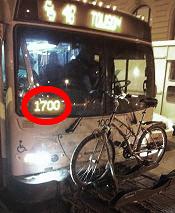
Block Numbers on MTA Buses help to identify the driver in the case of reporting an incident. 

Block Numbers on MTA Buses help to identify the driver in the case of reporting an incident. 

As people who bike, it is also extremely important that we exercise caution when riding near busses. In this video, it is clear that the person riding the bike is operating safely. But it is important to remember that as people on bikes, we should be passing busses on the left, and give them a wide berth so we can be certain we are visible outside of their blind spots. And if you experience an incident, we encourage those riding to document and report. It can be terrifying to be passed closely, but maintaining composure and taking the appropriate steps to report will keep everyone safe and ensure your complaint is taken seriously. And remember, if safe to do so, you can and should take the lane to encourage vehicles to either decelerate and wait or pass safely in the adjacent lane. 

Folks should also know, that at the invitation of the MTA, Bikemore is involved in a project to create additional resources for both transit operators and people on bikes to increase the culture of safety.

We look forward to more opportunities to collaborate with the various agencies that operate busses throughout the city to ensure the safety of all road users, be it bus operators, passengers, pedestrians or people on bikes. 


Bike Law with Peter Wilborn 10.14.2015

Next Wednesday, on October 14th, Bikemore is proud to host Peter Wilborn, founder of Bikelaw.com. You can pre-register for the event here. 

If you've ever wondered: 

  • What to do if you've been hit by a person driving a car
  • What to do if you've been doored 
  • What to do if a person in a car is encroaching on your space or safety
  • What to do if a police office pulls you over for violating a cycling law 

Then this talk is for you! 

We recently spoke with Peter in anticipation of his trip to Baltimore and asked him a few questions.

What's your bike story? When did you first learn to ride, and how did that lead into your work now?

I was a "Breaking Away Kid" and shaved my legs before I had leg hair to shave.  I've ridden almost every day since.  I commute (my favorite riding), tour, ride fast, ride with my kids, you name it.  I became a bike lawyer in 1998, when my brother was killed on his bicycle.   

In 140 characters or less, what is bikelaw.com

National network of bicycle lawyers who do what we can for people we like for a cause we love.  

As bike ridership increases in cities across America, what impact has that had on the demand for the services of attorneys like you?

The phone never stops ringing.  Yes, there are more collisions these days because of the growth in ridership (and how unprepared our cities were), but I think it is getting safer over all.   

If you could create a PSA that would be on billboards for folks to see across America, what would it say?

Ride Proud!

And finally, you used to live in Maryland, and still practice law in Maryland. Inquiring minds want to know: Pit Beef or Crab Cakes?

I did grow up in Maryland, and raced in College Park.  Ate so much crab as a kid that I developed an allergy!

We hope you can join us next Wednesday, October 14th, for a night of fun learning along with fellow Bikemore folks! Make sure to pre-register to ensure your spot! Thank you to our host De Klein Duivel who will have the bar open for the event. 

Response to Heather Cook's Plea


Today bike advocates from Bikemore and Bike Maryland joined the Palermo family for a court appearance by Heather Cook, the episcopal bishop responsible for the death of beloved Baltimore bicyclist Tom Palermo. 

The purpose of today’s hearing, one day prior to Cook’s scheduled trial was so that Cook could enter a plea of guilty on 4 of the 14 charges. 

Cook plead guilty to automobile manslaughter, driving while intoxicated, leaving the scene of a fatal accident, and texting while driving resulting in death. 

The State is seeking a maximum of ten years jail time and five years probation. Sentencing will take place on October 27th at 2pm. We have written a Victim Impact Statement to the judge requesting the maximum sentence. 

While the family has declined to comment on whether or not the recommended sentence is appropriate, as advocates we have been asked to weigh in. We believe that in this incredibly painful time our best action is to support the Palermo family in pursuing whatever justice they seek. But trying to quantify what justice for Tom would look like is futile. And for us, the sooner Heather Cook begins paying for her crime the better. What we want to remain in the forefront of people’s minds is that Tom was loved by so many people who are still here on earth. His joy for bicycling, his love for his family was immense. There is no specific punishment that can somehow restore the loss of someone like Tom. 

We believe that in order for this to not happen again, as a city we must commit to stronger enforcement of negligence while operating a motor vehicle. We have to commit to having zero tolerance to distracted driving. If the city claims they can’t afford to enforce the laws the state passes, we have to stop accepting that as an acceptable response. There was a time when driving drunk was more socially acceptable than it is today. There was a time when child seats were scarce, if used at all, and seatbelt laws were just coming into fashion. The argument that getting people to put away phones while we are driving is just too hard doesn’t hold water. Culture change related to driving can happen, because it has happened in our lifetime. And Bikemore is committed to ushering in the next wave a change for Baltimore. Cook was grossly negligent in her actions, but we are all guilty of sneaking a peek at a text or email, scrolling to find our favorite song, or typing in GPS directions from time to time. What do we have to do to make that dangerous behavior a thing of the past? How many people walking, people on bikes, and people in cars have to be killed in order for us to take this issue seriously? 

We want to honor Tom and his family by ensuring families in Baltimore do not have to experience the pain and loss they have. We are working to make sure when people ride their bike, they get home safe. Will you join us? 

Bikemore Comments on the Southeast Strategic Transportation Plan

Heatmap of bicycle activity in Southeast Baltimore (via Strava)

Heatmap of bicycle activity in Southeast Baltimore (via Strava)

Bikemore, the bicycle safety advocacy organization for the Baltimore metropolitan area, is pleased to see the priority which has been placed on multi-modal transportation planning in the Southeast Strategic Transportation Vision, and is encouraged that DOT continues to prioritize biking and walking in future planning efforts.

It is clear that the opportunities for increasing traffic capacity in Southeast are very limited, particularly in historic areas such as Fells Point, and further, that many of the possible capacity increases could only be accomplished at the cost of unacceptable degradation of bicycle/pedestrian accommodation and general neighborhood livability. Demand management is therefore the most promising path forward, and increasing bicycle ridership among both commuters and residents is an essential part of reducing motor vehicle demand.

We believe that dedicated facilities and easy to understand way-finding are essential to increasing and encouraging bicycle use, and we particularly support the parts of the plan that create (or improve existing facilities into) separated facilities such as cycle tracks, paths, and protected bike lanes. Research continues to show that this type of facility is necessary to significantly increase bicycling mode share.

We do have concerns with a few specific points within the plan:

We disagree with the continued designation of the President Street bike lane as a desirable facility. Not only is the quality of infrastructure poor, but it places riders in the vulnerable position of traveling alongside high speed traffic, completely unprotected, and therefore is presently used by only the most confident of cyclists. Unless the plan is for that to become an improved protected facility, it should not be considered part of the network. Parallel alternatives exist.

The installation of "share the road" signs alone does not qualify as a proper bicycle facility. Where signs are placed without any effort to calm or reduce traffic along the corridor they create a false sense that bicycling will feel safe and pleasant on that particular roadway. A prospective cyclist who has a bad experience “sharing” a busy and otherwise unimproved road may come to distrust all bicycle accommodation and be reluctant to ride.

There is a major gap in the SE bike network, both in the existing and planned accommodation, which is obvious from even a quick look at the maps: the barrier caused by the I-95 and I-895 elevated highways and the NS, CSX, and Canton Railroads. It is, for example, almost impossible to safely bicycle from the O’Donnell Heights neighborhood to any of the employment, retail, or entertainment opportunities of Canton, Fells Point, or Downtown. Likewise it is very difficult to bicycle from any of the more central neighborhoods to employment at Amazon or any of the other Holabird or Dundalk area opportunities. This will be difficult, to be sure, but must be included, at least as a long-term plan.

Finally, we would like to see secure bike parking be part of a comprehensive transportation plan.

Maryland Avenue Cycle Track and Downtown Bicycle Network Project Update

In a meeting with Baltimore City Department of Transportation last week, Bikemore received an update on the 2.6 mile Maryland Ave Cycle Track. Current construction timelines estimate the project to begin construction in the Spring of 2016.

Here are some important milestones for the project we are watching to ensure the project does not experience any further delays.

  • Toole Design is currently putting together the PSE (plans, specifics, and estimates).

  • Baltimore Department of Transportation will advertise the project by 9/9.

  • Timeline for advertising is four weeks.

  • This means it will be mid November when the contract is awarded.

  • Given construction schedules it is unlikely whichever company is awarded the contract will begin construction before winter.

  • This means a Spring 2016 construction start.

  • The project is estimated to take 90 days for construction.

Included in the contract is the work to implement the Downtown Bicycle Network. This will include conventional bike lanes on Preston and Biddle and protected cycle tracks on Centre, Monument and Madison.

Additionally Bikemore has been communicating with Baltimore City DOT our recommendations for creating better connection to the Maryland Ave cycle track. BCDOT is already at work to improve signaling at Maryland and 29th st, and listening to input to improve safety and wayfinding from all routes feeding into the cycle track.

And while we are all frustrated with the delays, BCDOT deserves credit for ensuring that the plans didn’t languish in State Highway Administration final review. This is a priority of ours and theirs, and we appreciate them doing all they can within a less than perfect system to get the cycle track installed.

Despite perceptions, construction of the Roland Ave cycle track did not contribute to the delay.

Our hope is that as more of these projects get underway, the more comfortable State Highway Administration gets in quickly approving plans and empowering BCDOT to build the connected bicycle network we deserve.